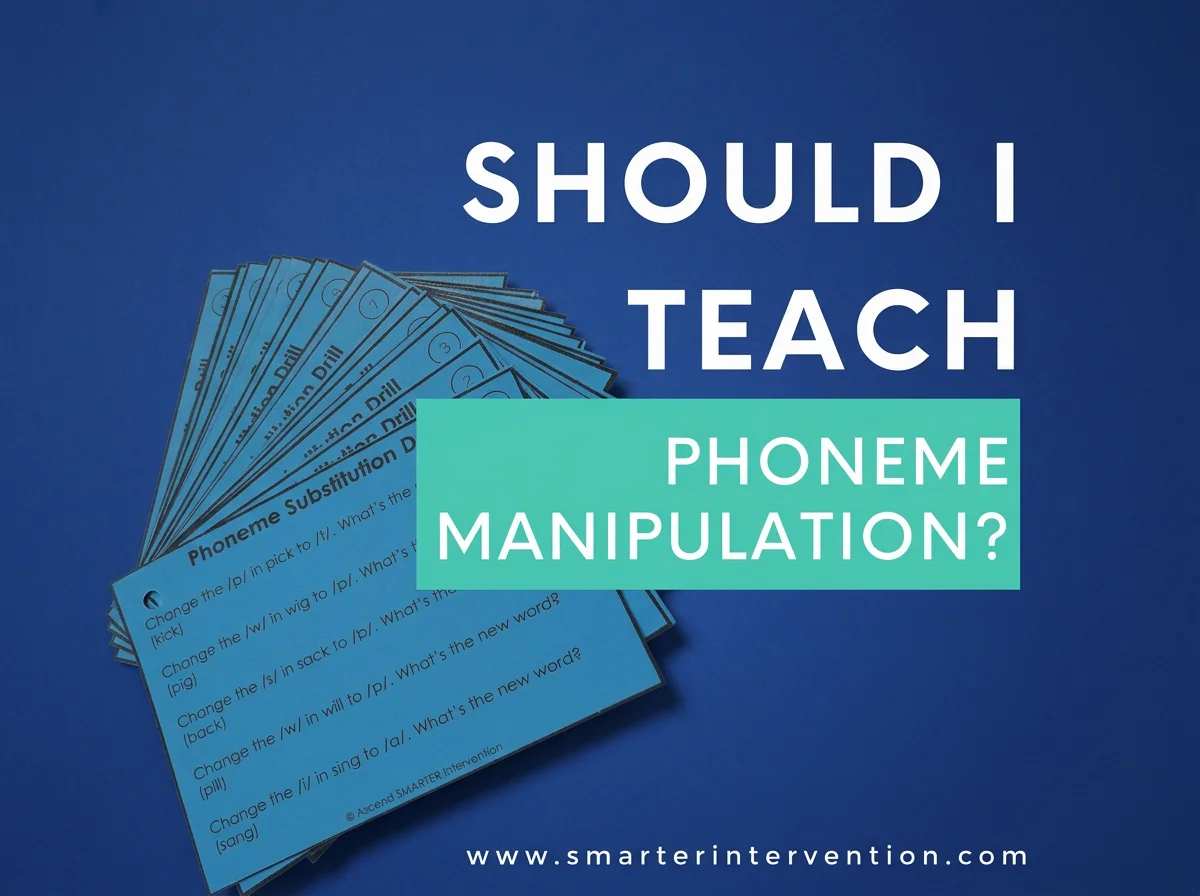
Say this word without the first sound…
Say this word backward.
Change the last sound in this word…
Are phoneme manipulation skills really necessary?
In short, yes.
Phoneme manipulation is the ability to substitute, delete, or change the sounds in our words. This is one of the most complex subskills under the phonological awareness umbrella.
While these drills can feel silly (or exceptionally difficult!)…
Phoneme manipulation skills help students become familiar with word structure and build fluency in both reading and spelling.
A student who struggles with phoneme manipulation may not be able to recognize that “pots” and “spot” are different. The letters (and sounds) in these words are exactly the same, but they follow a different sequence.
On the contrary, students with average to strong phoneme manipulation skills understand word structure. They can sequence and isolate sounds in their mind. They can delete sounds that they don't want or change the sounds to something else. This is helpful because sometimes students read or spell words incorrectly. If they read "sail" as "snail," they need to delete the /n/ as part of their error correction. If they are trying to write "pen" but keep saying "pin," they need to change the vowel sound. The more fluent these skills become, the more automatic reading and spelling can be.

How do I teach phoneme manipulation skills to my students?

We recommend starting with visuals. Have students use colored tiles or blocks to represent the sounds in your words. As they are asked to manipulate the sounds (i.e., take one away or substitute a sound), change the necessary tiles.
For example, if given the word "chip" and asked to make it "ship," start by building ch - i - p. Then, isolate the sound they are being asked to change (you can read more about sound isolation >>here.<<). Swap that tile and reblend the word with the new sound. As students get better at these tasks, they should be able to do them in their minds.
Now, we're not going to lie - these skills are advanced. As we say time and time again, we only spend a few minutes on PA skills in each lesson as a way to "warm up" the brain for reading and spelling. We'll target phoneme manipulation as a part of our PA work, but more of our focus goes to the other PA skills.
Next Steps
Phoneme manipulation can be challenging for students, but it plays an important role in helping them understand how sounds work within words. When students can take away a sound, substitute one, or change the order of sounds, they’re better equipped to work through unfamiliar words and make sense of spelling errors. The key is knowing which skills to target and how to give students meaningful practice without taking time away from reading and spelling.
If you’d like a practical way to bring these skills into your instruction, our on-demand training, Building Phonological Awareness that Actually Supports Useful Skills, walks you through the four core phonological awareness skill sets, how to choose targets based on what your students need, and how to build a simple, customizable routine into the reading instruction you’re already doing. You’ll see the routine modeled with a real student and learn how to connect sound work directly to reading and spelling.
You’ll also receive the Phonological Awareness Toolkit, including an editable 10-Part PA Drill, task cards, games and activities for differentiating instruction, progress-monitoring records, grade-level benchmarks, and “Creating the PA Bridge” guides that connect phonological awareness to reading and spelling. The training includes a one-hour PD certificate and lifetime access to the training and materials, so you can revisit them as your students’ needs change.