You might be wondering when it would be important to teach syllable blending. Is this a skill students even need?
The answer to that question is yes. This is a skill that students, in fact, need. But there are specific times when teaching this skill will be most important.
So first, let's get clear on what syllable blending is.

Syllable blending is the ability to take individual syllables and string them together to make words.
This is a crucial reading skill for a few reasons.
First, students will recognize syllables before they recognize individual sounds. Understanding how syllables blend together is the first step in recognizing how words come together.
Second, as humans, our memory can only hold so many things at once. This means that for longer words like "alligator," it is almost impossible for students to sound out each individual sound and hold them in their minds long enough to blend them together. Instead, blending a few "chunks" like al-li-ga-tor is easier for our brains.
So…when do we start teaching syllable blending?
Since students can generally recognize syllables at a young age, we incorporate blending drills into our PA instruction starting in Kindergarten.
However, these drills are even more important for older students.
As students get older, they need to read longer words. The longer the words get, the more critical syllable blending becomes. If we can support these skills early, we set students up with a necessary foundation.
How Do You Teach Syllable Blending?
With younger students, we typically start with easier, two-syllable words. We’ll ask, "What word do these syllables make? pan - cake” (pausing between each syllable). As students advance, we can increase the difficulty with longer and more complex words. For example, "What word do these syllables make? mo-tor-cy-cle"
The good news is that phonemic awareness skills can continue to develop well beyond the early grades. The key is knowing which skills to target and how to connect that practice to the reading and spelling challenges older students face every day.
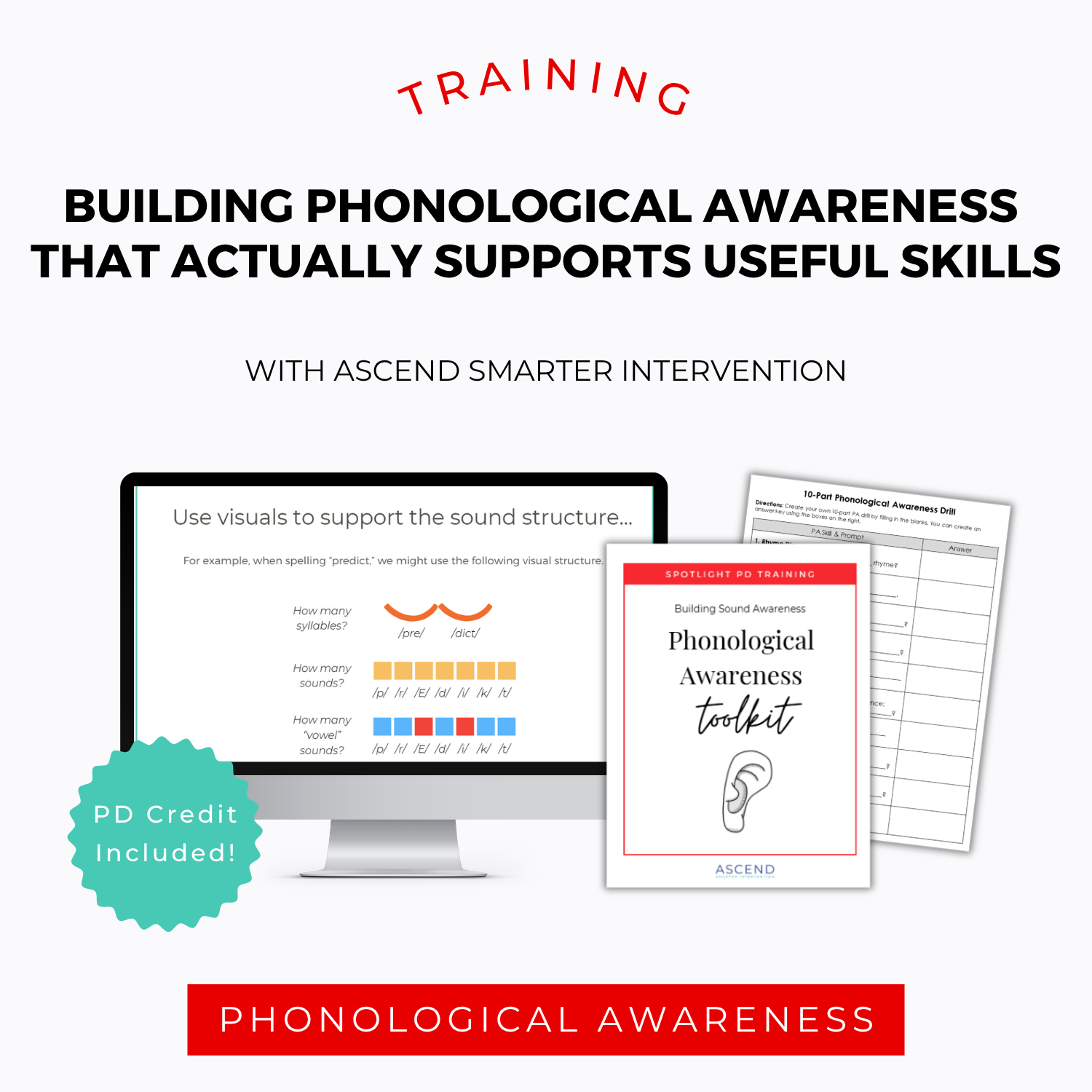
In our on-demand training, Building Phonological Awareness that Actually Supports Useful Skills, you'll learn how to build a quick, targeted routine into your existing instruction. You'll also get the Phonological Awareness Toolkit, which includes an editable 10-Part PA Drill, task cards, games, and activities for differentiating, blending, segmenting, and manipulating sounds, plus progress-monitoring records, grade-level benchmarks, and guides that connect phonological awareness skills directly to reading and spelling. The training includes a real-student demonstration, a one-hour PD certificate, and lifetime access to revisit the materials whenever you need them.