
Can you spell supercalifragilisticexpialidocious? Can your students?
In all seriousness, supercalifragilisticexpialidocious isn't the most functional word to spell – but as students progress academically, they do need to be able to break down long words for reading and spelling.
The key to reading and spelling long words is understanding syllables.
Syllables act as a bridge between the whole word and the phonemes (sound level) within the word. They provide a chunking strategy that supports working memory.
For example, if I asked you to spell supercalifragilisticexpialidocious, you might pause. That is a lot of phonemes to sound out and write down! However, if I ask you to spell each of the fourteen syllables separately, this task becomes infinitely easier.
Most of the time, our students won’t need to syllabicate fourteen-syllable words. They will, however, need to break down words with multiple syllables in order to read and spell them.
It is important to be able to break words into syllables because each syllable type has its own rules that we rely on to know what the vowel in the word is going to say and how to spell the words.
For example…
Crab - this has one syllable (we only hear one vowel). Since this is a closed syllable, the vowel (the ‘a’) makes its short sound. However, in the word “crabby,” we have two syllables. The first (crab) has the same closed syllable rule mentioned a second ago. The second syllable in this word (by) is an open syllable (‘y’ is acting as a vowel at the end of the syllable), and we know that ‘y’ at the end of a multisyllabic word will say /E/ like in “baby.” In supercalifragilisticexpialidocious, we use “su” at the beginning instead of “sue, soo, sou, sui, or sew” because it is an open syllable.
Helping students develop a sensitivity to syllables will help them grow into stronger readers and spellers.
So…how do we teach syllable segmenting?
When working with students…
…we teach them that a syllable is a word, or a part of a word, with one vowel sound, and there are 6 different types of syllables.
For some, this comes pretty naturally. For others, this requires repetition and practice.
You can add segmenting into your regular PA drill (we like to complete segmenting tasks as a brain "warm-up" prior to spelling). We also like to use our students' spelling words. For each word, we'll have students segment it before they spell it.
Now, as we will mention again and again, these activities should be quick. This should not be a focus for an entire lesson, as there are definitely additional valuable skills you need to make sure to fit in. If you're interested in learning more about how to fit it all in, you can check out our blog >>here<<.
Final Thoughts
Breaking longer words into syllables can make reading and spelling feel much more manageable for students. The trick is helping them develop this skill through regular, purposeful practice and knowing how to connect it to the other skills they need to become stronger readers and spellers.
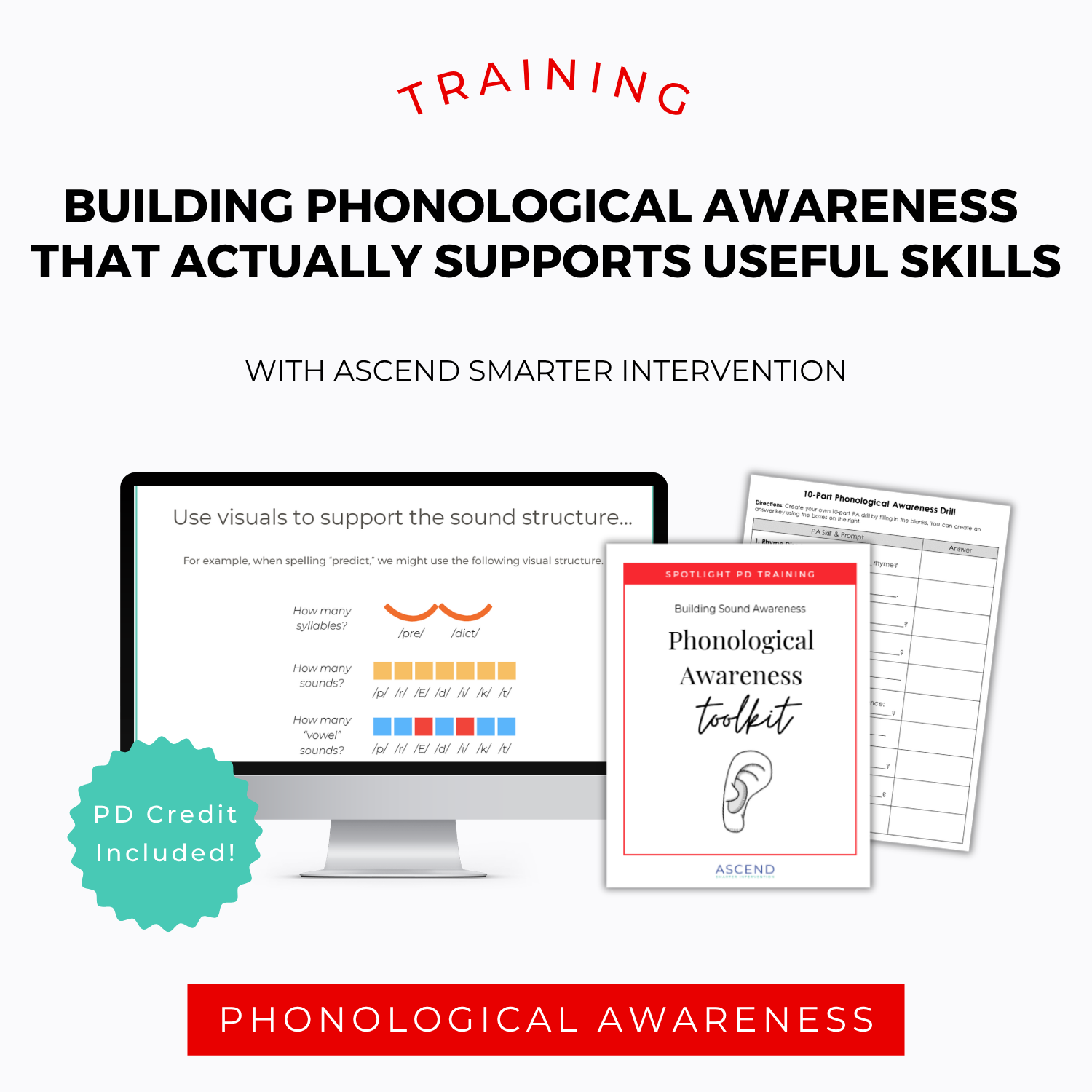
If you’re looking for a practical way to bring phonological awareness into your instruction, our on-demand training, Building Phonological Awareness that Actually Supports Useful Skills, walks you through the key skill areas, how to choose targets based on student needs, and how to build a simple, flexible routine into the reading instruction you’re already doing. You’ll see the routine modeled with a real student and learn how to connect sound work directly to reading and spelling.
You’ll also receive the Phonological Awareness Toolkit, with an editable 10-Part PA Drill, task cards, games and activities for differentiating instruction, progress-monitoring records, grade-level benchmarks, and “Creating the PA Bridge” guides that connect phonological awareness to reading and spelling. The training includes a one-hour PD certificate and lifetime access to the materials, so you can return to them as your students’ needs change.