Are your students missing a step in their spelling process?
When working on spelling, one of the first things we ask students to recognize is how many sounds they have in the word. We call this phoneme segmenting.
Phoneme segmenting is essential to spelling success.

In order to spell a word (especially an unfamiliar one!) we first need to identify what sounds we hear and then pair letters with those sounds.
For example, if we have the word "snap," we should break it into /s/ /n/ /a/ /p/. We should only be counting the sounds we hear, not the letters in the word. This is because sometimes multiple letters work together to make one sound.
For example, when segmenting the word "clutch," we have four sounds. When breaking this down, students are already vocalizing (or subvocalizing if completing this in their head) what those sounds are. This sets the foundation for them to then start pairing the correct letters with those sounds.
If students are not breaking the word down, it means they aren't sounding the word out. This often leads to guessing or writing from memory, which is much less reliable than segmenting the word and then pairing letters with the sounds.

So…how do I support phoneme segmenting?
For some students, sounding out their words may come naturally. For others, this needs more practice and repetition.
Visuals are a great multisensory strategy to pull in here.
When students are segmenting a word, have them use counter chips, stamps, or another visual to mark each sound they hear. Bonus points if they color-code consonants, vowel sounds, and other patterns.
We always include at least one phoneme segmenting task in our PA "warm-up." For students who need more support, have them segment each of their spelling words. They'll get more phoneme segmenting practice, and it directly translates to their spelling performance - it's a win-win!
Final Thoughts
When students learn to break words into individual sounds, spelling becomes less about guessing and more about understanding how words work. Some students pick up this skill naturally, while others need more explicit practice and support. The key is knowing which skills to target and how to connect that practice to the words students are learning to read and spell.
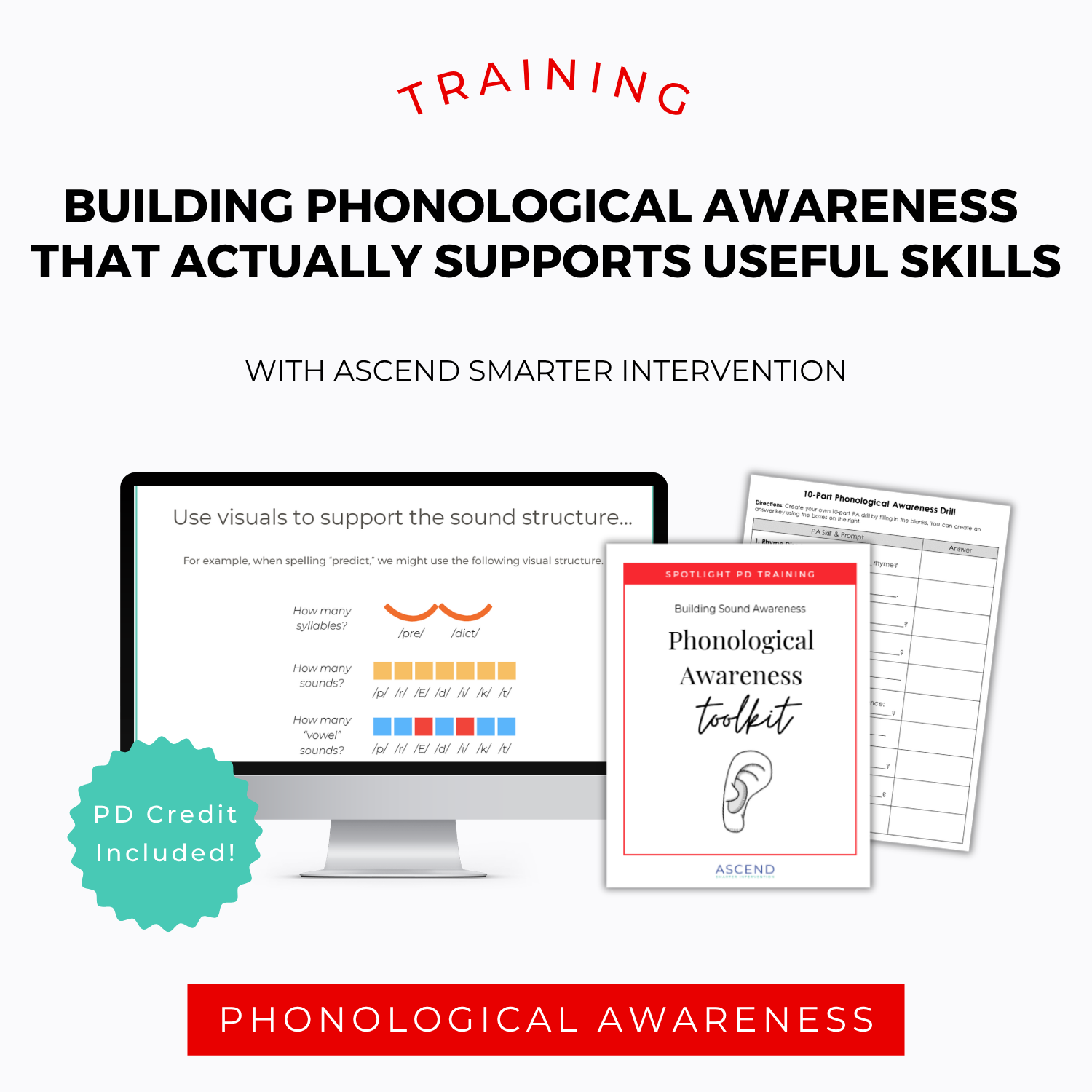
If you’d like a practical way to build phonological awareness into your existing lessons, our on-demand training, Building Phonological Awareness that Actually Supports Useful Skills, walks you through the key skill areas, how to choose instructional targets based on student needs, and how to build a simple, flexible routine into your reading instruction. You’ll also see the routine modeled with a real student and learn how to connect sound work directly to reading and spelling.
The training includes the Phonological Awareness Toolkit, with an editable 10-Part PA Drill, task cards, games and activities for differentiating instruction, progress-monitoring records, grade-level benchmarks, and “Creating the PA Bridge” guides that connect phonological awareness to reading and spelling. You’ll also receive a one-hour PD certificate and lifetime access to the training and materials, so you can return to them as your students’ needs change.