Insider Spotlight: She Started in a Janitor's Closet. Here's Where She Is Now.

A career that started somewhere unexpected…
I wasn't in the room for this conversation. Lindsey sat down with Vicki, a speech language pathologist who has been doing this work for decades, and when I listened to it, I was beyond inspired.
Vicki started her career in California and then, as she put it, decided to have a great adventure and moved to Alaska with her husband, where she spent about thirteen years. She worked at a state school for the deaf, which meant she learned sign language fast. Really fast. And she and her husband started fostering students from that school because the kids were being integrated into public school in Anchorage and they needed a place to live.
So she signed from the moment she woke up to the moment she went to bed.
She also said something about her early days as an SLP that made me laugh. When she talks about working out of a room in her first school, she means the custodian's room. When he wasn't using it.
She laughed when she said it. But I think about that detail in the conversation a lot. Because, really, when you think about it nobody starts at the destination. And Vicki's story is really about what it looks like when you just keep moving toward what matters to you, where you find joy and purpose, one step at a time, and you just keep going. Moving toward what feels right.
Literacy was always there
Both of Vicki's parents were teachers. Literacy was never an afterthought for her. It was woven into how she thought about her work from the beginning. Even in her early SLP sessions, there was always a book. All of her therapy goals were met through some kind of literacy activity. That wasn't a requirement. It was just how she worked.
Over the years, she noticed that of all the kids she worked with (including preschoolers, middle schoolers, high schoolers, kids with severe autism, kids with significant physical needs) she could count on one hand the ones who sailed through reading and language comprehension when they hit school. Language issues and literacy issues always seemed connected. She could see it with every one of her students. And she kept finding ways to help, even when literacy wasn't technically in her lane.
Then during the pandemic, she decided to go deeper with literacy. She took sixty hours of training with Susan Barton. She came back to her Linda Mood Bell programs. She completed another sixty hours with a literacy organization out of Washington State. She was definitely building something, even though she wasn’t exactly sure exactly what it was.
And now she supports everyone she can through literacy, of different ages, abilities, and backgrounds.
Including her student who didn't know there were rules
One of the people Vicki works with right now is an adult. She’s a bright woman with cerebral palsy, in a wheelchair, with some vision challenges, who wanted to learn how to read.
Vicki told us what happened in third or fourth grade. Her mom thought the school was teaching her to read. The school thought her mom was teaching her to read. And this little girl, who thought she didn’t want to read, didn't tell either of them.
And eventually, she grew up. And she found Vicki.
Now, in their sessions, when she encounters a word she doesn't recognize, she has tools to break it down. And Vicki said she tells her every single session, “isn't it grand that you have rules? That when you look at a word you can't read, you know you have what you need?”
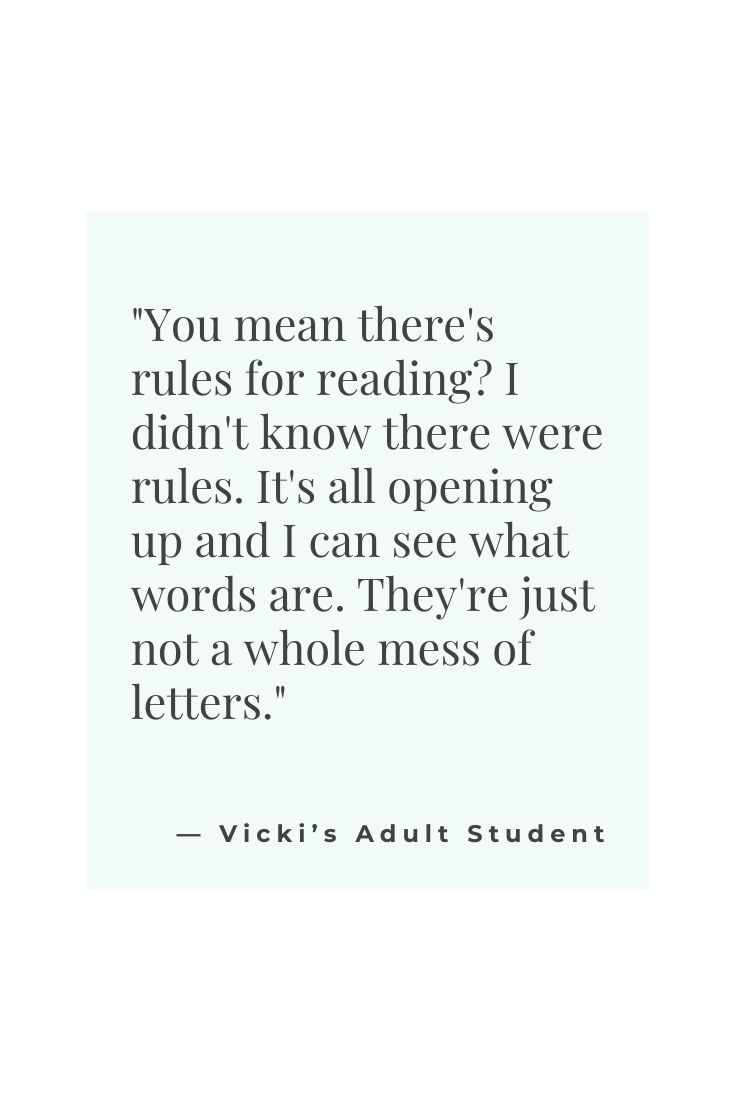
"You mean there's rules for reading? I didn't know there were rules. It's all opening up and I can see what words are. They're just not a whole mess of letters." — Vicki’s Student
How incredible is that?
And she supported a fourth grader in a dark place…
Vicki also works with a fourth grader whose family has dyslexia running all the way down on her father's side. When they started working together, this girl was in what Vicki described as a really dark place. She couldn't read. She knew she couldn't read. And that was impacting her beyond just her literacy.
Her student has an IEP. She gets support at school and her parents are deeply involved. But something still wasn't clicking.
Vicki started working with her and just went step by step. Vicki said that one of the things that helped the most was that she didn't try to know the full curriculum, everything that would come within the structured literacy progression, all at once. She didn't wait until she felt like an expert. She just showed up and worked through it with this 4th grader, session by session.
At the beginning of this school year, she could tell that things were changing. This fourth grader is now reading chapter books on her own. And she has, in Vicki's words, this fabulous attitude of I can do this now. Don't try to be a teacher to me. I've got the tools. I can do this.
"It is just so fun to watch. It just gelled." — Vicki Brackett, SLP
What she built, and how
Today, Vicki sees a few kids, one adult, and she volunteers with her local adult literacy program, working with adults who are learning to read for the first time. Many of them from refugee communities, learning English as a second language. She was raised in a home where volunteering your skills was non-negotiable. So that's just part of how she works.
She's also very clear about what she wants her work and life to look like. She knows the hours she's able to commit to. She knows the population she's best suited to serve. She knows what feels right and what doesn't. And that clarity, she says, makes it easy to say no. And the incredible thing about this is that it’s not from fear or scarcity, but from knowing exactly what she's building.
"Staying in my lane makes my life a whole lot easier. Less stress. I can say no very easily because I know what my lane is." — Vicki Brackett, SLP
She also said something that Lindsey echoed, and that I think is so important to remember, just because you started in one lane doesn't mean that's where you'll stay. Where you are right now isn't where you'll be forever (unless that’s what you want). That's the journey. That's what it looks like when you keep moving toward what fits.
She also discussed the importance of community.
Late in the conversation, Vicki shared something so important.
She talked about how isolating it can feel to do this work without a professional community, without colleagues to bounce ideas off of, without a place to bring the hard questions about a student who isn't progressing the way you hoped. That isolation is real, and it's something a lot of people working in private practice or as solo interventionists feel but don't say out loud. She said that when she joined the Delivering SMARTER Intervention program, it made a big difference for her.
"Not only did I get a curriculum, I got a community. And as someone doing this on my own, that's not something I had." — Vicki Brackett, SLP
Vicki is one of the most generous members of our DSI community. She shows up, she shares what she's learning, she asks good questions, and she helps other people feel less alone in this work. That's not something we built. That's just who she is.
Go listen to this one…
I think what I love most about Vicki's story is that it's not a highlight reel. It's a career. It's decades of showing up for kids who needed her, from a deaf student in Alaska to a woman in a wheelchair who never knew there were rules for reading to a fourth grader who now tells people she's got this.
She started in a janitor's closet. And she never stopped moving toward what mattered to her.
If you're somewhere in the middle of your own version of that right now, this conversation is just what you need. Listen here and go find Vicki in our DSI community (if you’re not already a member, you can learn more about the program here). She's exactly the kind of person you want in your community.