Insider Spotlight: She Stopped Looking for One Perfect Program. Here’s What She Does Instead.
It can be really tempting to look for the one literacy program that works for every student, in every setting, every time.
Honestly, I understand the appeal.
When students are struggling, especially when they are not reading or writing at grade level, we want to know exactly what to do. We want to know what to use, where to start, and whether we are making the right decision. A program can feel like a map, and when you are standing in front of students with very real needs, a map feels reassuring.
But one of the things that stood out to me during our SMARTER Literacy Chat with Rosemary was that she made it so clear that effective instruction is not just about finding the right program.
It is about understanding the student in front of you.
Throughout the conversation, Rosemary talked about using different instructional approaches to meet the needs of different students. She uses DSI for most of her one-on-one intervention students. She uses Book Clubs for reading groups at a micro school. She uses a separate composition writing program for students who need support with written expression. And she pulls from different assessment tools depending on the setting and the student.
As I listened back to this episode, I just loved that she was not trying to make one program do everything. She was choosing instruction based on what each student actually needed.
She was not talking about instruction as if there is one perfect pathway for every student. She was talking about using data, paying attention to student needs, and choosing instruction based on the kids in front of her.
In literacy intervention, it can be easy to fall into the trap of asking, "Which program works?"
But the better question is, "What do these students need?"
Students do not all come to us with the same literacy histories, language backgrounds, instructional experiences, or learning profiles.
Some students have had strong literacy instruction in the past but still have a very specific area of need. Some students have had inconsistent instruction and need a more systematic progression of skills. Some students are English language learners who are navigating language and literacy at the same time. Some students can read the words on the page but struggle to make meaning from what they read. Others have strong oral language and comprehension skills, but decoding continues to get in the way.
Sometimes we only have a few weeks with our students, and in other situations we may work with students indefinitely.
So when we try to make one program solve every literacy problem, we can end up missing the students (and reality) in front of us.
Now I want to be clear, that does not mean programs are not valuable. They absolutely are.
A strong program can give us structure, sequence, routines, and materials. It can help us avoid the exhausting feeling of constantly reinventing the wheel.
But the program itself is not the decision-maker.
The data is what helps us decide whether that program is the right match for that student, at that time, for that goal.
So how exactly do we do this?
Start with the Student Profile
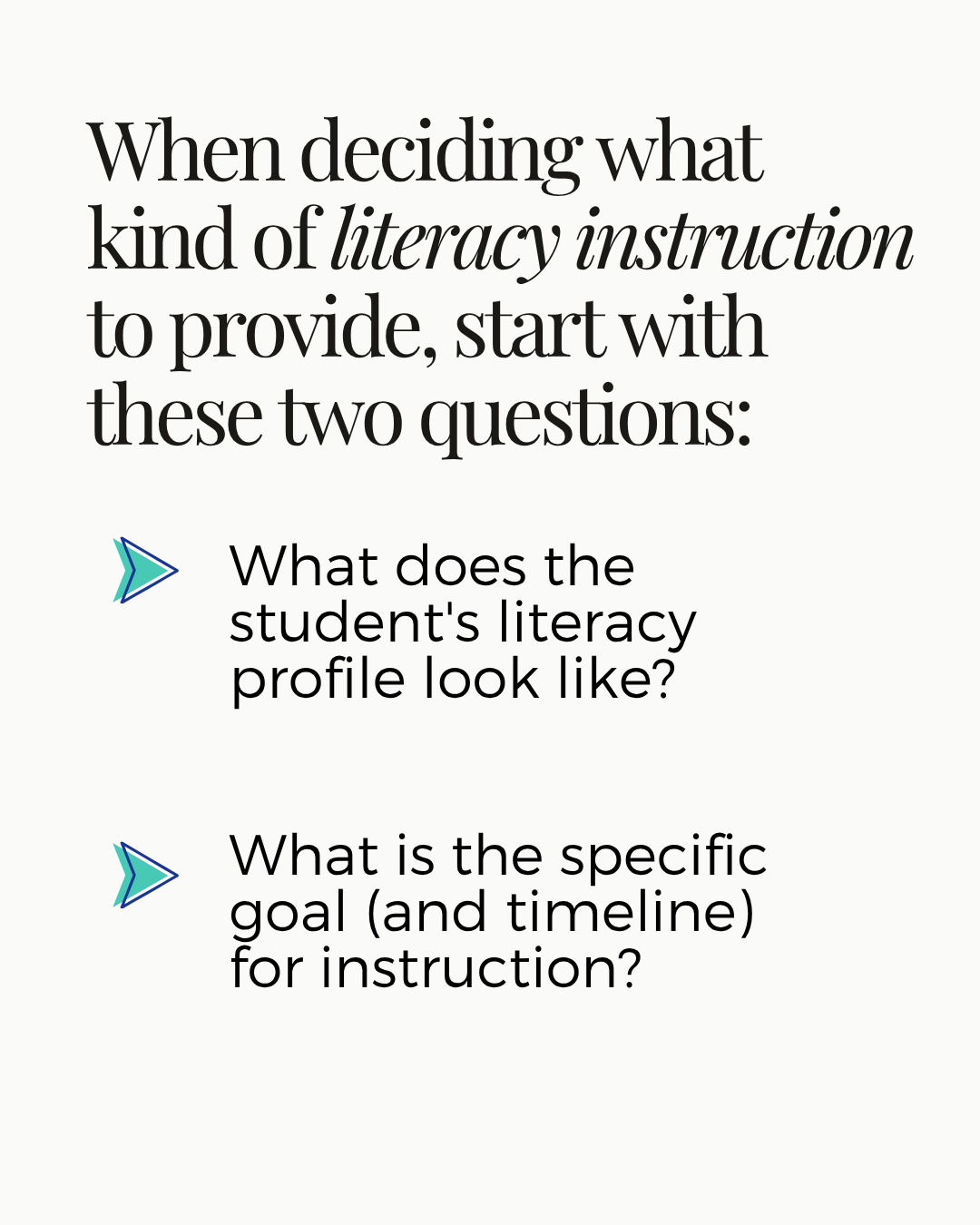
When we are deciding what kind of literacy instruction to provide, we usually start with two big questions:
1. What does the student's literacy profile look like?
2. What is the specific goal (and timeline) for instruction?
The literacy profile helps us understand what is getting in the way. The goal helps us understand what kind of support makes the most sense.
One way we organize the learning profile is by looking at two major areas: word recognition and language comprehension. In other words, can the student read the words accurately and efficiently? And can the student understand and think deeply about what they are reading?
When we look at those two areas together, we can start to see patterns.
Four common literacy profiles
Of course, students are complex, and no grid can capture every part of who they are as learners. But this kind of framework can help us organize the data well enough to make the next best instructional decision.
When we look at word recognition and comprehension together, we often see students fall into one of four broad profiles.
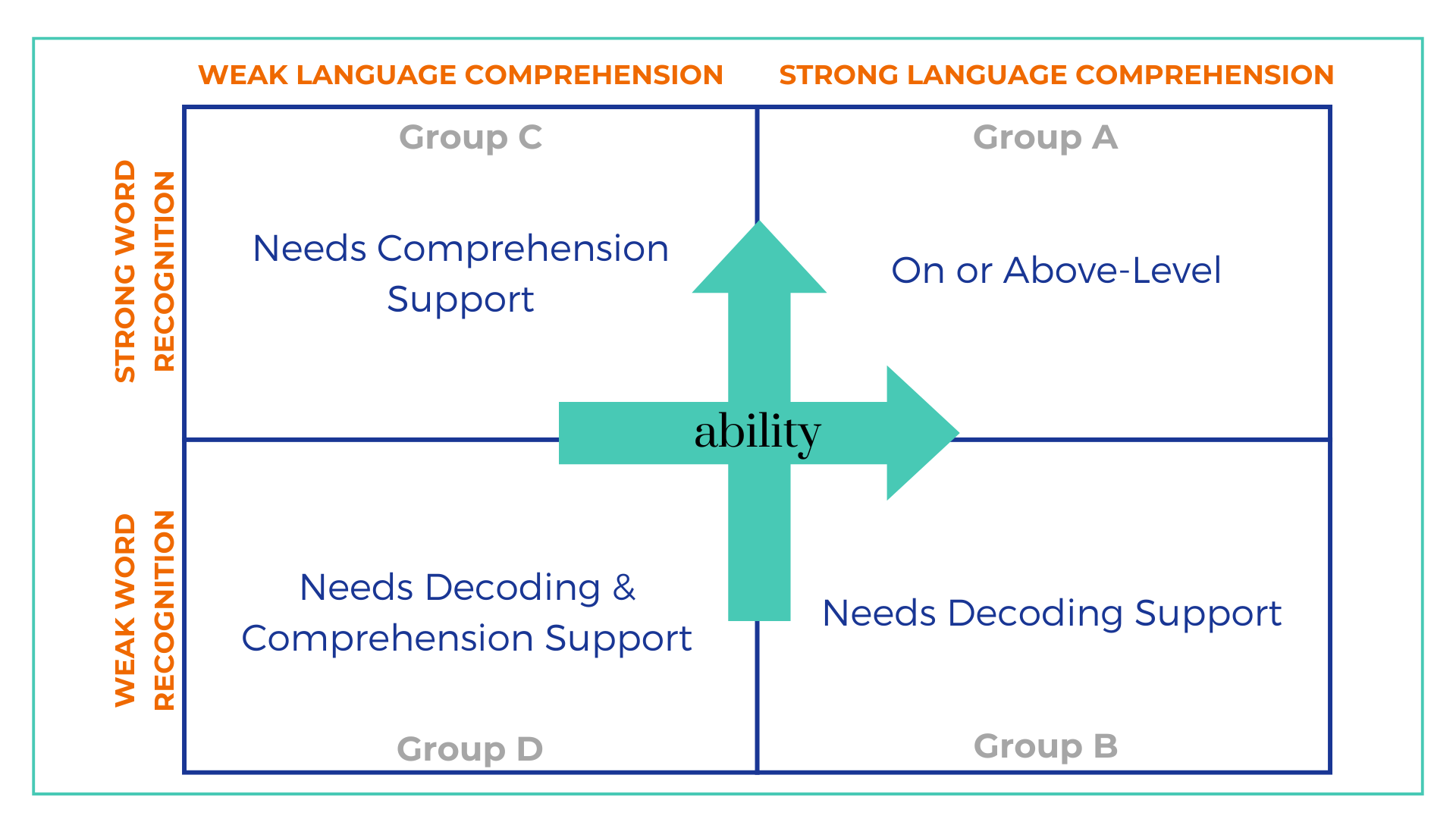
Group A: Strong word recognition and strong comprehension
These are students who are generally reading on target or above target.
They may not need intervention in the traditional sense, but that does not mean they do not need thoughtful instruction. These students benefit from enrichment, book clubs, deeper conversations about text, writing extensions, vocabulary development, or opportunities to build knowledge around meaningful topics.
For these students, the goal is not remediation. They’re already where they need to be. Instead, the goal is engagement, growth, discussion, writing, or expanding the complexity of the texts they can read and discuss.
Group B: Weak word recognition and stronger comprehension
These are students who understand language, stories, and ideas, but they struggle to access the words on the page.
They usually have strong listening comprehension. They can participate in rich discussions when text is read aloud. They understand grade-level content when they don’t have to read it themselves.
But when they have to read independently, word recognition gets in the way.
For these students, instruction needs to focus on decoding, phonics, advanced word study, fluency, or other word recognition skills. This is where systematic, structured literacy instruction can be incredibly important because students need a clear progression of skills that helps them become more accurate, automatic readers.
Group C: Strong word recognition and weaker comprehension
These are students who can read the words, but they are not fully making meaning from the text.
Sometimes these students are missed because they sound like good readers. They may read accurately and fluently. But when you ask them to explain what they read, make an inference, summarize the main idea, talk about vocabulary, or write about the text, the breakdown becomes more obvious.
For these students, more decoding instruction is not the answer.
They need support with vocabulary, syntax, background knowledge, comprehension routines, oral language, written response, or strategies for monitoring their own understanding.
This is an important distinction because if a student's primary need is comprehension, we do not want to spend all of our instructional time solving a decoding problem they do not actually have.
Group D: Weak word recognition and weak comprehension
These are students who need support on both sides.
They struggle to read the words, and they also struggle to understand what they read. For these students, instruction often needs to be carefully designed so that we are building word recognition skills while also supporting language comprehension, vocabulary, knowledge, and meaning-making.
This is where it can be especially important to have a clear instructional plan.
If we only work on comprehension, students may still be blocked by the words on the page.
If we only work on decoding, students may become more accurate readers without building the language and comprehension skills they need to understand increasingly complex text.
These students need support with both.
Now coming back to the two big questions…
The profile matters, but so does the goal.
The student profile gives us a starting point, but it is not the only thing we consider.
We also have to ask: What are we trying to accomplish?
For example, if a student's profile suggests that they need intensive literacy support and the goal is to help them move toward grade-level reading, we would likely use a systematic, structured literacy intervention program and move through a clear progression of skills.
But if a student has adequate decoding skills and the goal is to help them engage more with their reading and we only have them over the course of the summer, a book club style intervention might be a better fit.
If a student has one very specific area of need, like generating written responses using correct grammar, we may not need to start a full intervention program from the beginning. We may need to target that specific skill directly.
And, we are not only focusing on what are we trying to accomplish, but also what is our timeline? Because for us, if we only have a few weeks to work with a student or student group, we need to be very strategic in what we are targeting in such a short timeline. That instruction may look different than if we had them for a full school year for example.
The other thing that stood out to me in Rosemary’s conversation was that
It was not just about having the data to inform her instruction, but also about using that data to explain why she was doing what she was doing.
Because it’s one thing to know what a student needs.
It is another thing to be able to articulate it clearly, whether that is in a meeting, during a parent conference, or in a report.
During the conversation, Rosemary talked about writing reports for parents, showing them assessment data, and walking them through what the data meant and what she was targeting.
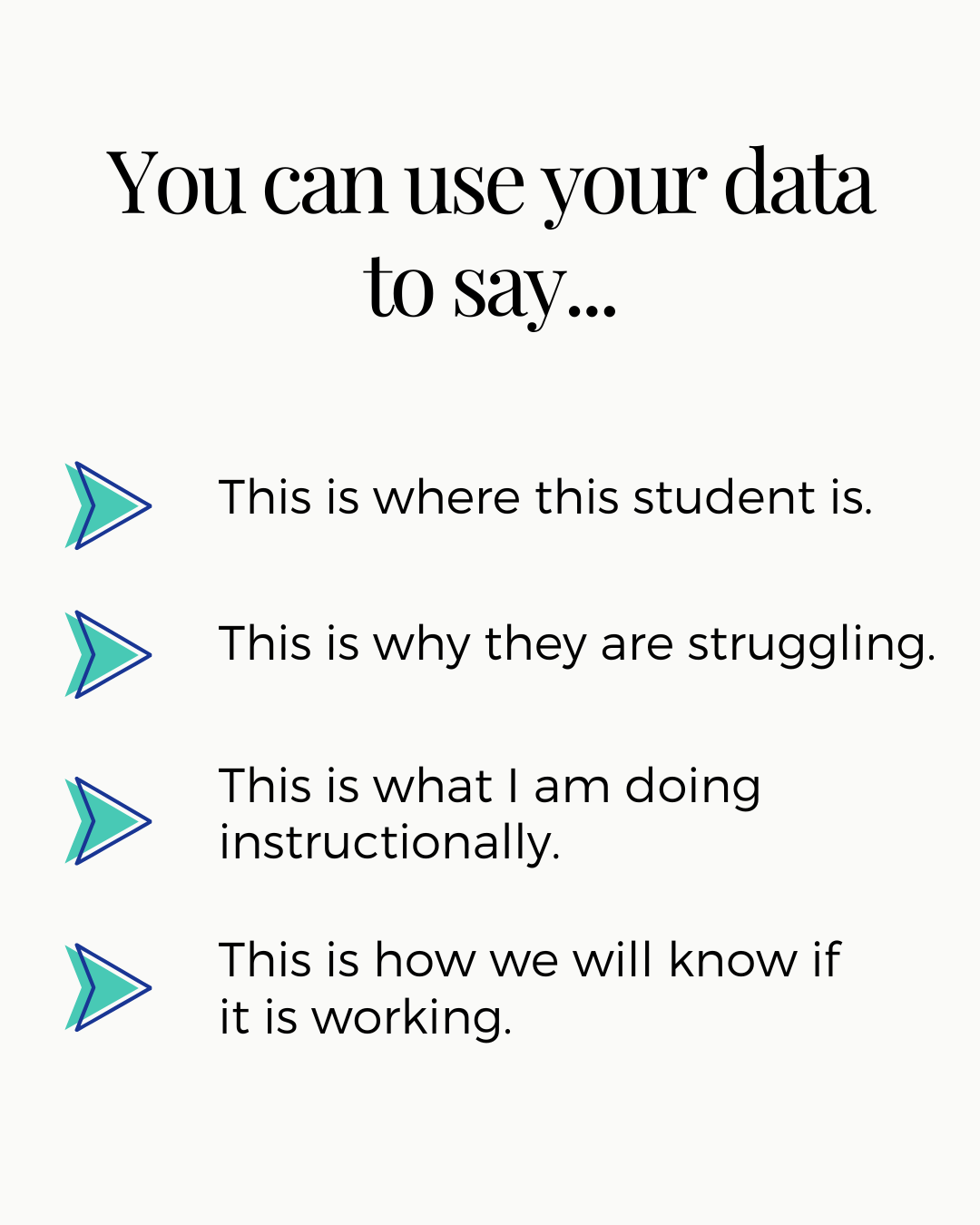
And that’s the magic of using data to inform your instruction; you can use it to say:
This is where this student is. This is why they are struggling. This is what I am doing instructionally. This is how we will know if it is working.
And being able to do that creates a very specific kind of confidence. Not general confidence. Not "I feel good about what I am doing" confidence. It is the kind of confidence that comes from being able to look at a student's data, identify the pattern, match the instruction, and explain the reasoning behind it.
That is not just good teaching. That is the kind of professional clarity that changes how parents understand their child's progress and how educators feel about their own expertise.
An important note…
The goal is not to collect enough data to feel certain about every possible instructional decision. Honestly, we may never collect that much data!
The goal is to organize the data you have well enough to choose the next best step. And to be able to share that data in a meaningful way with others.
And what I loved about this conversation with Rosemary is that she was thinking about students and recognizing what they needed. She was using different tools for different purposes.
And we all want to get to that level of instructional decision-making.
Because sometimes the right next step is a full, systematic intervention. Sometimes it’s targeted skill work. Sometimes the right next step is something like a book club. Sometimes it’s a combination.
But the starting point should always be the same:
→ Who are the students in front of me?
→ What does the data tell us about what they need?
→ What are we trying to accomplish?
→ What kind of instruction is most likely to help these students move forward?
The Takeaway
There is no one perfect literacy program that works for every student all the time. But there also doesn’t need to be.
Instead, we can use our student data to understand our students’ learning profiles. Then, we can clarify the goal of our instruction. And then, from there, we can choose instruction that actually matches the students in front of us.
That is what Rosemary is doing. And it is what we want more educators to feel confident doing, too.
Because when we stop looking for one perfect program, we can start making meaningful instructional decisions. And that is where lasting literacy growth begins.
If this is the kind of clarity you are looking for in your own instruction, the 5CCL Learning Lab is where we help educators and literacy specialists build exactly this. Not just general confidence, but the specific ability to look at a student's data, understand what they need, choose the right instructional path, and explain the plan. Whether that is in a parent meeting, a PLC, or just for your own peace of mind.
To hear more from Rosemary and how she thinks about instruction for her students, listen to her full SMARTER Literacy Chat episode.