Insider Spotlight: How She Led a District Through One of The Biggest Instructional Shifts Education Has Seen in Years
If you have been teaching long enough, you have likely lived through the moment when someone tells you that what you have been doing is no longer the right thing to do.
Sometimes it comes from a training. Sometimes it comes from a headline. Sometimes it comes from a parent who read something over the weekend and wants to know what you are going to do about it.
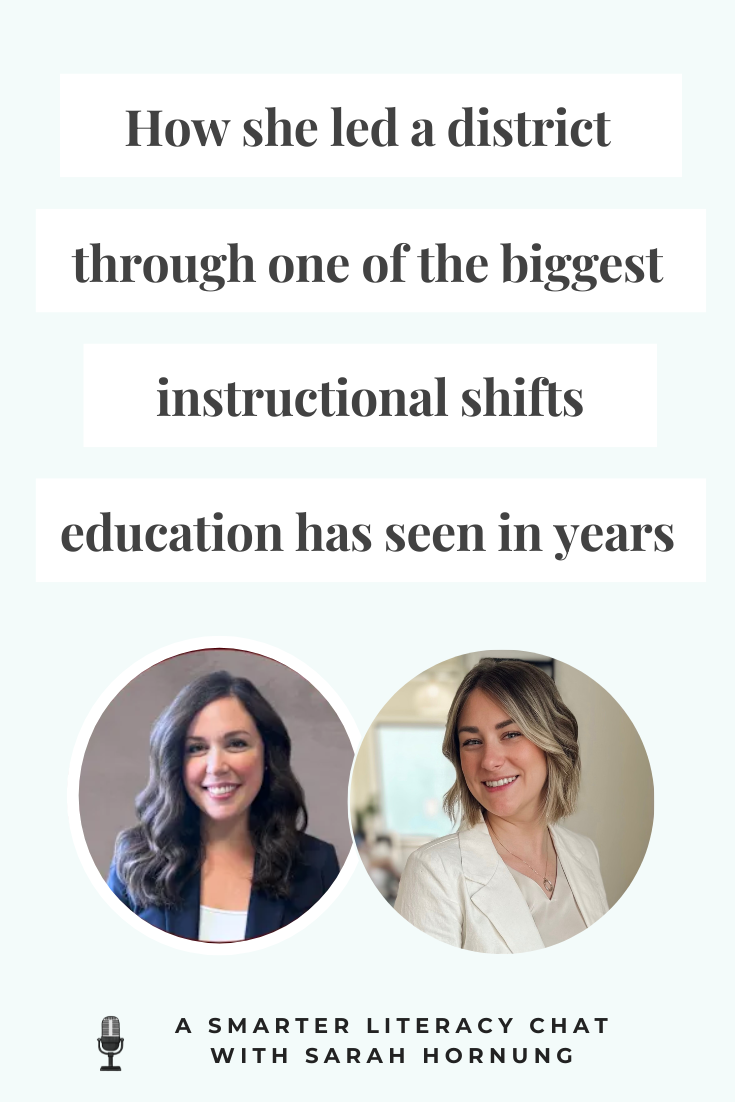
That is the beginning of Sarah Hornung's story. Sarah is the Assistant Superintendent for Curriculum Innovation and Pupil Services in Orchard Park Central School District outside of Buffalo, and she sat down with Lindsey on the SMARTER Literacy Podcast to talk about what it actually looked like to lead a district through one of the biggest instructional shifts education has seen in years. Lindsey was teaching in Orchard Park while all of this was happening, so this episode shares both perspectives. The administrator responsible for making the decisions, and a teacher who would be directly impacted by the decisions.
How It Started…
Sarah stepped into the role in August of 2023. She was new to the position but not new to the district, and she had just come out of leading technology through the pandemic.
Within her first week, parents and school board members were at her door asking what she was going to do about Readers Workshop, which was the district's adopted curriculum at the time. Within her first thirty days, Teachers College separated from Lucy Calkins and it was a New York Times story.
Sarah describes it as terrifying. Leadership one hundred one, as she puts it, is that you come in, you listen, and you get a lay of the land before you change anything. She did not have that option. The national conversation had arrived in her building before she had unpacked her office.
I think that is worth recognizing, because most of us only experience curriculum change from the receiving end. We see the decision. We rarely see the pressure that shaped it, or the person absorbing that pressure so it does not land on us.
She Couldn’t Just Do What She Was Told…
The loudest request Sarah received was to throw everything out. Get rid of the curriculum immediately. But she just couldn’t do it. She knew that having nothing was going to be far worse, than keeping what they already had and knew in place. She said, it was difficult to reckon with, but
"The curriculum wasn't hurting anybody. It just wasn't best practice."
So she went to bat for her teachers. Her thought was that it was still in a child's best interest for their teacher to be using materials they had been trained in, materials they felt confident using, while the district figured out what came next. Because if she pulled everything and gave teachers nothing to replace it, she would have created a bigger problem. Hundreds of teachers, all doing their own thing, all at once.
Her motto through the whole transition became go slow to go fast. Do not move so quickly that you make a mistake that is hard to walk back. Keep the guardrails up. Please do not throw out your materials. Please do not go rogue. Give us some time to thoughtfully develop the next chapter.
I see the opposite of this constantly, and I do not think it is anyone's fault. We are living in a moment that rewards moving fast. New thing, new label, new fix, and the sense that if you are not already doing it… you are behind. That pressure is real.
But patience is not the same thing as inaction. What Sarah was protecting was the time it takes to actually understand your community and clearly see your vision before you start choosing tools. That is not something that can be created overnight.
She talked about the grief…
The other thing Sarah did in that first year was to give space for teachers to feel all the feels that were coming up.
She calls it grieving, and she understood it deeply. Sarah was a special education teacher and a reading specialist. She knew explicit, direct instruction was right for her students. But she also wanted her students with disabilities to have the same experience as their classmates, so she brought in balanced literacy routines because she believed she was giving them the gold standard.
The more she learned, she realized that her students already had the gold standard in the explicit instruction she was providing, and that some of what she added to help them was not serving them the way she thought it was. She felt badly about it. She says many teachers felt the same, and I know she is right.
This is important because it comes up in almost every conversation I have with educators. You were never doing it wrong.
Society changes. Students' needs change with it. Research keeps moving, and more becomes available to us than we had before. Being willing to change is not an admission that your past instruction was a failure. It is what it looks like to stay in the work.
And in fact, one of the educators in our community shared this beautiful quote,
“The Learning Space is the space between not-knowing and knowing...and it generally brings one feeling: frustration. Resilience doesn't come from getting to ‘knowing’ as quickly as possible; resilience comes from the length of time you can tolerate The Learning Space.” - Shared by Heather Diebel from a quote in her office by Clinical Psychologist Becky Kennedy.
Sarah's first year of change was largely about giving teachers room to digest that and reach the point where they did not carry guilt or shame about what they had been doing, because what they had been doing was what everyone was told to do. It was what we knew.
She gave her teachers space…
Sarah built a Literacy Steering Committee as a shared decision-making group, because she knew deep down that
"If you don't give people a place to say how they're feeling, they will say it somewhere else."
She says it half as a joke. It is not a joke. When teachers do not have a place to be heard, that feeling still goes somewhere. It shows up as frustration, as burnout, and sometimes as an excellent educator deciding to leave the profession altogether because nothing he or she said ever seemed to reach anyone.
So Sarah brought everyone to the table. Pre-K through twelve, reading specialists, academic intervention teachers, classroom teachers, administrators, and school librarians, because librarians have strong opinions about what it means to build a culture of reading and everyone was important. Lindsey was on that committee, and she describes the relief in the first meeting when Sarah told the group this was not her decision to make alone. It was also the first time in Lindsey's career that she had sat down with colleagues K-12.
They started by clarifying the vision first
One of the things that I found so inspiring was that year one of that committee was not about choosing a curriculum. It was about defining what it looks like to be a strong reader and writer in Orchard Park.
Sarah's said:
"I believe that often we start associating the program with our vision or mission, and those are two different things."
The program is not the vision. The program is what you reach for after you know what you are trying to build. When we skip that step, every new adoption feels like starting over, because there is nothing underneath it holding the pieces together.
One of the anchors the committee refused to give up was fostering a love of reading. Three years later, Sarah says that is still the concern, still the thing they are working to protect, and still hard in a world where every one of us goes to bed choosing between a book and a social media scroll. She is honest that some of that is beyond what any school day can fix. But it stayed in the vision, which means it stays in the conversation.
She decided that anyone who wanted to pilot could pilot
By year two, the committee moved toward bringing together a pilot group, and Sarah made a deliberate choice that any teacher who wanted to pilot could pilot. In a district with more than five thousand students, she did not want a single person to be able to say the decision was Sarah's and her five favorite people.
What she did not fully anticipate was what it would do for implementation. By the time the district adopted, so many teachers were already in year two of using the materials that they could turn to a colleague and say, let me help you, here is what I learned last year. Lindsey found Delivering SMARTER Intervention during that pilot window, and she describes secondary teachers checking in with each other about what was working and offering to help.
That is not a rollout. That is a community.
And she made this important distinction so clear…

While they were piloting, Sarah kept telling people something I wish every teacher heard before a new adoption.
“You will hate something about every program you look at. You will love something about every program you look at. And that is okay.”
She goes further and says we should be critical of them, because it would be foolish to fall so in love with a program that we believed it was the answer to our prayers. Then she says the most incredible thing:
"You are the magic maker in the classroom. This is a tool."
We talk about this all the time. Teaching literacy is both an art and a science. And while your curriculum can act as a tool to support the science of it, you bring the art. What matters most is staying open enough to keep having the conversation about what’s working, what’s not.

That is why we say what we say when we work with schools. This works beside what you already have. Please do not throw out what you have. It is a way, not the only way. And for educators, that can be such a breath of fresh air honestly, because it means nobody is about to tell them that everything they have been doing is wrong.
Sarah's district at Orchard Park has taken that all the way into their professional learning. Now that teachers are trained in the programs, the learning is about explicit instruction, opportunities for students to respond, engagement, and feedback. Universal practices that apply across math and ELA, so the focus is on what students respond to rather than on what a manual says. Some teachers have told her they always knew prior knowledge mattered, they always knew a KWL chart worked, and they are glad to see it back.
Where the community shows up…
Orchard Park has four elementary schools, which means grade level teams that are not geographically connected. So each grade level now has a lead teacher in each building. Those four teachers meet with instructional coaches before a unit is taught for the first time, with a half day to unpack it, look at the text complexity of the upcoming texts, and identify what their colleagues will need. Maybe an anchor chart. Maybe some background knowledge students are unlikely to have.
They run a few weeks or months ahead of their colleagues, not in teaching, but in previewing. They also reflect on the last unit, look at the data, and note what to do differently. And then they build. Actual work time, together.
What emerged from it was vertical alignment. No more one school skipping seven lessons because they ran out of time while another reorders the units and a third drops an assessment. Students across the district are having a similar experience. At first, Sarah was worried that the teachers would hate it. But instead, teachers are now asking whether they can do the same thing for math.
That model did not come from a program. It came from people who knew what they were building and had a place to say so.
What I keep coming back to…
When Lindsey asked Sarah for one piece of advice, Sarah gave the credit away. She said the teachers she works with are the ones who deserve the success of the last several years, because they are the ones showing up every single day doing everything they can for kids.
Earlier in the conversation, she said the thing that explains it all:
“the people closest to the problem are usually the ones with the solution.”
Orchard Park's upcoming focus on writing did not come from a conference or a podcast. It came from teachers saying this is where we need to look next, and someone listening.
A program will never do that for you. A vision built with the people who have to live inside it will.
If you’re ready to have your mind blown about what is possible when teams come together, you can listen to the full conversation with Sarah on the SMARTER Literacy Podcast.