
Insider Spotlight: How She Stopped Piecing Her Literacy Intervention Together
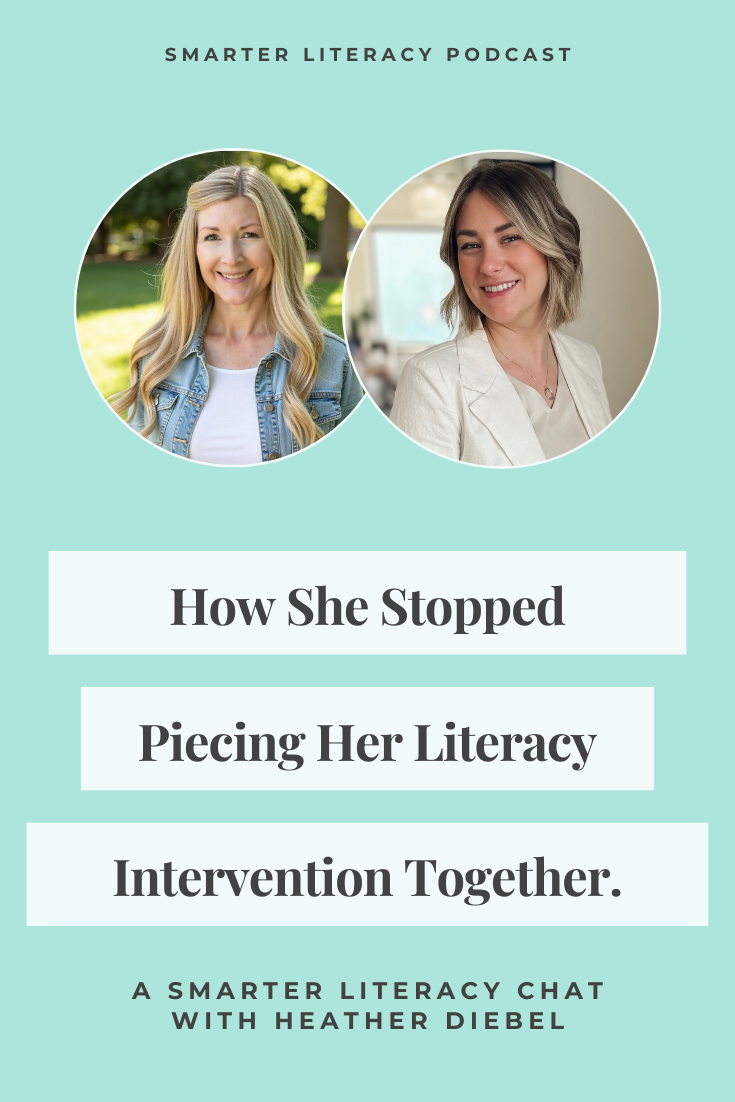
Raise your hand if you've ever experienced something that looks like this:
→ Hours spent searching for the right worksheet, the right passage, the right way to explain a skill a student is missing.
→Late nightspiecing together a lesson plan from five different sources, because none of them, on their own, gave you what your student actually needed.
That was Heather's reality when she started teaching third grade, in a school with no reading curriculum at all.
This was before you could go online and pull a resource in quickly. She was buying workbooks from expensive teacher stores, and if she lost a copy of something, that was it. Start over.
But the piecing together went deeper than just materials. Heather taught during what she calls the great reading war (if you’ve been teaching literacy for a while, you know what she’s talking about), when the guidance she was given was to have students guess at words using context clues and pictures.
And the whole time, something in her kept asking:
Why aren't we teaching them the sounds?
Why aren't we teaching them how to blend?
She was following what she'd been trained to do, and it still didn't make sense to her.
So even when Heather was doing exactly what she was told, she still felt like something wasn't fully coming together.
And leaving the classroom didn't solve it…
Heather eventually left the traditional classroom to build her own literacy practice, and she was really honest about something here. Starting her own practice didn't automatically fix the piecing together. For years, she was still pulling from a program the school had used, still ordering things online, still building a computer full of files, programs, and PDFs, still asking herself, do I already have this? Does this already cover what I need?
She felt like she had to keep searching. Her instruction just didn't flow, for her or for her students.
She shared that what changed everything was getting pickier, not giving up…
Heather went back and got her master's in reading, and she said that the more she learned about the science of reading, the pickier she became about what she was willing to use. She researched curricula. She wrote papers comparing companies. And she still wasn't satisfied.
Heather said that she just got really picky. Which I think can be hard because sometimes being picky can start to make you start to second-guess yourself, like maybe you're the one being unreasonable. But that was not the case here; Heather was absolutely not being unreasonable. It was really that she knew what her students needed, and she refused to settle for less than that, even when it took months to find.
In early 2023, she decided to give herself a deadline. She just knew there had to be something more comprehensive out there. She spent two or three months going back to the research, calling companies, asking questions, until she found Delivering SMARTER Intervention, where the scope and sequence, the explicit phonics instruction, the spelling, and the writing were already connected. Her words: "I was literally jumping for joy."
What changed wasn't just the materials
What stood out to me most as I was listening back to this conversation was that Heather said, "my time is now spent with children, not on planning."That's exactly what I saw happen with my own students when instruction stopped being something I had to rebuild every night.
And I don't think we talk enough about the other half of that equation. It's not only about being more present for your students. It's about getting your own time back too. Being present for your own life, so you can pour more into your students when you’re with them.
That shift is also what let her step fully into being an advocate, for her students and for their parents navigating IEPs and 504s for the first time. It's what let her sit with a student for months reviewing a single skill until it finally clicked, without feeling like she was falling behind some invisible schedule.
And it's part of why, near the end of this conversation, talking about what it means for a child to learn to read, what it opens up for them, Heather started to tear up. So did Lindsey. So did I (and I wasn’t even there!!!).
This work is important enough to make us all cry from time to time. The impact is real.
And when so much of our energy goes into piecing instruction together, it can be harder to find the space to actually be present for those “aha” moments our students will share with us, the ones we got into this work for in the first place.
The takeaway
Heather spent years building her instruction piece by piece, because she cared enough to keep searching for something better. That effort was never wasted. It's also not something you have to keep carrying alone.
You don't have to keep building this yourself. You certainly can. But there is a solution that already exists, one where the sequence, the structure, and the pieces are already connected for you.
If that's where you're at right now, piecing things together and wondering if there's a clearer way, we'd love for you to join one of our free trainings, How to Structure Elementary Literacy Intervention or How to Structure Secondary Literacy Intervention, depending on your setting, so you can see what this looks like.
To hear more of Heather's story, from that first classroom with no curriculum to running her own thriving practice, listen to the full conversation on the SMARTER Literacy podcast. You seriously do not want to miss this, and if you’re currently in need of a bit of inspiration and motivation, you must go listen right now!