Do your students ever mix up certain sounds? Maybe they mispronounce words, like calling milk "melk" or they spell "met" as "net."
Sometimes, students spell things wrong because they haven't learned a sound yet.
Other times, they err because of their attention to detail.
But sometimes, students genuinely cannot tell the difference between two sounds.
When a student struggles with auditory discrimination, they cannot recognize the difference between certain sounds.
Common errors include voiced and unvoiced pairs like "big/pig" or words with sound patterns that are very similar to one another like "thin/fin" or “met/net.”
Why is auditory discrimination important?
When reading and spelling, we need to process discrete differences in words. If we can't, we will mispronounce and misspell our words. It can lead to vocabulary struggles as well.

For example, if a student can't hear the difference between a short ‘e’ sound and the short ‘i’ sound, they may refer to a “pen” as a “pin.” If this is not corrected, they may believe that the writing utensil they use is called a pin and not recognize the mistake.
How can I support auditory discrimination?
One of our favorite ways to support auditory discrimination is to have students sort words based on the sounds they hear (we use pictures so that they can’t use orthographic cues).
For example, in the pictured activity, students would sort the picture of the bear and the table into the /b/ sound column, and the pin, panda, and apple would all be sorted into the /p/ sound column.
You could do this with any pairs that students are struggling with as a fun way to keep them practicing and engaged! The images of the mouth formation also help students recognize how their mouth should look when making these sounds.
Next Steps
When students confuse sounds like /b/ and /p/ or /ĕ/ and /ĭ/, it can show up in more than just pronunciation. Those mix-ups can affect spelling, word recognition, and the way students make sense of what they read. Giving students targeted practice hearing the differences can help, especially when that practice connects to the reading and spelling skills they’re working on.
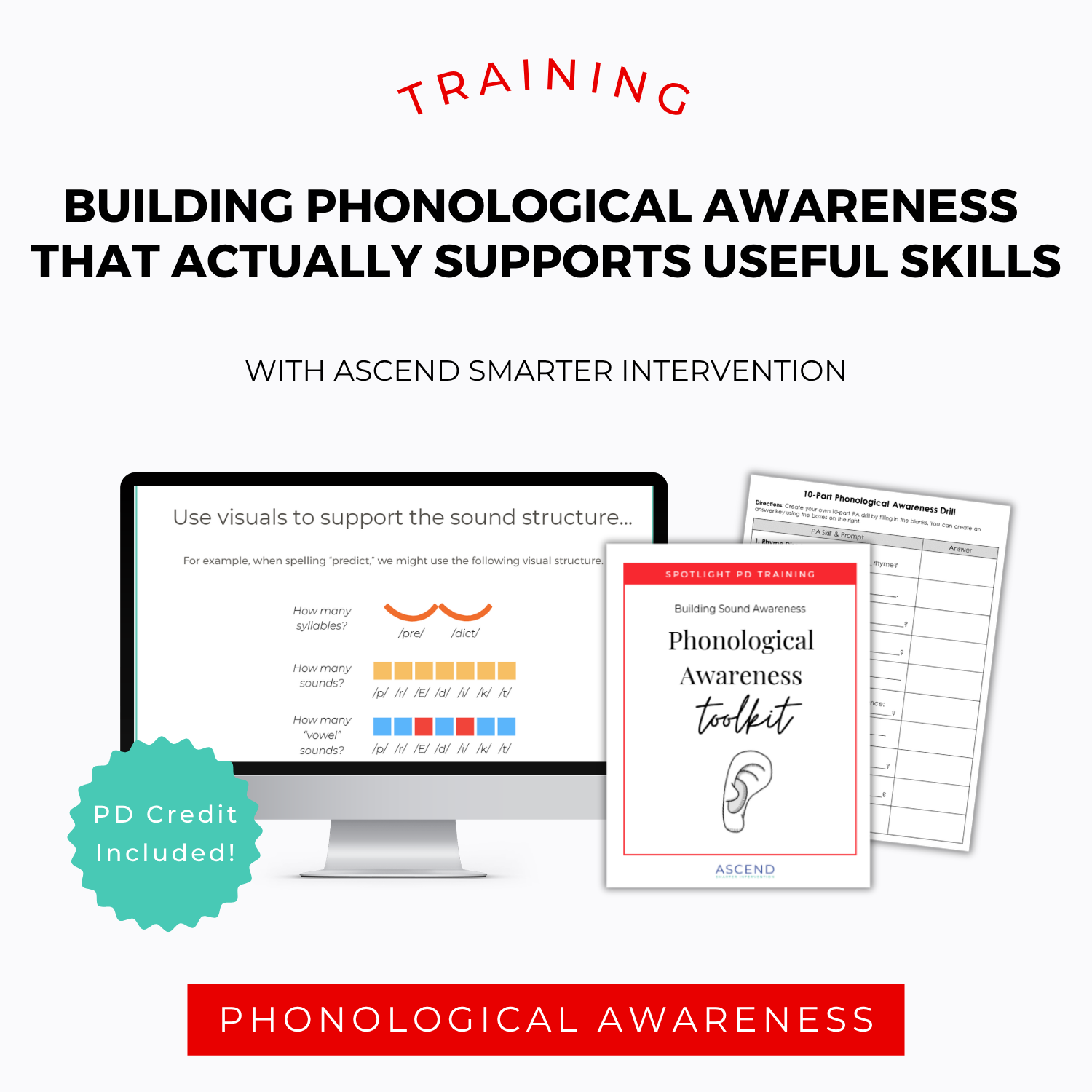
The challenge is knowing which skills to focus on and how to fit that practice into an already busy literacy block. Our on-demand training, Building Phonological Awareness that Actually Supports Useful Skills, walks you through the four core phonological awareness skill sets, how to choose targets based on what your students need, and how to build a simple, flexible routine into the reading instruction you’re already doing. You’ll see the routine modeled with a real student and learn how to connect sound work directly to reading and spelling.
You’ll also receive the Phonological Awareness Toolkit, including an editable 10-Part PA Drill, task cards, games and activities for differentiating instruction, progress-monitoring records, grade-level benchmarks, and “Creating the PA Bridge” guides that connect phonological awareness to reading and spelling. The training includes a one-hour PD certificate and lifetime access to the materials, so you can revisit the routine and resources as your students’ needs change.
Now, as we will mention again and again, this should be a quick activity or center-based activity in your lessons. This should not be a focus for an entire lesson, as there are definitely additional valuable skills you need to make sure to fit in. If you're interested in learning more about how to fit it all in - you can check out our blog >>here<<.