When should a student take responsibility for their learning?

“Students need to take more responsibility for their learning.”
I think many of us have said something like this (I know I have) at some point. Many of us have felt the frustration underneath it.
Students seem unmotivated. They disengage quickly. They ask, “Do we have to do this?” Or they comply on the surface, but the learning never really sticks.
But here’s the question we don’t always stop to ask:
Have we helped students understand why they should care?
We often talk about responsibility as if it’s a character trait. Something students either have or don’t have.
In reality, responsibility is an executive functioning outcome. And it begins with goal clarity.
Students are far more likely to engage, persist, and follow through when they understand:
what they are working toward,
why it matters,
and how it connects to something they care about.
When that connection is missing, what looks like a lack of motivation is often a lack of meaning.
“They’re Not Motivated” Isn’t the Whole Story
There were many moments in my own work with students where I felt stuck. I was showing up prepared, offering support, and scaffolding instruction, yet some students still seemed disengaged.
What I eventually realized was that they weren’t resisting the work; they just didn’t understand the purpose of the work. Once we slowed down and started with goal-setting conversations, things shifted. Not overnight. But gradually.
Start With the Right Questions
Before asking students to “try harder” or “take responsibility,” we need to help them answer a few foundational questions:
What is my goal?
What am I actually working toward right now?Why is this important?
Why does this matter for me, not just for school?What will I get when I achieve this goal?
Sometimes this is internal (confidence, independence, progress).
Sometimes it’s external (grades, privileges, rewards). Both are valid starting points.What might block me from getting it done?
Time, frustration, boredom, difficulty, distractions — naming barriers reduces shame and increases problem-solving.How does this fit into my priorities?
Where does this task sit alongside everything else competing for my attention?
These questions transform learning from something being done to students into something they can participate in intentionally.
What This Looks Like Across Age Levels
For younger students, responsibility often begins with external motivation. Token systems, visual goals, and concrete rewards can help students experience success and build momentum. That’s not a failure of intrinsic motivation. It’s developmental.
As students get older, the conversation can shift. We can begin asking how skills connect to their interests, goals, or future plans. A student may disengage not because the work is “too easy” or “too hard,” but because they don’t see how it connects to anything they care about.
When students understand the why, effort becomes more sustainable.
Goal Setting Is Not a One-Time Conversation
Goals aren’t something we set once and move on from. They need to be revisited, reflected on, and adjusted.
When students struggle, it’s often a signal to return to the beginning:
Is the goal clear?
Does it still matter?
Is the timeline realistic?
Do supports need to change?
That reflective loop is where executive functioning grows.
Responsibility Grows From Agency
When students are invited into the goal-setting process, they begin to feel a sense of agency. They’re no longer just complying with expectations. They’re working toward something they understand.
And that’s when responsibility starts to show up naturally, not because students were told to care, but because they finally had a reason to.
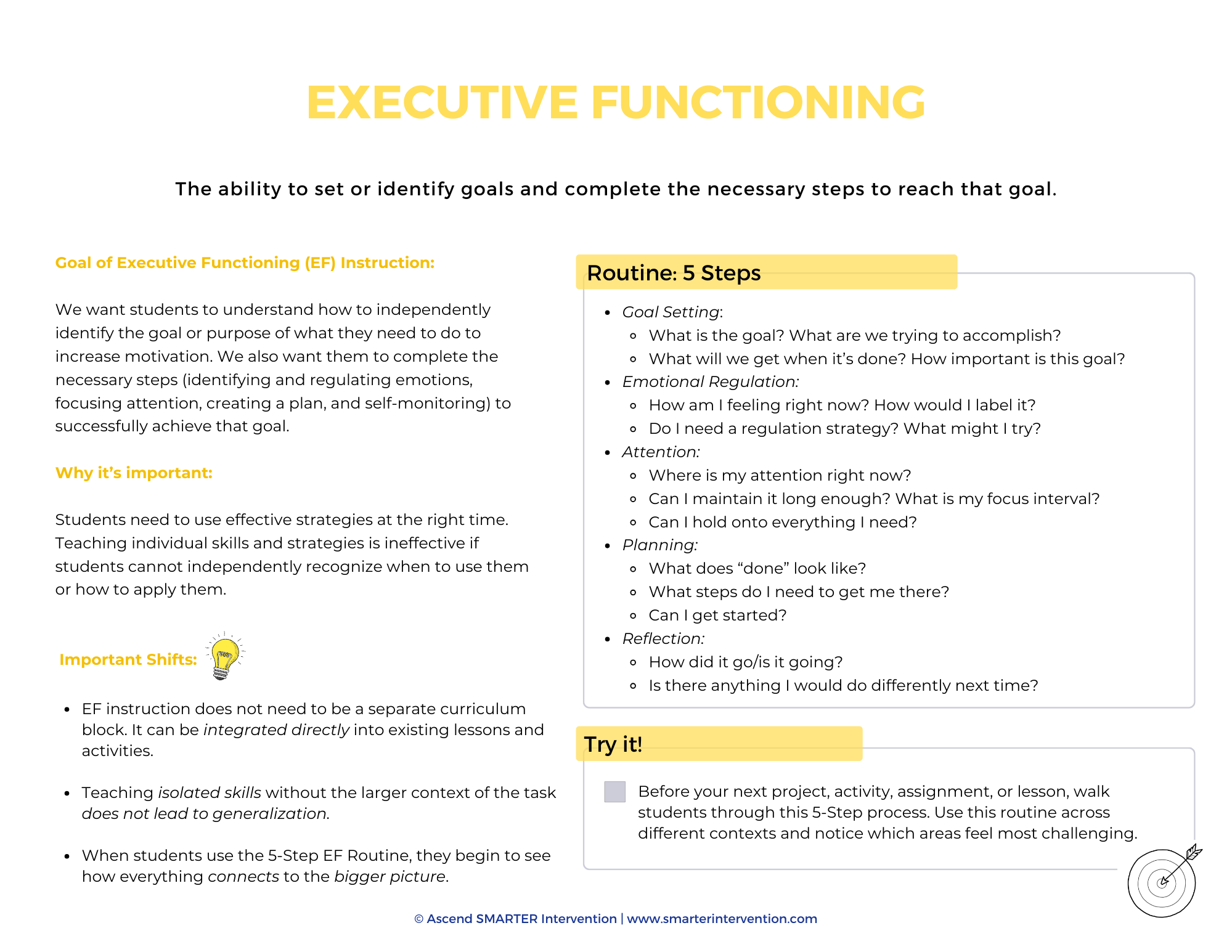
Want tools to support this process?
The FREE Executive Functioning Routine provides educators with a framework to help students set and identify goals.
The routine uses 5 steps to guide students through any task or project, increasing motivation and helping them to successfully achieve that goal.