
Why Can't My Students Follow Directions?
“Why can’t they follow directions?”
This is one of the most common concerns we hear across grade levels, settings, and content areas.
And the reason that so many students struggle to follow directions is that following directions is not a single skill.
It is a complex executive functioning task that requires multiple memory systems, attention, sequencing, and self-monitoring to work together in real time.
When any part of that system is overloaded, breakdowns occur.
Following Directions Is a Working Memory Task
To follow directions, students must:
attend to the information being given
hold it in mind long enough to act on it
remember the correct sequence
filter out irrelevant information
initiate the task
This happens inside working memory, the brain’s short-term “workspace.” Working memory is not where information is stored long-term. It’s where information is actively held, manipulated, and used. And it has a very limited capacity.
Short-Term Memory vs. Long-Term Memory
Understanding the difference helps clarify why directions can be so difficult for so many students (even students who may have a “great memory for things that happened forever ago.”
Long-term memory
Stores information over time
Includes knowledge, routines, and automatic skills
Short-term memory
Holds information briefly
Includes working memory, which allows us to use that information
Following directions happens almost entirely in short-term memory. If information doesn’t get processed efficiently, it never reaches long-term storage.
Working Memory Has Multiple Components
Working memory is not one thing. It draws on different types of short-term memory, most notably:
Auditory Short-Term Memory
This supports:
remembering spoken directions
holding verbal sequences in mind
repeating information internally
Students relying heavily on auditory memory may silently rehearse directions to keep them from disappearing.
Visual Short-Term Memory
This supports:
remembering what something looks like
holding visual details in mind
recalling spatial or visual cues
Visual memory allows students to store more information at once, especially when patterns or images are involved.
Why This Matters for Following Directions
Consider this direction:
“Go to the store and get bread, mayonnaise, a can of tuna, pickles, lettuce, and milk.”
Someone might repeat the list auditorily over and over or visualize a tuna sandwich and a carton of milk. The second approach reduces cognitive load by chunking information into meaningful units.
Instead of remembering seven items, the brain remembers two concepts:
lunch
milk
That’s working memory efficiency.
Sequencing Adds Another Layer of Complexity
Many directions require not just memory, but order.
Students must remember what comes first, what comes next, and what must be completed before moving on. Sequencing relies on auditory memory (for order), working memory (to hold steps), and attention (to stay with the task).
A weakness in any of these areas can result in incomplete or incorrect follow-through.
When Strong Skills Aren’t Used Automatically
Sometimes students have the necessary memory skills, but don’t access them when needed. This happens when skills are under-practiced, context-dependent, and not yet generalized. In many cases, a student may demonstrate strong memory in one setting and struggle in another. This isn’t an inconsistency; it’s a lack of automatic integration. That’s why repetition, variety, and explicit strategy instruction matter.
Why Directions Overwhelm So Easily
Directions can be incredibly overwhelming for students because they often come all at once, are delivered verbally, require immediate action, and assume strong working memory. So what this means is that even clear directions can overload a student’s system. When that happens, students may miss steps, complete tasks out of order, appear inattentive, or ask for repeated clarification. This is not because they are purposefully trying to make you crazy or just not listening. It’s cognitive overload.
How an Executive Function Lens Changes Instruction
When we understand the memory demands of directions, we naturally shift how we support students.
This might look like:
breaking directions into smaller chunks
pairing verbal directions with visuals
checking for understanding before starting
reducing unnecessary language
externalizing steps through checklists or models
It’s important to recognize that following directions is a skill, not a character trait. Just because a student struggles to follow directions does not mean that they are lazy or defiant or that they’re being disrespectful. It’s really just a sign that the task demands are exceeding the students’ current executive functioning capacity. When we teach students how to hold, organize, and act on information, we empower them to succeed.
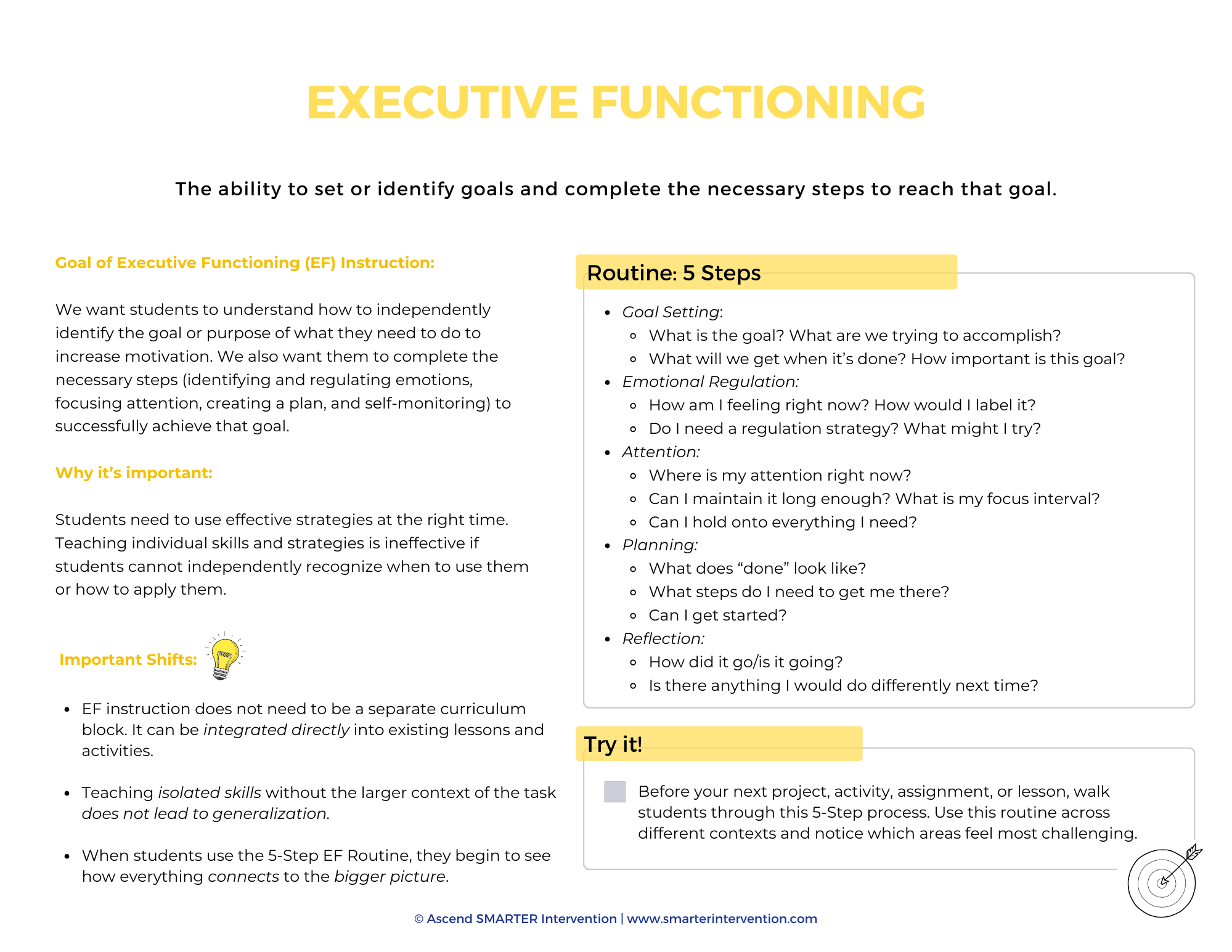
Want to see how working memory fits into the bigger picture?
Check out our FREE Executive Functioning Routine
In this guide, we:
Break down goal setting, emotional regulation, attention, planning, and reflection into steps
Explain the importance and goal of including EF in your instruction
Provide simple steps and prompts you can use with your students
This routine is designed for educators who are ready to take this knowledge into practical, grounded implementation.