
Have you ever had students struggle with finding the main idea and details in their lessons?
So often, my students struggle with the main idea and key details because…
…they are either WAY too broad, WAY too specific, or start talking in the longest run-on sentence, trying to tell me every last detail about the passage they can squeeze in.
Recently, I have found that it has actually been a vocabulary activity that has allowed me to explicitly teach them how the ideas in the stories and passages we read come together to form the main idea and key details.
So, we all know that in order to comprehend what we read, we need to understand what the words mean. That’s no secret.
However, the overlap between vocabulary and comprehension is bigger than that.
One of the first skills we teach our students when it comes to vocabulary is the ability to categorize.
We will give them three words like “dog, tiger, bird,” and they should identify the category as “animals.” When we look at the main idea and details of a story, the process is the same.
Think about it. Let’s say that we read the following paragraph.
“There are many different animals in the world. Dogs are domesticated animals that are often kept as pets. Tigers are animals that live in the wild. Birds can be either domesticated, like a canary, or wild, like an eagle. Animals are a great part of our world.”
The three details of the paragraph are the same as the words provided earlier - “dog, tiger, bird.”
The main idea is “animals,” just like it was in the vocabulary task.
Now let’s say that the words/sentences within the paragraph were about “dogs, cats, and hamsters.” Now, the level of specificity needed increases from “animals” to “pets.” This would be true for a vocabulary task and the main idea task.
Watching the “Oh my gosh, I get it now” look in my students’ eyes when they are explicitly taught this connection has been incredible. I encourage each of you to try this activity this week to show students how both of these skills connect.
Want Support Bringing Vocabulary to Life?
When students struggle to explain the main idea, identify key details, or make sense of a passage, the problem isn’t always comprehension itself. Sometimes, they’re missing a clear understanding of the words that hold those ideas together. Helping students explore word meanings more deeply can give them a stronger foundation for making connections and understanding what they read.
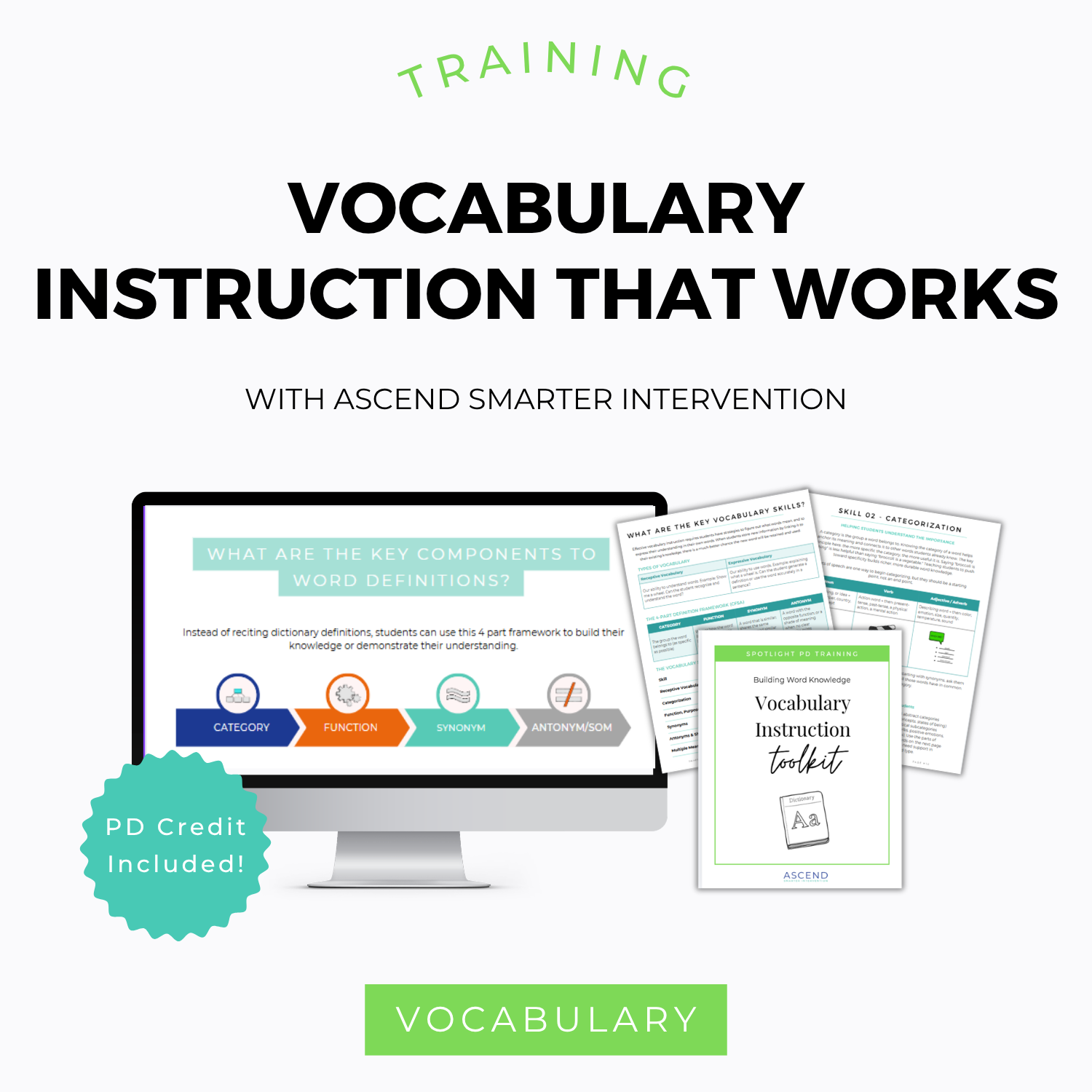
Our on-demand training, Vocabulary Instruction That Works, gives you a practical four-part framework for teaching word meanings: Category, Function/Purpose/Features, Synonym, and Antonym. You’ll learn how to use this routine within the lessons you’re already teaching, helping students move beyond memorizing definitions to building the kind of word knowledge they can actually use in reading and writing.
You’ll also receive ready-to-use vocabulary activities to help you put the framework into practice, along with a one-hour PD certificate and lifetime access to the training and materials. It’s a manageable way to make vocabulary instruction more intentional and help students build the word knowledge they need to understand what they read.
Then, be sure to check out our video below to see how we take our categorization vocabulary tasks and turn them into main idea and key detail tasks!
Double-click to edit...