Vocabulary Instruction That Works
Practical Tools + Strategies You Can Use in Any Lesson

This training gives you a clear, practical framework for teaching vocabulary in a way that sticks. You'll walk away with a four-part routine that fits inside the instruction you're already doing and helps students build real word knowledge that supports comprehension and written expression.
Imagine this...
Imagine a student coming to an unfamiliar word in the middle of a passage. Instead of skipping past it or flagging it for later, they pause. They ask themselves what group the word belongs to. They think about what it does or what it's used for. They pull up a word that's similar and one that's different. And just like that, they've built a working definition out of what they already know.
Now imagine that happening consistently. Students start recognizing vocabulary gaps before those gaps become comprehension breakdowns. They approach unfamiliar words with a process instead of a shrug. And when you ask them to explain something in writing, they have the words to do it, and the confidence to put them together.
That's what intentional vocabulary instruction makes possible. Not memorizing long lists. Not looking everything up in the dictionary. A clear, repeatable framework students can actually use.
But here's what we see all the time...
Vocabulary often gets pushed to the margins. It shows up when a word happens to come up in a lesson, gets explained briefly, and then disappears. Or it becomes a weekly list: words assigned on Monday, tested on Friday, forgotten by the following Monday. Students can decode every word on the page and still walk away from a passage with no idea what they just read, because the words didn't connect to any meaning in their minds.
And it's not for lack of trying. You might have a curriculum that gives you vocabulary words to teach. You might be pulling words from your texts or your content areas. You might be explaining words when students ask. But without a consistent framework that gives students a process for building and expressing word knowledge on their own, that instruction lands differently for every student. And often, it doesn't land at all.
The problem isn't that vocabulary instruction doesn't happen. It's that it often doesn't have the structure that makes it stick.
Sound familiar?
➡️ You explain a vocabulary word during a lesson, and three days later, a student asks what it means again, or misuses it in their writing.
➡️ Students can copy a definition from the dictionary, but when you ask them to explain the word in their own words, they go blank.
➡️ You have students who decode fluently but still miss the meaning of what they read because key vocabulary words aren't connecting to anything stored in memory.
➡️ You're not sure which words are worth slowing down for, and there isn't always time to figure it out in the moment.
➡️ Vocabulary instruction feels like one more separate thing to manage, so it ends up being inconsistent or happens only when there's time left over.
If any of that resonates, this training was built for exactly where you are.
Give Your Students a Framework for Word Knowledge,
Not Just a List of Words to Remember.
In This Training, You'll Learn How To
→ Use the four-part CFSA vocabulary framework to guide students in building their own working definitions, in their own words, from their own knowledge base
→ Distinguish between receptive and expressive vocabulary, and assess where your students actually are using a simple rating tool that fits inside existing lessons
→ Integrate vocabulary instruction into phonics work, read-alouds, and content-area texts without creating a separate block or adding instructional time
→ Help students recognize when vocabulary is breaking down their comprehension during reading, and teach them what to do when it happens
→ Differentiate vocabulary instruction for students at different levels, including students who need receptive-first scaffolding and those who are ready for deeper expressive work
→ Support written expression by helping students develop the word networks that make writing richer and more precise
When you purchase Vocabulary Instruction That Works, you get:
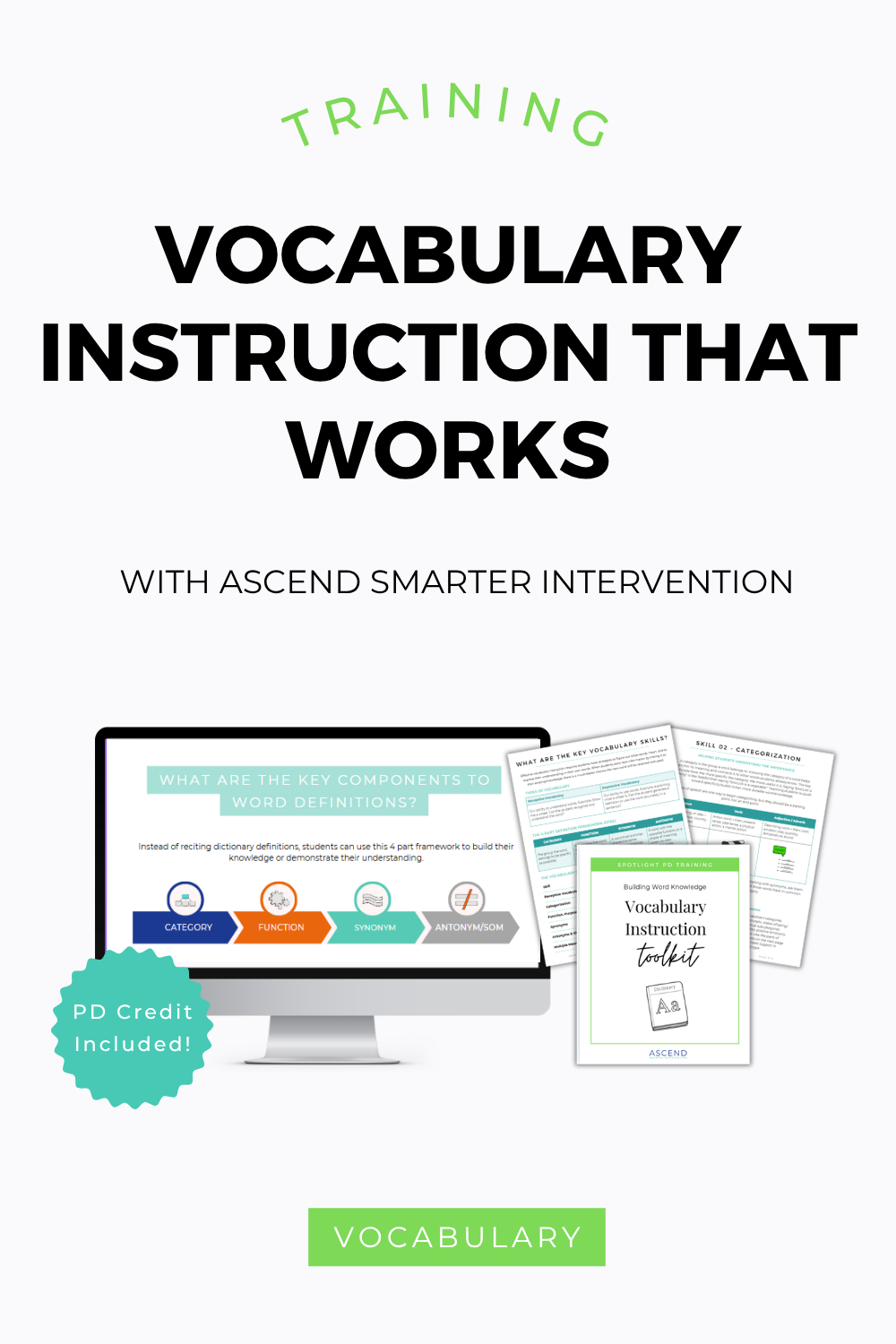
✅ 1-Hour On-Demand Video Training - A focused, practical training from Corey that walks you through the why and the how of vocabulary instruction, including the four-part framework, how to integrate it into your existing lessons, and how to use both vocabulary support pathways with any age group. Watch once, rewatch sections as needed.
✅ The Vocabulary Instruction Toolkit - Your complete, ready-to-go system for vocabulary instruction. The toolkit covers all six vocabulary skills, from Receptive Vocabulary and Categorization through Synonyms, Antonyms, Shades of Meaning, and Multiple Meanings in Context, with downloadable resources for each skill area. It's organized so you can use what you need and return to sections as your instruction grows.
✅ 1-Hour PD Certificate - Complete a short quiz after the training and receive your professional development certificate automatically by email.
✅ Lifetime Access - This training is yours to keep. Come back anytime, whether that's next week, next semester, or three years from now.
Everything you need to start implementing immediately.
Here’s how it works:
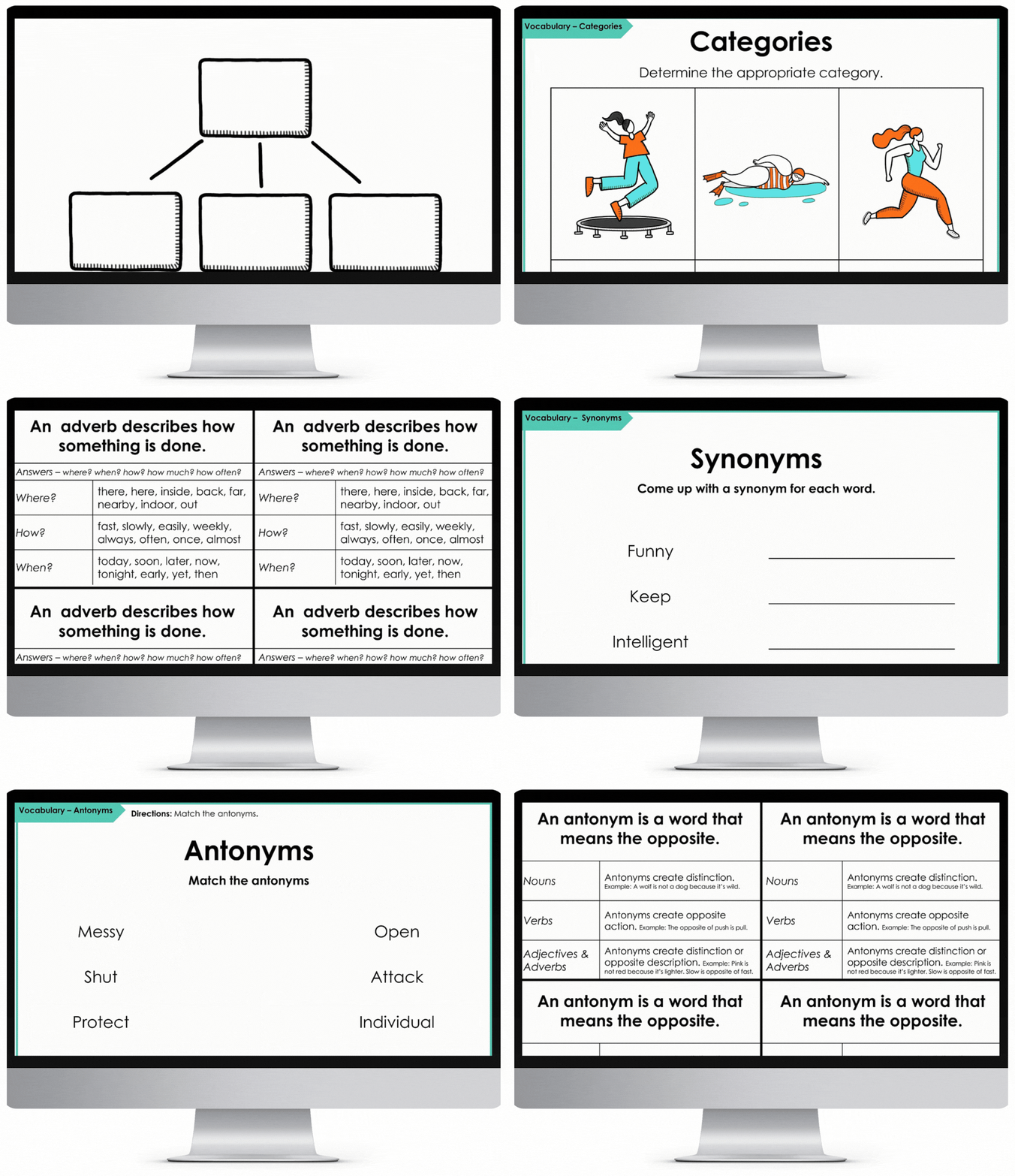
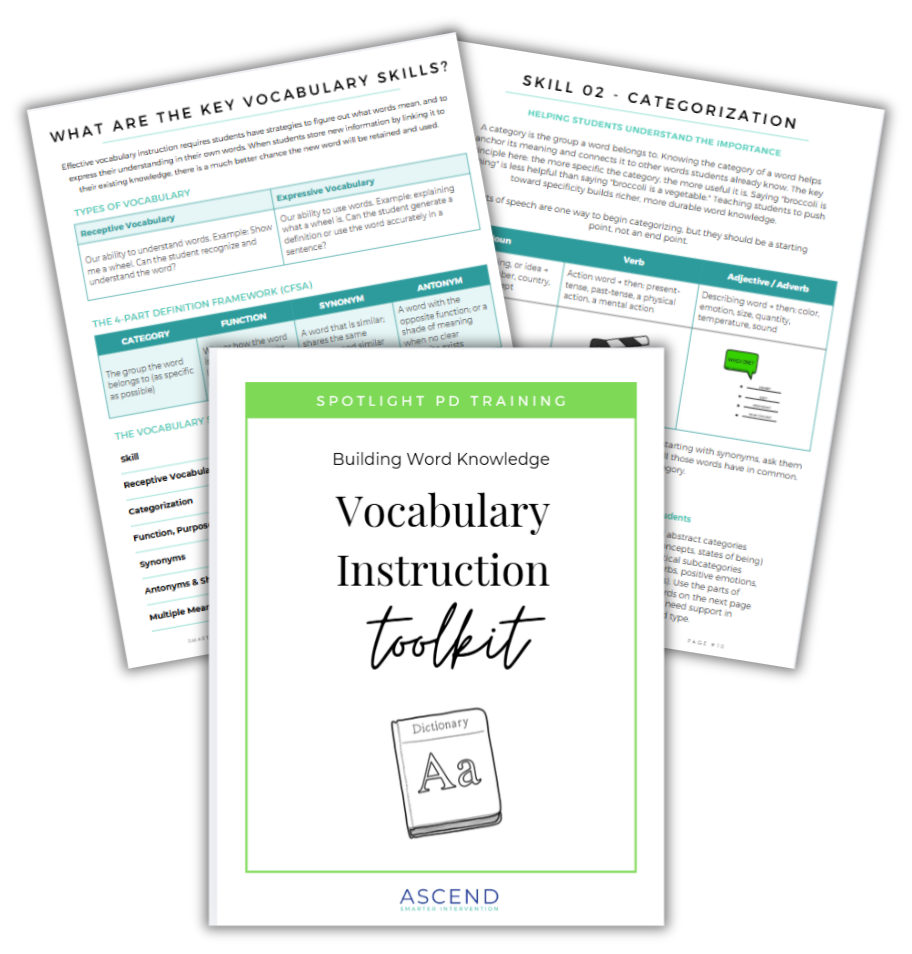
👆 Just some of the resources included in the Vocabulary Instruction Toolkit!
Get a Sneak Peek at the Vocabulary Instruction Toolkit
The toolkit is what you'll reach for after the training is over. It's organized around six vocabulary skills, which means you can use the sections that fit your students right now and return to the rest as you're ready. It's not a curriculum. It's a system you can build into whatever instruction you're already doing.
Here's a look at what's inside:
Skill 01: Receptive Vocabulary
This tool instantly identifies which words need the most instructional time and builds the metacognitive habit of noticing what you do and don't know. Includes a downloadable Receptive Vocabulary Rating Scale and the Vocabulary Bookmarks reference resource.
Skill 02: Categorization
Students learn to identify what group a word belongs to and to push toward specificity. The more specific the category, the richer the word knowledge. Includes the Categories Lesson Activities, and the Vocabulary Parts of Speech Task Cards to support students who need help identifying word type.
Skill 03: Function, Purpose, and Features
This is the "why and how" step, the part of a definition that distinguishes one word from another in the same category. Includes Function, Purpose and Defining Features Activities, and the Vocabulary Graphic Organizer Function Card.
Skill 04: Synonyms
Synonyms are the anchor that makes writing richer. Includes Synonym Development Activities and the Vocabulary Graphic Organizer Synonym Card.
Skill 05: Antonyms and Shades of Meaning
This section helps students determine whether a word has a clear antonym (same category, opposite function) or requires a shade of meaning instead (same category, similar function, different in a specific and important way). Includes Antonyms Activities and the Vocabulary Graphic Organizer Antonym Card.
Skill 06: Multiple Meanings and Vocabulary in Context
This is one of the most directly transferable vocabulary skills for comprehension. Includes the Vocabulary in Context Graphic Organizer and Activities, plus the Full-Page CFSA Organizers for classroom reference.
Measuring Vocabulary Ability
Five concrete data points for tracking vocabulary growth, including the Rating Scale, category generation accuracy, definition framework completion, synonym/antonym accuracy, and context application, with clear guidance on how to use that data to drive your instruction.
Print what you need. Use what fits. Return to sections as your instruction grows.
This training is for you if…
→ You work with students who can decode but still struggle to understand what they read
→ Your vocabulary instruction feels inconsistent or hard to fit in, and you know it matters
→ You want a framework that works across grade levels and content areas without requiring a separate curriculum
→ You're looking for something practical you can start using in your next lesson, not a program overhaul
→ You support students with limited print exposure who need more intentional vocabulary development
This training is especially helpful for:
Educators in intervention settings, where structured, explicit instruction is critical and equally applicable in general education classrooms, for teachers who want to strengthen how foundational skills connect to real reading. The routine you’ll learn works across grade levels (K through 12, and yes, well past first grade) and settings (general education classrooms, intervention, small groups, and one-on-one instruction).
This training is not:
This training is not a fit if you're looking for a comprehensive vocabulary curriculum. It's a framework and a toolkit, designed to fit inside the instruction you're already doing, not replace it.
What to Expect
When you complete this training, you'll walk away with a clear understanding of why vocabulary instruction matters, not as a general statement, but as a specific piece of how students access meaning from print. You'll have a four-part framework you can start using the same day. And you'll have a toolkit full of resources that are ready to print and use, organized around the six vocabulary skills that matter most.
This won't feel like another initiative. It's a process that fits into what you're already doing, with a routine that becomes more natural the more you use it.
If we haven’t met...

I’m Corey, and I’ve spent over 20 years working directly with students (including those with significant reading difficulties) in both clinical and classroom settings. My background is grounded in cognitive development and learning research, and I’ve spent my career translating evidence-based practices into clear, usable instruction for educators.
This training isn’t theory alone. It’s built from what has been used, tested, and refined with real students. And this approach has been shared with over 100,000 educators worldwide who are working to make literacy instruction easier, more connected, and more effective for their students.
You’re in the right place if:
→ You want a vocabulary routine that students can use across different classes, subjects, and settings
→ You're looking for research-aligned instruction that finally shows you how it fits into your day
→ You want tangible tools you can share when parents, colleagues, or administrators ask how you're building these foundational skills
Frequently Asked Questions
-
This framework is designed to work alongside whatever vocabulary instruction you already have in place. If your curriculum provides word lists, you can use the CFSA framework to build on them. If you pull words from your texts, this gives you a consistent process for teaching them. It adds structure. It doesn't replace what's working.
-
Yes, and this is exactly what the training is designed for. The framework integrates into phonics instruction, read-alouds, and content-area lessons. You do not need a dedicated vocabulary time to use it effectively.
-
Yes. The training includes specific guidance on differentiating for students who need receptive scaffolding first, meaning you do more of the generating, and students practice recognizing and rating. The approach scales down as well as up.
-
The six-skill vocabulary framework applies across grade levels. The entry points shift (concrete and familiar words for younger students, abstract and academic vocabulary for older ones), but the framework is the same.
-
You’ll get instant access after purchase. Log in to your dashboard, and everything (the training and the downloadable guide) will be ready for you right away.
-
A professional development certificate is automatically emailed to you upon completion of a short quiz at the end of the training.
-
On-demand training courses are for individual use only. For school-wide access, please contact us for group pricing.
-
We’re confident you will love this training, but if you’re not fully satisfied, you can request a full refund for up to 7 days, no questions asked.
Give Your Students a Process for Word Knowledge That Moves With Them.
When students have a framework for vocabulary, a real process they can use independently, vocabulary instruction stops being a box to check and starts being the bridge between decoding and comprehension, it was always meant to be.