Before Choosing a Literacy Intervention, Ask These 2 Questions
If you work with struggling readers, it can be tempting to start your intervention support by asking:
What should I use?
Specifically, what program should I use? Which group should this student go into? Where should I start teaching?
Those are important questions, but they probably aren't the first questions we need to answer.
Because there is no single literacy intervention that is going to meet every student's needs every time. Students who are struggling with reading aren't necessarily struggling for the same reason, and they aren't always working toward the same type of goal.
Before we decide what instruction should look like, I like to step back and ask two questions.
Question 1: What does this student's literacy profile look like?
We often have a lot of data.
You may have access to universal screening scores, benchmark assessments, reading levels, fluency score, previous progress-monitoring data, IEP goals, maybe even a diagnostic evaluation.
But more data doesn't always make the instructional decision feel easier.
So rather than trying to analyze everything at once, I like to start much more simply:
Is this student currently meeting the reading target we expect for their grade level?
If the answer is yes, they may not need additional literacy intervention at all. If the answer is no, then we need to figure out where the breakdown is occurring. That's where I generally start with two pieces of information.
Start with universal screening data
Universal screening gives us an initial sense of who may need additional support. Depending on your setting, that might come from a district screener, benchmark assessment, standardized measure, or another tool your school already uses.
At this point, I'm not necessarily trying to diagnose the student's exact reading difficulty.
I'm simply asking:
Is this student meeting the target, approaching it, or falling below it?
That helps us identify who may need a closer look.
Then, listen to the student read
This is the piece I don't want to skip. I want to hear the student reading connected text aloud. I'm paying attention to their rate and accuracy, but I'm also listening to the way they approach the text.
Are they reading automatically?
Are they stopping to sound out a lot of words?
Are they guessing?
Are they accurate, but have slow and effortful reading?
What happens when the text becomes more difficult?
Universal screening gives us one view of performance. Oral reading gives us another. Together, those first two pieces of information help us answer an important initial question:
Does this student appear to need additional support?
The Caseload Snapshot I use actually begins with these same two steps: Screen using universal screening data, and Observe through listening to their oral reading.
After I’ve made the determination that a student does, in fact, need additional support, I want to get to the most important instructional question.
What kind of support does the student need?

This is where I want to know whether the primary difficulty is related to:
Word recognition
the student's ability to accurately and efficiently read the words on the page,
Language comprehension
the student's ability to understand the language, vocabulary, sentences, and ideas,
or both.
A student who has strong language comprehension but struggles to accurately decode words needs different support than a student who reads the words accurately but doesn't understand what the text means.
And a student who struggles in both areas is going to need support in both.
This is the same basic profile represented in the Simple View of Reading. In the framework we use, students generally fall into one of four groups:
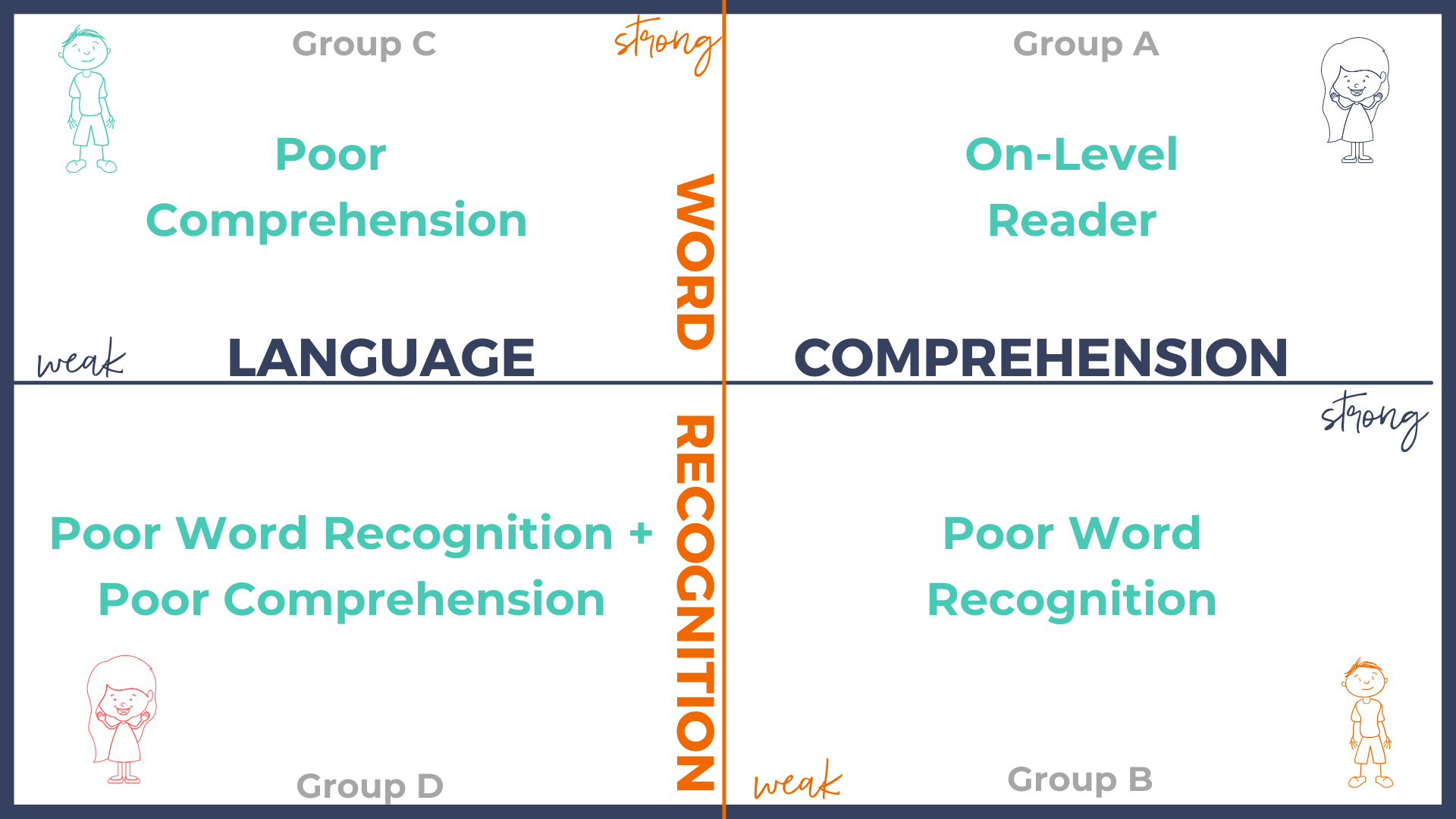
Group A: Word recognition and language comprehension are both relatively strong.
Group B: Word recognition needs support.
Group C: Language comprehension needs support.
Group D: Both word recognition and language comprehension need support.
The goal isn't to give students a label, but to use the information to help us know exactly what to target.
Because “below benchmark” doesn't tell us what to teach.
It simply tells us that we need to look closer.
Once we understand whether the breakdown is primarily in words, meaning, or both, we can make much more targeted choices about instruction. Then we can move into question 2.
Question 2: What are we trying to accomplish, and by when?
Even once we know what a student is struggling with, we still need to ask:
What is the actual goal of this intervention?
Not every student who has a literacy difficulty needs the same intensity, duration, or type of support.
For example, a student who has strong decoding skills and strong comprehension but reads more slowly than expected may need a shorter-term, highly targeted intervention designed around an isolated fluency difficulty.
A student who has substantial gaps in foundational word-recognition skills and is several years below grade level is probably going to need a much more sustained instructional plan.
Those students may both appear on a list of “struggling readers,” but we're not trying to accomplish the same thing with each of them.
So the question is:
What are we trying to do, and by when?
That's an important question because students working toward sustained progress in foundational reading skills need a very different plan from students working on one isolated area.
So before choosing an intervention, I want to know:
What specific skill or skills need support?
How significant is the gap?
What outcome are we working toward?
How much instructional time do we have?
How will we know whether the intervention is working?
Now we're in a much better position to make an instructional decision.
You don't need every possible data point before you begin
Now I know that assessment can get overwhelming quickly. The answer isn't necessarily to give every student every assessment we have access to before instruction can start.
We want to collect enough information to make the next good decision.
I start broadly with the first question:
Who might need support?
Then I listen to all of my students to make sure I’m not missing anything:
What does their reading actually sound like?
If the student is showing difficulty, I identify:
Is the breakdown primarily in word recognition, language comprehension, or both?
Then, for the students who need it, I can dig deeper into the specific skills involved, summarize what we know, group students with similar instructional needs, and monitor whether they are responding.
That's the progression we use as part of our Data to Decisions process: Screen → Observe → Identify → Dig Deeper → Summarize → Group → Monitor.
And importantly, not every student needs to move through every step. If a student isn't flagged through universal screening or oral reading, that can be a pause point. They can continue receiving strong Tier 1 instruction while we reassess later to make sure they’re continuing to progress as expected.
The goal is not more data. It's better instructional decisions.
Assessment is only helpful when it changes what we do next. I don't want to collect data simply because I’m supposed to collect data.
I want to be able to look across my caseload and answer:
Who needs support?
What kind of support do they need?
What are we trying to accomplish?
And what instruction gives us the best chance of getting them there?
Once those questions are clear, choosing an intervention becomes significantly easier.
Want to map this across your own caseload?
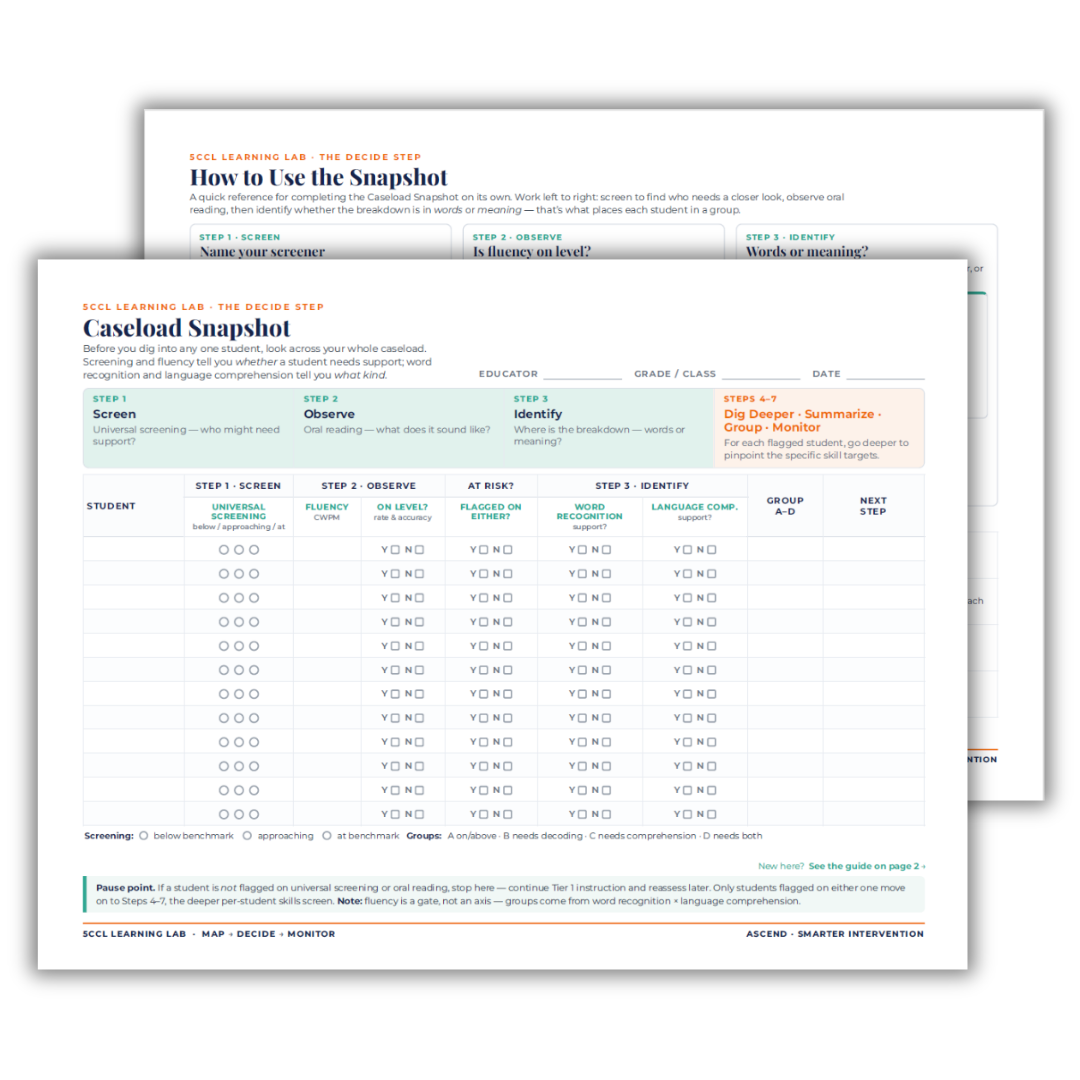
I created a free Caseload Snapshot to help you organize these first decisions across your students.
You'll have one place to record universal screening information, oral reading fluency, whether a student appears to need support with word recognition and/or language comprehension, their instructional group, and the next step you want to take.
Download the Free Caseload Snapshot →
You don't need to solve every student's entire reading profile at once.
Start with the students in front of you, collect the information that helps you make the next instructional decision, and build from there.