
Hey there!
Today, we wanted to share a quick intervention tip on using a Phonological Awareness strategy to support spelling.
Syllable & phoneme segmenting and how they support spelling
When we break words into syllables, we are creating chunks. So, for example, in the word alligator, we are breaking the word up into al - lig - a - tor.
Then, once we have a word in chunks, we want to break it up further into sounds (aka phonemes). We like to do this by having students use chips or a manipulative, but if you don’t have them, you can simply have a student draw lines on a piece of paper or whiteboard for each sound they hear.
Then, they need to attach letters (or letter groups) to the sound block. You can check out the video below to see this in action with single-syllable words.
Now, if you have a student or students spelling longer words, you would start by:

1. Segmenting the word into syllables
Start by having the student break the word into syllables. In the picture, you see two scoops for the syllables in the word “railroad.”
2. Segmenting each syllable into sounds.
Once you have your word in syllables, segment each syllable into sounds as you see in the picture. Then, students should identify what makes each sound. For older or more advanced students, you can begin to pull in affixes here as well.
You can see this in action by watching the video at the bottom of the page!
Auditory Discrimination will also play a big role in students’ abilities to spell.
Auditory discrimination, or the ability to hear the differences between sounds, will impact students’ ability to correctly identify which sounds they are hearing in the word. For example, if students struggle with differentiating between /b/ and /p/, then they may struggle to spell words like bear/pear, pin/bin, etc.
We like to practice auditory discrimination as part of a phonological awareness drill or warm-up.
Final Thoughts:
When students struggle with spelling, the answer isn’t always more practice with word lists. Sometimes, they need more support hearing the individual sounds in words and connecting those sounds to the letters they write. A few intentional minutes of phonological awareness practice can help build that connection.
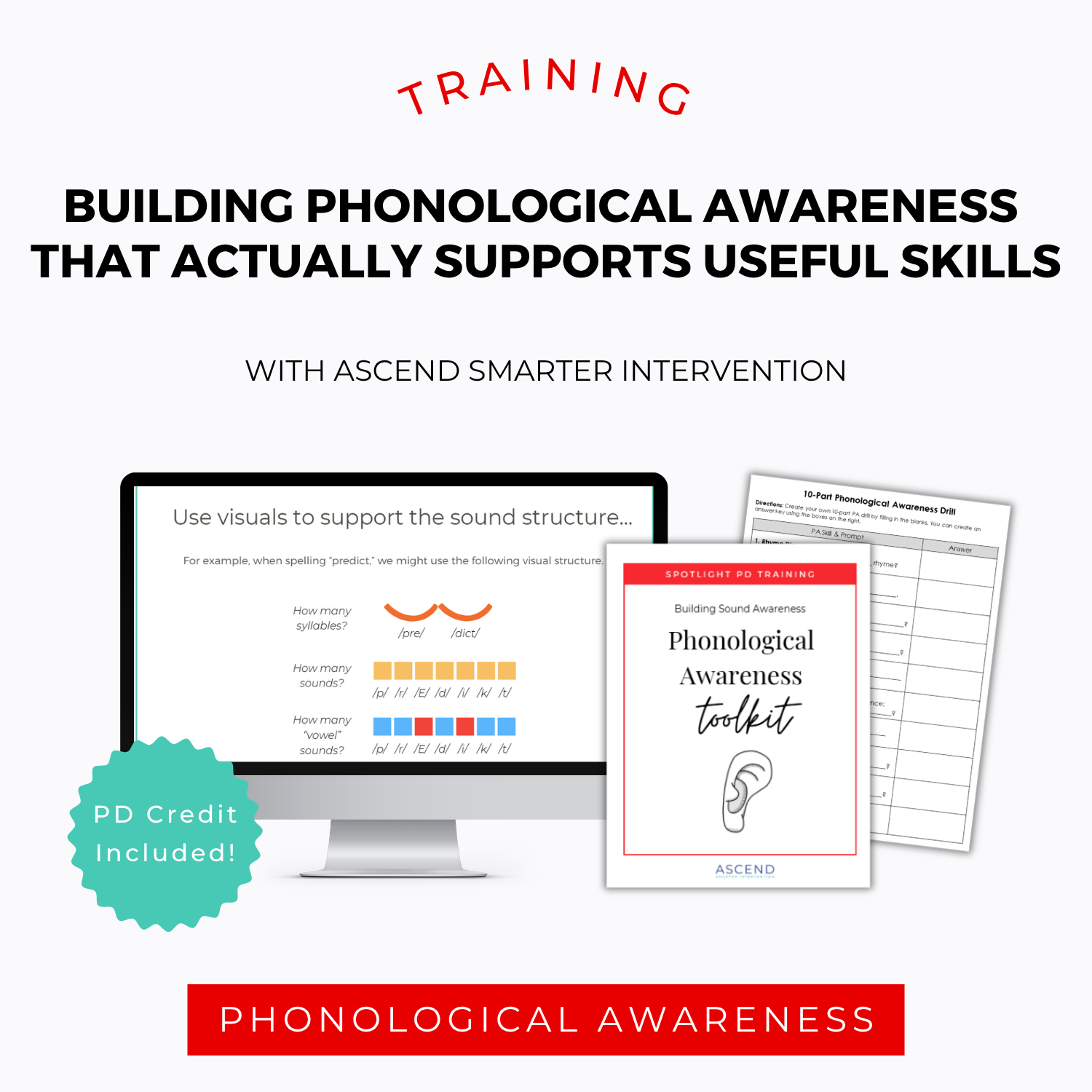
If you’d like a clearer plan for bringing these skills into your instruction, our on-demand training, Building Phonological Awareness that Actually Supports Useful Skills, walks you through the key skill areas, how to choose what to target based on student needs, and how to connect sound work to reading and spelling. You’ll also get practical materials to use with your students, including an editable 10-Part PA Drill, task cards, games and activities for differentiating instruction, progress-monitoring records, grade-level benchmarks, and guides for connecting phonological awareness to reading and spelling. The training includes a real-student demonstration, and you can revisit it whenever you need a refresher.