How to Build Comprehension Skills for Secondary Students
If you have middle or high school students who are struggling with comprehension, you are absolutely not alone. Comprehension is such a complex skill, and many students don’t have a clear strategy to help them dig deeper into text. The good news is that comprehension is a skill that can be developed.
The important thing to keep in mind is that we are looking to build routines so that students know when to use each of the different strategies. It’s great to teach how to find the main idea and key details, and to teach how to make inferences and predictions, but it’s even more important that they know how everything fits together so they can actually use these strategies independently.
So what exactly does that look like?
We use what we call the Universal Language Comprehension Routine when we work with secondary students (and honestly, this approach works well for elementary students as well!).
What is the Universal Language Comprehension Routine?
This is the routine we follow each time we engage with a new text. It includes three primary steps or phases, and we call it the “3 Across and 5 Deep” Strategy.
Three across, meaning these three steps or phases, and then 5 deep for the five levels of comprehension we work through after reading a text.
Step 01 - Before Reading
This step includes all of our pre-reading strategies, including vocabulary preview, syntax and sentence structure preview, and background knowledge activation.
Step 02 - During Reading
This step occurs while reading, where we focus on annotations (taking effective notes), as well as self-monitoring for decoding and vocabulary.
Step 03 - After Reading
This step occurs after reading, where we take the information we gained from our text and start to engage with that information. We work through the “5 Levels of Comprehension,” which is where the 5 Deep strategy comes into play. The five levels include:
Level 1 - Recalling Information (Direct Recall)
Level 2 - Organizing Information (Sequencing & Main Idea)
Level 3 - Connecting Information (Text connections, compare & contrast, cause & effect)
Level 4 - Making Leaps (Inferences & Predictions)
Level 5 - Analyzing Information (Moral, Author’s Purpose, Key Takeaways, etc.)
How can I incorporate the Universal Language Comprehension Routine into my instruction?
You can incorporate this routine into any text that students are working through. Let’s walk through step-by-step!
Step 01 - Before Reading
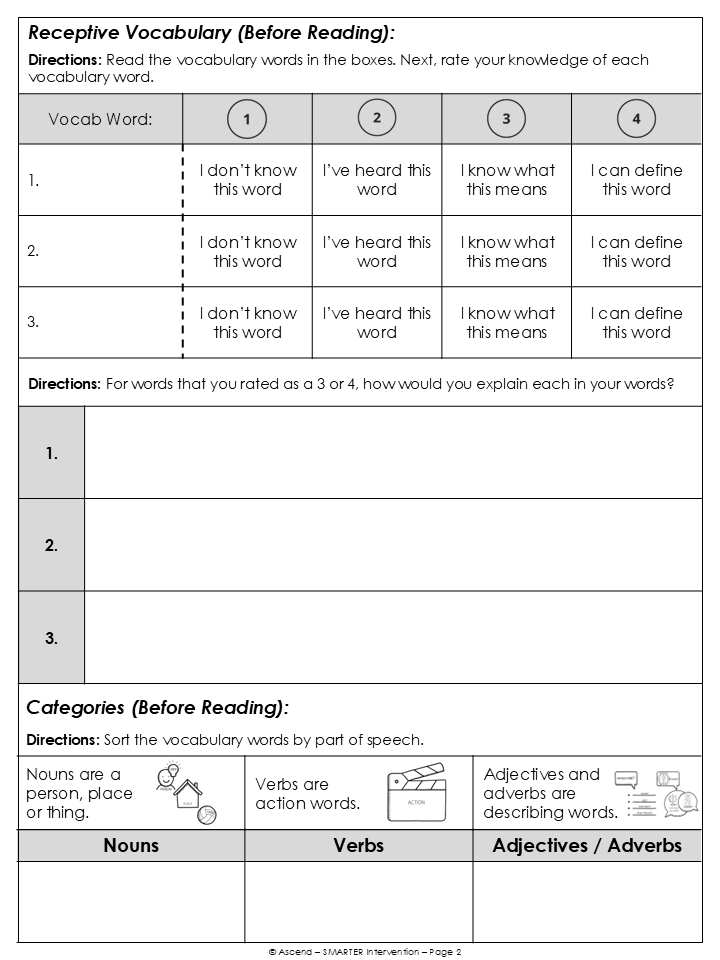
Select three vocabulary words from the text that you want to discuss before digging into the article, chapter, etc. These could be words that are bolded in the text, come from an index or glossary, or just seem like words that might be good to discuss!
Have students rate their knowledge of each word from 1 - I don’t know this word, 2 - I’ve heard this word but don’t know what it means, 3 - I know what this means, but I’m not sure I can define it, to 4 - I can define this word.
Have students write their definition of words they rated as a 3 or 4.
Have students sort the three words into noun, verb, or adjective/adverb (they can leave the word out altogether if it doesn’t fit into one of these three categories.
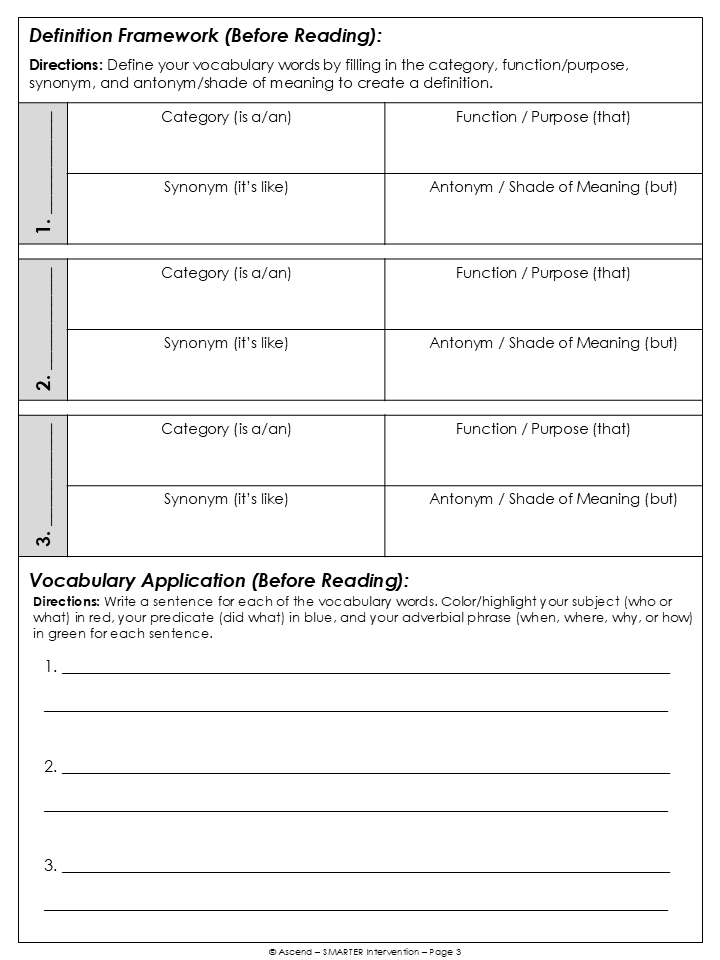
Talk through each of the words using the lens of the “Vocabulary Definition Framework,” where you start with a category, move into a function/purpose/features, provide a synonym, and an antonym or shade of meaning. You can learn more about exactly what this looks like here!
Have students use each word sentence and then identify the subject (who or what), predicate (did/does what), and adverbial phrase if present (when, where, why, how). We have students color-code these to make it more engaging and, honestly, more effective. We use red for the subject, blue for the predicate, and green for the adverbial phrase/clause, and always keep that scheme consistent.
At this point, you are done with the initial vocabulary work.
The point of this is to get students used to using an effective framework for explaining their knowledge, and then also making sure that they understand the nuance of the word's meaning. It can be incredibly effective to have students share their own responses because often students create different categories, functions, synonyms, and antonyms/shades of meaning, which is where the richness of vocabulary and communication can be developed!
Finally, we move into the background knowledge section of the Prereading Process.
7. Have students identify the author/source of the information and determine familiarity and credibility of the source. This can absolutely be a conversation because they may be unfamiliar or unsure.
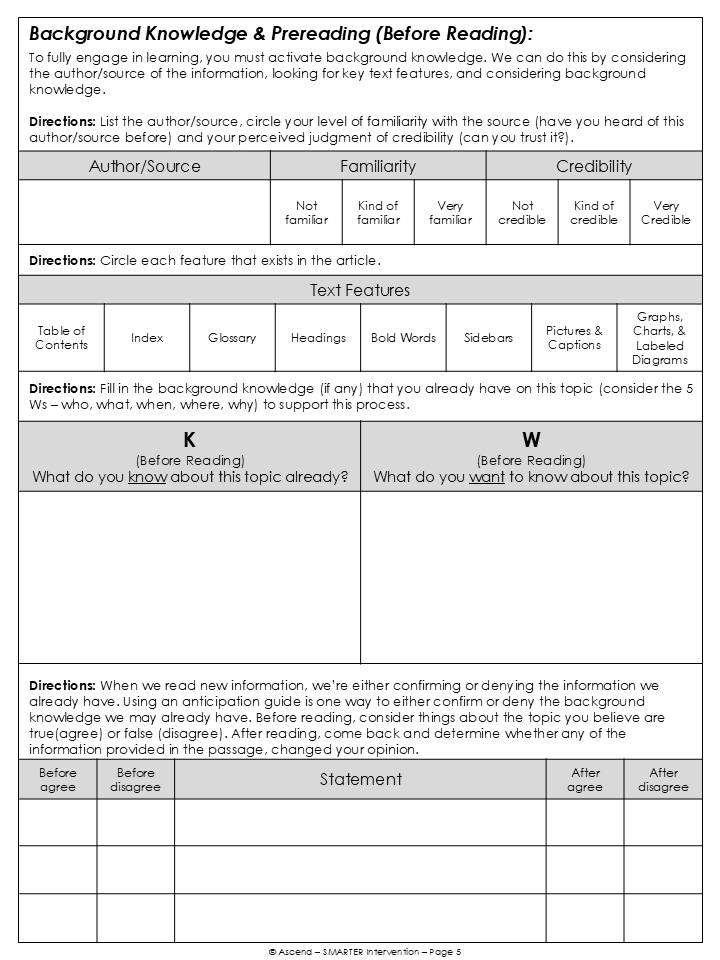
8. Have students look for any text features that exist (table of contents, index, glossary, headings, bold words, sidebars, pictures, captions, graphs, charts, diagrams, etc.)
9. Have students write down or discuss things they know about the topic based on predictions of what the passage/article may be about after reviewing the author/source and any relevant text features. We often have students find a few sentences within the text as well to make effective predictions about the content.
10. Have students write down or discuss things they want to know, wonder about, or think might be important to look for as they’re reading the text.
11. Work together as a group to write down three statements about the content that may or may not be true based on previous knowledge of the topic. This is called an anticipation guide. After reading, students can come back to see whether they have any additional thoughts or knowledge on those statements.
Step 02 - During Reading
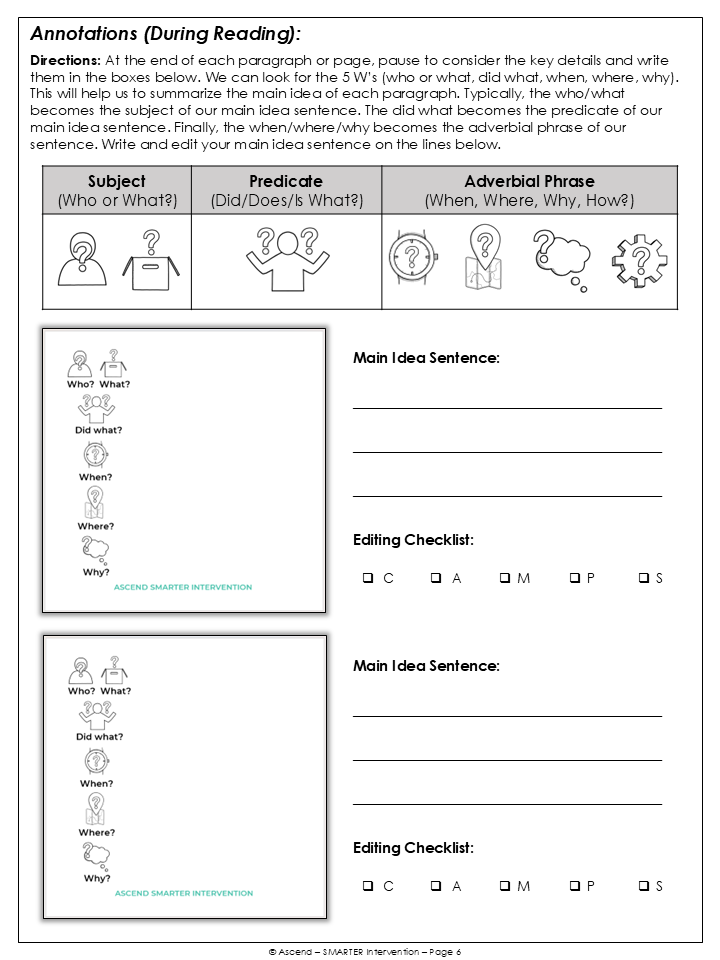
The most important thing for students to consider while reading is whether or not they are retaining the information. We want them to focus on pulling relevant information from the text (to maintain attention) and also to self-monitor whether there are words getting in the way of comprehension (either because they can’t read the word or because they don’t know what the word means).
Have students pause at the end of each paragraph or page to note down the 5 Ws (who or what, did what, when, where, why). Not all of these 5 Ws are present on every page, but this is how we’re focusing attention. After each paragraph or page, we are trying to organize that information into a main idea sentence (who or what, did what, when/where/why/how).
Have students complete the self-monitoring checklist at the end of each paragraph or page:
Do I understand what I am reading? Yes/No
Underline the words I don’t know the meaning of
Circle the words I cannot sound out/decode
That’s it! While reading, we really just want to make sure we’re maintaining attention to what we’re doing and thinking about whether we’re actually gaining information or just reading words on a page.
Step 03 - After Reading
This is where we reflect on everything we’ve just done to put the pieces together.
Have students review their annotation sticky notes for key details and information that supports Level 1 Comprehension Processing = direct recall!
Have students organize their sticky notes in sequential order, which helps them remember what information occurred where in the text (nothing is worse than reading an article and wanting to go back to a specific concept and not being able to find it! The sticky notes solve that problem!) They can also use those sticky notes to create an overarching main idea for the passage (who/what, did what, when/where/why/how).
Then have students connect the information back to what they already knew or other information that may be similar/different (compare/contrast). They can also think about the cause-and-effect relationships within the text itself.
Next, have students make inferences or predictions based on a combination of their connections and the direct recall information from the text.
Finally, have students analyze key takeaways, including whether or not that information matches what they already knew, adds something different, and how they can synthesize the information.
That’s it!
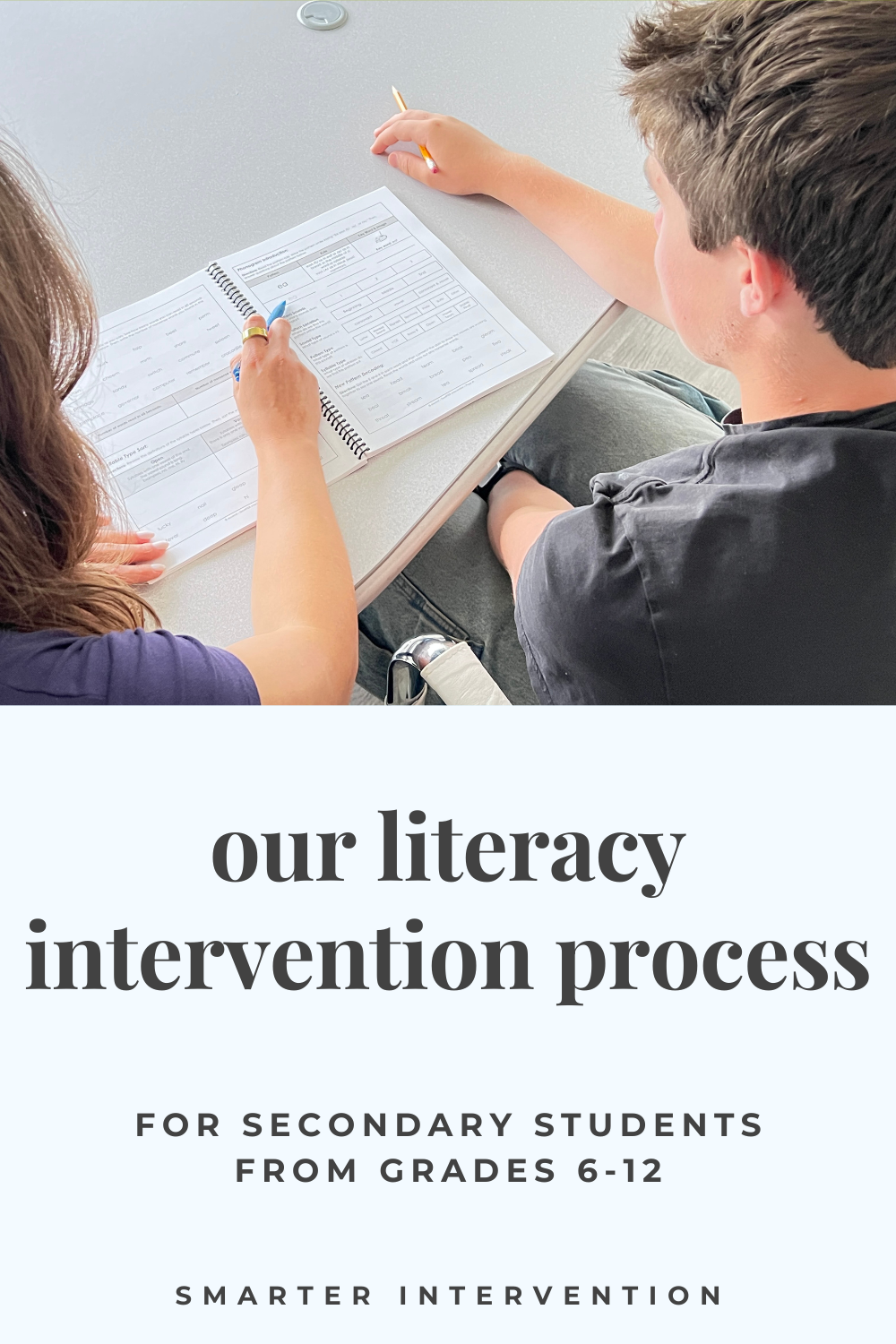
As you can see, it’s all a building process!
And it becomes a game-changer because it’s something that students repeat over and over and over until that neural network becomes solid.
They know what to do first, next, and last every time they come to a text where the goal is comprehension.
If you want to learn more about how we support Secondary Students, check out our free Spotlight Professional Development Training, “Delivering Effective Secondary Literacy Intervention: The 5-Step Framework for Grades 6-12.”
Inside the training, we walk through our 5-Step Process for supporting students at the secondary level, and you can learn exactly how we design and deliver effective literacy lessons for middle and high school students.
We also share some example lessons that are already completely done for you, so you can see what this framework we just walked through looks like in action! You don’t want to miss it!