Executive Functioning: Perseverance

When we think about perseverance, we often think big.
Overcoming major challenges. Pushing through obstacles. Sticking with something even when it’s hard.
While that framing isn’t necessarily wrong (I mean, that is perseverance), it can be unhelpful when we’re supporting students who are struggling to stay engaged with everyday academic tasks.
For many students, difficulty with perseverance is not a matter of willpower or motivation. It’s a mismatch between the demands of the task and their current ability to sustain attention.
Perseverance Is Often an Attention Skill
Within our 5-Step Executive Functioning Framework, perseverance fits most closely within Step 03: Attention.
In practice, perseverance often reflects:
How long a student can sustain focus
How much cognitive effort they can tolerate at one time
Whether they have strategies to stay engaged when a task is challenging or uninteresting
When we ask students to “just persevere” without considering their current attention capacity, we may be asking them to do something they are not yet developmentally or cognitively ready to do.
A Running Analogy
(because it matters, and if you know me, you know I honestly can’t help it…)
If someone is brand new to running and their long-term goal is to complete a half-marathon, I could take them out on a ten-mile run on day one and tell them they need to “persevere” to reach their goal.
They would likely become overwhelmed, lose motivation, and begin to associate running with failure. And who could blame them? So, we don’t do that. Instead, we build stamina gradually.
We start with intervals:
Run for 2 minutes
Walk for 1 minute
Repeat
Over time, those running intervals get longer as endurance improves. The same principle applies to attention and perseverance.
Perseverance Requires Training Attention Stamina
Students vary widely in their ability to sustain attention.
Some students can maintain focus for 45–60 minutes at a time. Others may be able to focus for 10 minutes, 5 minutes, or maybe even just 1–2 minutes.
This doesn’t mean we will need to stay here; we obviously need to be able to attend for longer than a minute or two eventually. They are simply starting points that we can grow from.
Perseverance develops when we:
Identify a student’s current attention stamina
Set expectations that match that capacity
Gradually increase the length of focus intervals over time
What This Looks Like in Practice
Rather than asking students to persevere indefinitely (which would be like me asking you to go for a run with me but not telling you how long or far we were going), we can support them by:
Using visual timers to define clear start and stop points
Breaking tasks into short, manageable focus intervals (what is the very specific goal of this interval?)
Allowing brief, planned breaks between intervals (we use this one to build in time for movement ALL the time!)
Gradually increasing focus time as stamina improves
Tools like the Pomodoro technique work well for this reason. Students know:
How long they are expected to focus
That a break is coming
That the task has an endpoint
This predictability reduces cognitive load and increases follow-through. Just like when I am doing speedwork, I need to know how long I need to “struggle through discomfort,” and I need to know that a break is coming!
Shifting the Narrative Around Perseverance
When students struggle to persevere, it’s easy to assume that they don’t care, they aren’t trying, they lack grit, etc.
But more often, the issue is that the task requires more sustained attention than they currently have the capacity for.
When we reframe perseverance as an attention skill that can be developed over time, we reduce shame, increase motivation, and create more realistic pathways for growth, which helps them feel better and more confident about their ability and more willing to try.
Perseverance is not about pushing harder. It’s about building stamina, one interval at a time.
Want a simple way to support this process?
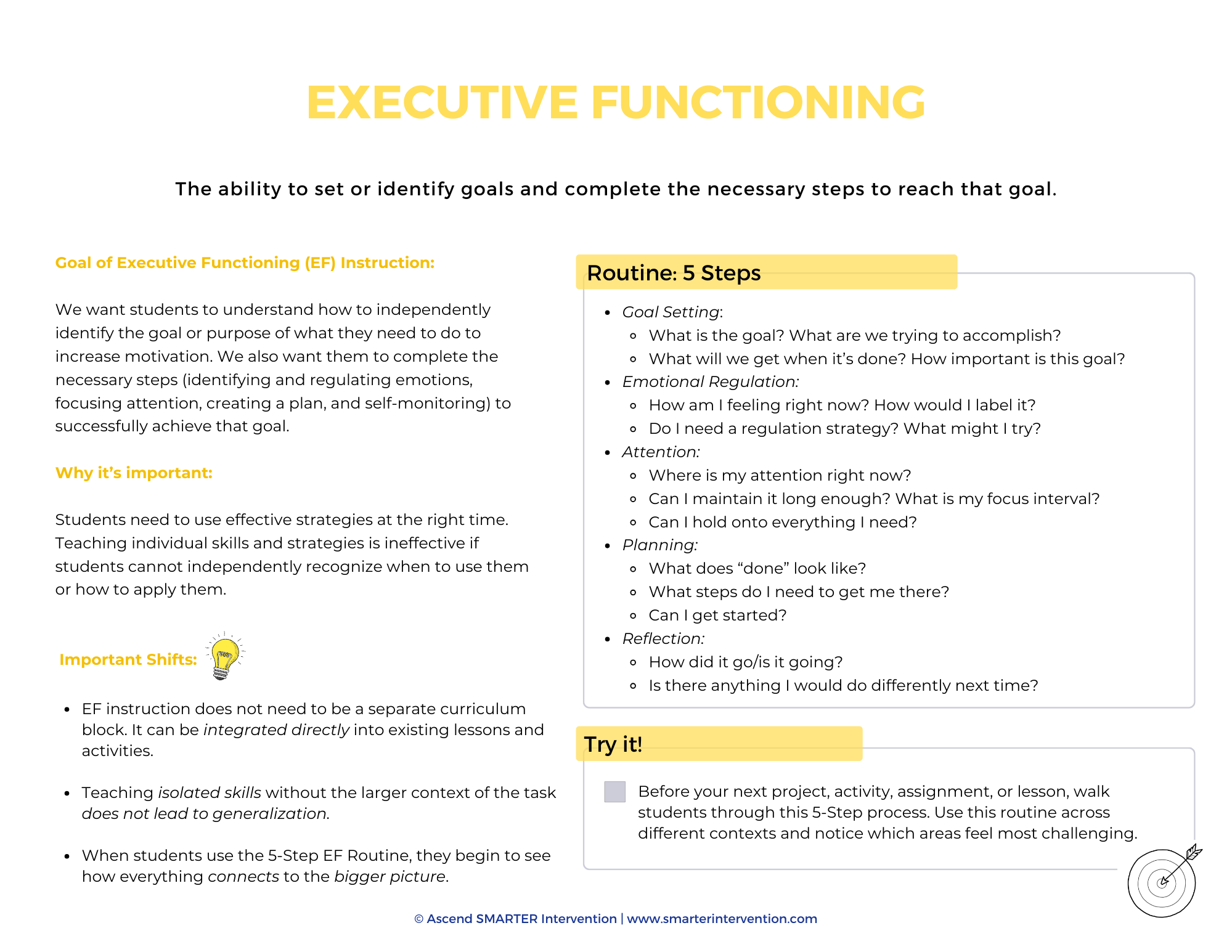
Check out our FREE Executive Functioning Routine!
In this guide, we:
Break down goal setting, emotional regulation, attention, planning, and reflection into steps
Explain the importance and goal of including EF in your instruction
Provide simple steps and prompts you can use with your students
This routine is designed for educators who are ready to take this knowledge into practical, grounded implementation.