Executive Functioning: Flexibility

Planning is essential for success. But planning alone is not enough. Even the best plans sometimes fall apart.
Materials are missing. Time runs out. Instructions change. A strategy doesn’t work the way we expected.
What determines success in those moments is not how well a student planned, but how well they can adjust.
That skill is called flexibility.
What Is Flexibility in Executive Functioning?
Flexibility refers to a student’s ability to:
Adjust plans when circumstances change
Shift strategies when something isn’t working
Consider alternative solutions
Adapt thinking without becoming stuck
Flexibility is not about being easygoing or compliant. It is a cognitive skill that allows students to respond productively when expectations and reality don’t match.
Where Flexibility Fits in the EF Framework
Within our 5-Step Executive Functioning Routine, flexibility lives primarily in Step 5: Self-Monitoring & Reflection. Flexibility is activated when students ask:
Is this plan working?
Do I need to try something different?
What are my options now?
In this way, flexibility connects directly back to planning. Plans are meant to be used, not followed rigidly. Especially when something isn’t working out the way we’d expected.
Why Students Struggle With Flexibility
Many students experience difficulty with flexibility because they rely heavily on routines for predictability, they have limited tolerance for uncertainty, they interpret change as failure rather than feedback or they lack experience generating alternative plans
When flexibility is underdeveloped, students may:
Shut down when something goes wrong or refuse to shift strategies. They may become emotionally dysregulated or persevere with ineffective approaches. This is not stubbornness. It reflects a need for explicit instruction and modeling.
Teaching Flexibility as a Skill (Not a Personality Trait)
Flexibility is often framed as something students should have: “Just be flexible.” But like all EF skills, flexibility must be taught, practiced, and supported. Effective instruction focuses on normalizing that plans change (you can even model, “oh, that didn’t work out like I expected!”). You can help students learn to separate effort from outcome. You can teach students how to generate alternatives (you can even model a Plan A and Plan B). You can help students reflect without shame. Flexibility develops when students learn what to do after a plan breaks down.
What Flexibility Looks Like in Practice
In classroom settings, flexibility can be supported by helping students practice:
Acknowledging the situation
What changed?
What isn’t working right now?
Regulating emotional responses
How is this making me feel?
What do I need to do to stay engaged?
Problem-solving
What are my options?
What can I try next?
Who can I ask for help?
Perspective-taking
Is there another way to look at this?
How might someone else approach this situation?
These steps help students move forward rather than get stuck.
Flexibility Is Not the Absence of Structure
It’s important to clarify that flexibility does not mean abandoning routines or expectations.
In fact, strong structure often makes flexibility possible. When students have clear goals, defined steps, and predictable routines, they are better equipped to adjust when something goes off course. Flexibility works with planning, not against it.
Reframing Setbacks as Information
When plans don’t work out, it’s easy to feel like it’s our fault, and it’s easy to step into shame. But when we can start to look at this in a different light, we can just see it as “information” instead of a failure. We want to make sure we take time to reflect. Reflection questions might include:
What part of the plan didn’t work?
Why do I think that happened?
What might I change next time?
This reframing builds resilience without relying on vague encouragement like “well, at least you tried.”
Want a simple way to support this process?
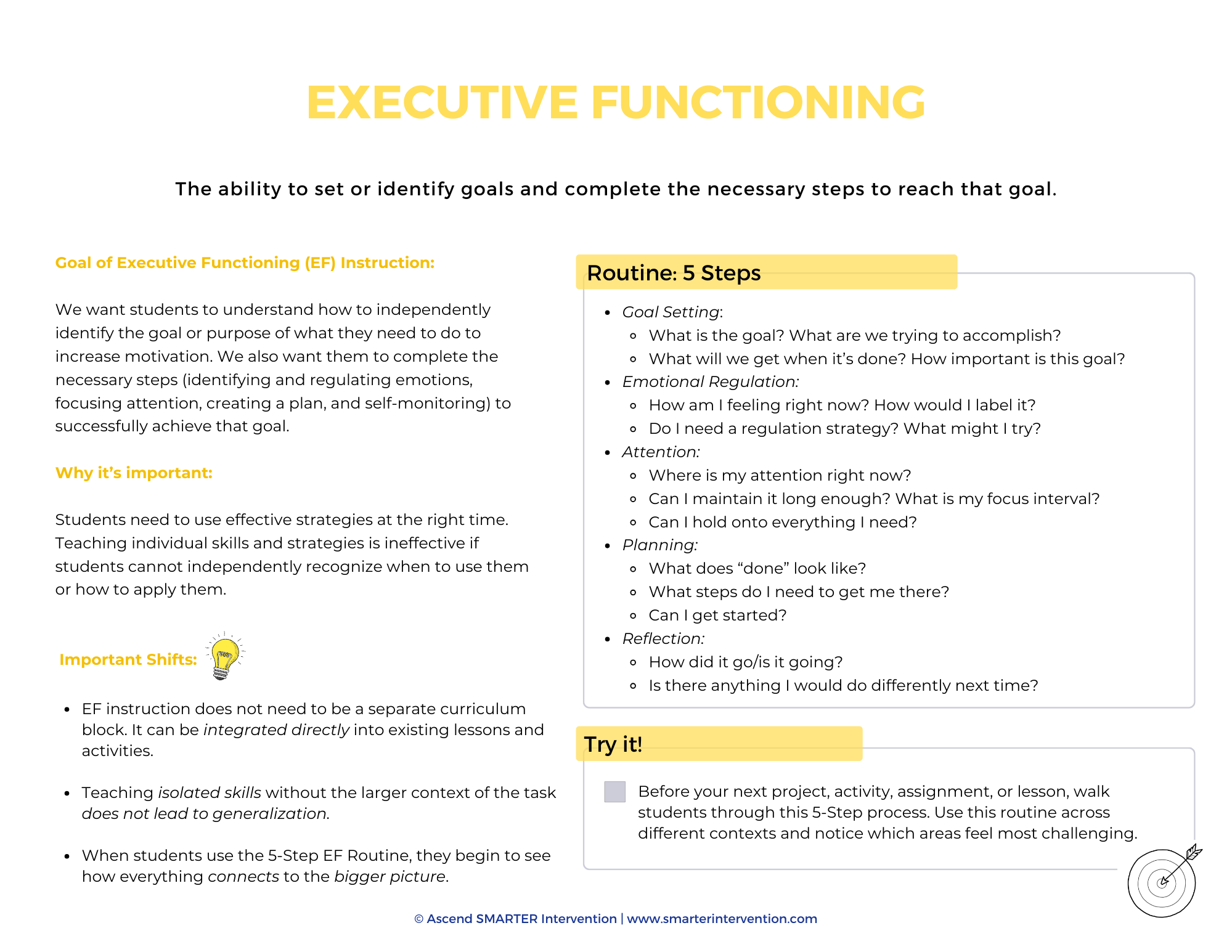
Check out our FREE Executive Functioning Routine!
In this guide, we:
Break down goal setting, emotional regulation, attention, planning, and reflection into steps
Explain the importance and goal of including EF in your instruction
Provide simple steps and prompts you can use with your students
This routine is designed for educators who are ready to take this knowledge into practical, grounded implementation.