Knowing What You Know and What You Don't Know - EF: Metacognition

There is nothing more frustrating than putting a tremendous amount of effort into something, only to have it not go well.
I remember being in college and preparing for an exam in a general education physics class. Physics did not come naturally to me, but I was confident in my ability to learn the material. For the first test, I studied for 46 hours. That may sound like an exaggeration, but at no point could I confidently say, “I am ready for this test.” I just kept rereading my notes, making new lists, and creating charts, hoping something would eventually click.
I took the test and truly couldn’t tell how it went. When I received my grade, I had earned a 42.
I was stunned. The score did not reflect the effort I had put in. When I asked my professor for help, she asked a simple question: “What exactly are you confused about?”
I had no answer.
I couldn’t pinpoint what I understood and what I didn’t. Without that awareness, she had no way to help me.
The skill I was missing wasn’t intelligence or work ethic. It was metacognition.
What Is Metacognition?
Metacognition refers to our ability to assess our own knowledge. It is knowing:
What we understand
What we don’t understand
Where we need to redirect our attention for success
This skill is a critical part of executive functioning because it allows students to monitor their thinking, adjust strategies, and seek help in meaningful ways.
When students lack metacognition, they often:
Overestimate or underestimate their understanding
Study inefficiently
Struggle to ask for specific help
Believe effort alone should equal success
The Four Cognitive States of Learning
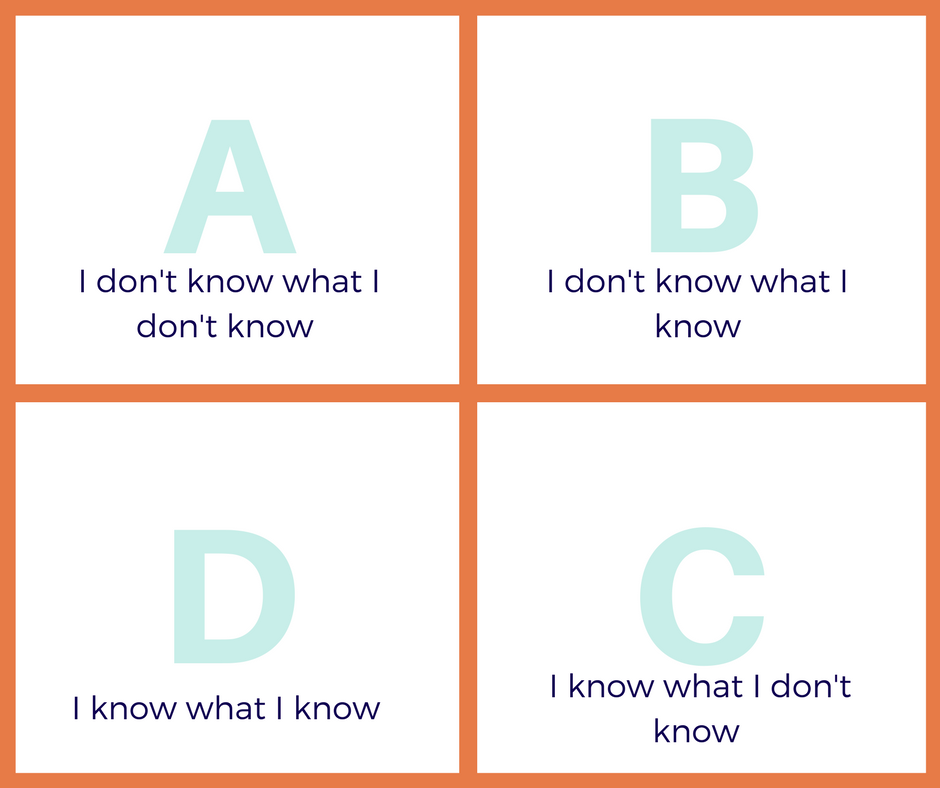
When learning something new, students typically fall into one of four cognitive states:
A. I don’t know what I don’t know
This is a common starting point when a concept is new. While it’s not a problem to begin here, students need support moving out of this stage in order to make progress.
B. I don’t know what I know
In this stage, students may have understanding but lack confidence. They second-guess themselves and struggle to demonstrate mastery consistently. Or they study for hours when they already know the material, which becomes a time-management nightmare.
C. I know what I don’t know
This is a powerful place to be. When students can articulate what they don’t understand, they can ask specific questions and receive targeted support.
D. I know what I know
This reflects true understanding and confidence. Students can explain concepts, apply them flexibly, and teach others.
The most productive learning happens when students move between C and D. If I had been able to identify which physics concepts I didn’t understand, I wouldn’t have spent 46 hours studying inefficiently. I could have sought targeted support and used my time far more effectively.
Why Students Struggle With Metacognition
Metacognition does not develop automatically. Many students:
Assume understanding because something “looks familiar”
Don’t recognize confusion in the moment
Lack routines for checking their understanding
Equate time spent with mastery
This is why students often say, “I studied so much,” and are shocked by poor outcomes.
Effort matters. But accurate self-awareness matters just as much.
Ways to Support Metacognition in Instruction
Some strategies we regularly use to support metacognition include:
Asking students to highlight or flag words, steps, or ideas they don’t understand while reading
Using graphic organizers to work through processes step by step, making breakdowns visible
Having students use rating scales to indicate their level of understanding (e.g., we do this all the time with our vocabulary rating scale, 1 = this might be a nonsense word; 2 = this is a real word, but I don’t know what it means; 3 = I know this word, but can only partially explain it; 4 = I know this word and can explain it)
A useful prompt is:
“How do you know that you know this?”
For example, a student confident in long division might say:
I can accurately answer the practice problems
I understand why the steps work
I can explain the process to someone else
After an assessment, students can compare their performance to these indicators and reflect on where the breakdown occurred. This process helps separate content gaps from issues like anxiety, attention, or strategy use.
Metacognition Within the EF Framework
Metacognition plays a unique role in executive functioning.
It helps students:
Notice when attention is breaking down
Recognize when strategies aren’t working
Reflect on progress and adjust plans
For this reason, metacognition connects closely to both attention and reflection within the 5-Step EF Framework.
Want to support this process with a simple, student-friendly tool?
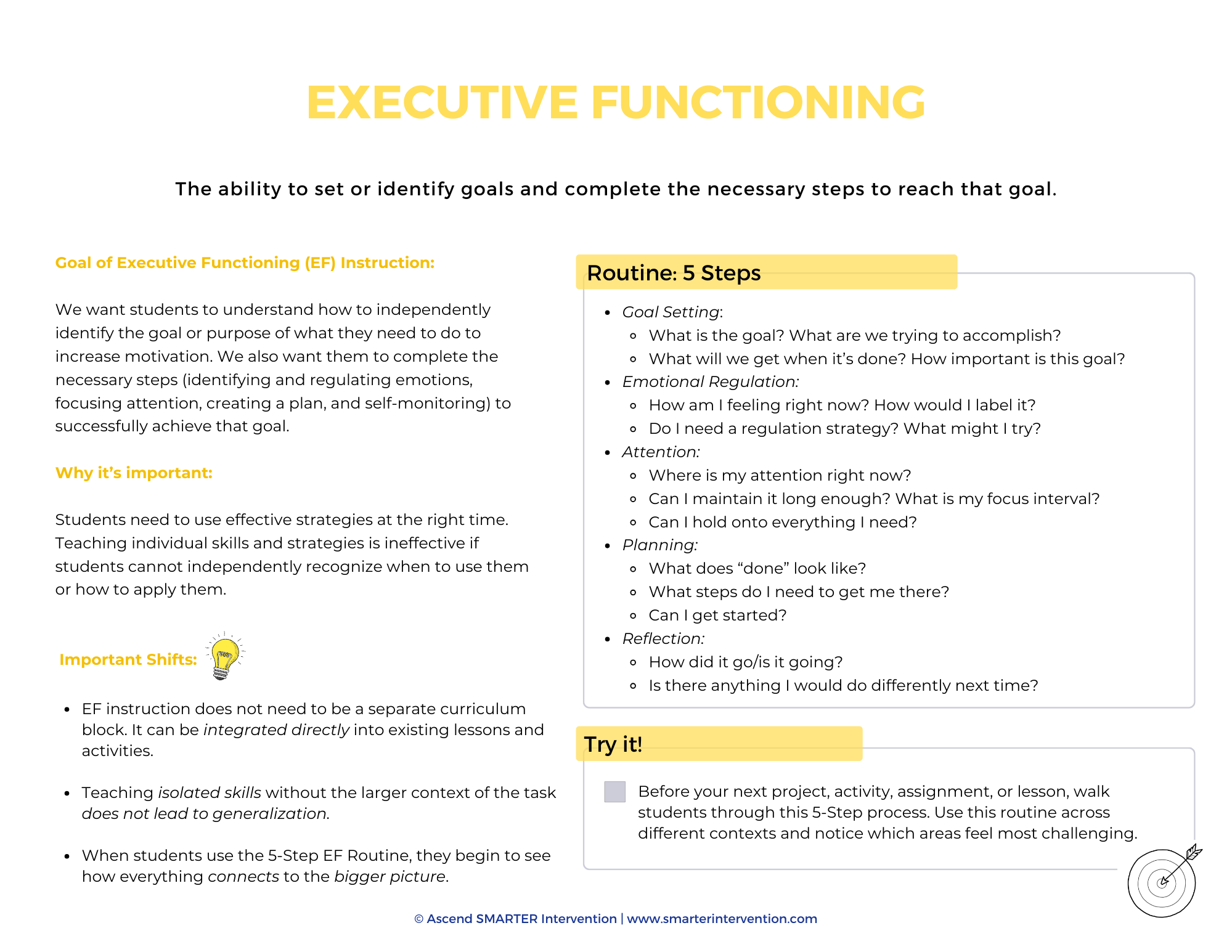
Check out our FREE Executive Functioning Routine!
In this guide, we:
Break down goal setting, emotional regulation, attention, planning, and reflection into steps
Explain the importance and goal of including EF in your instruction
Provide simple steps and prompts you can use with your students
This routine is designed for educators who are ready to take this knowledge into practical, grounded implementation.