
Receptive and expressive language skills play a large part in how we communicate with other people. Students with expressive/receptive language disorders face a number of challenges in school. It is estimated that 1 in 20 students has some type of language disorder. These students are often working overtime to cope with their challenges and can go undetected or misunderstood.
What is it?
Receptive language refers to the ability to understand information.
It includes understanding the words, sentences, and meaning of what other people say or what is read.
Expressive language refers to…
…the ability to put your own thoughts into words and sentences, in a way that makes sense and is grammatically accurate.
Difficulty with one or both of these areas could signal a language disorder. Challenges in these areas would also make it hard for a student to find the right words and form clear sentences when speaking. Understanding what another person is saying may also be hard – such as when directions are given.
3 ways to build receptive and expressive language skills in the classroom
Model the desired behavior.
When the child answers a question with a one-word sentence, you can respond by modeling back with a full, correct sentence, so that the child hears the words in the correct order. By modeling and scaffolding this for students, you can help them work their way up to producing a correct, full-sentence response.
Give choices.
Instead of asking your child open-ended questions, you can ask either-or questions, so your child has to choose the correct one.
Plan ahead.
When you can, let the student know in advance that they’ll be called on. This gives them more time to compose their thoughts.
Red Flags:
You may notice that a student’s vocabulary is very basic, and their sentences are short, grammatically incorrect, or incomplete. While their friends can chat and tell jokes, this student may have trouble following the conversation and may miss the jokes. They also may speak in two-word sentences and have trouble answering even simple questions. A language disorder is not generally associated with a cognitive disorder.
Bringing Vocabulary to Life
Helping students understand language and express their ideas takes more than introducing new words. They need opportunities to think about what words mean, connect them to familiar concepts, and practice using them in their own speaking and writing. A simple, consistent routine can make those opportunities easier to build into the instruction you’re already doing.
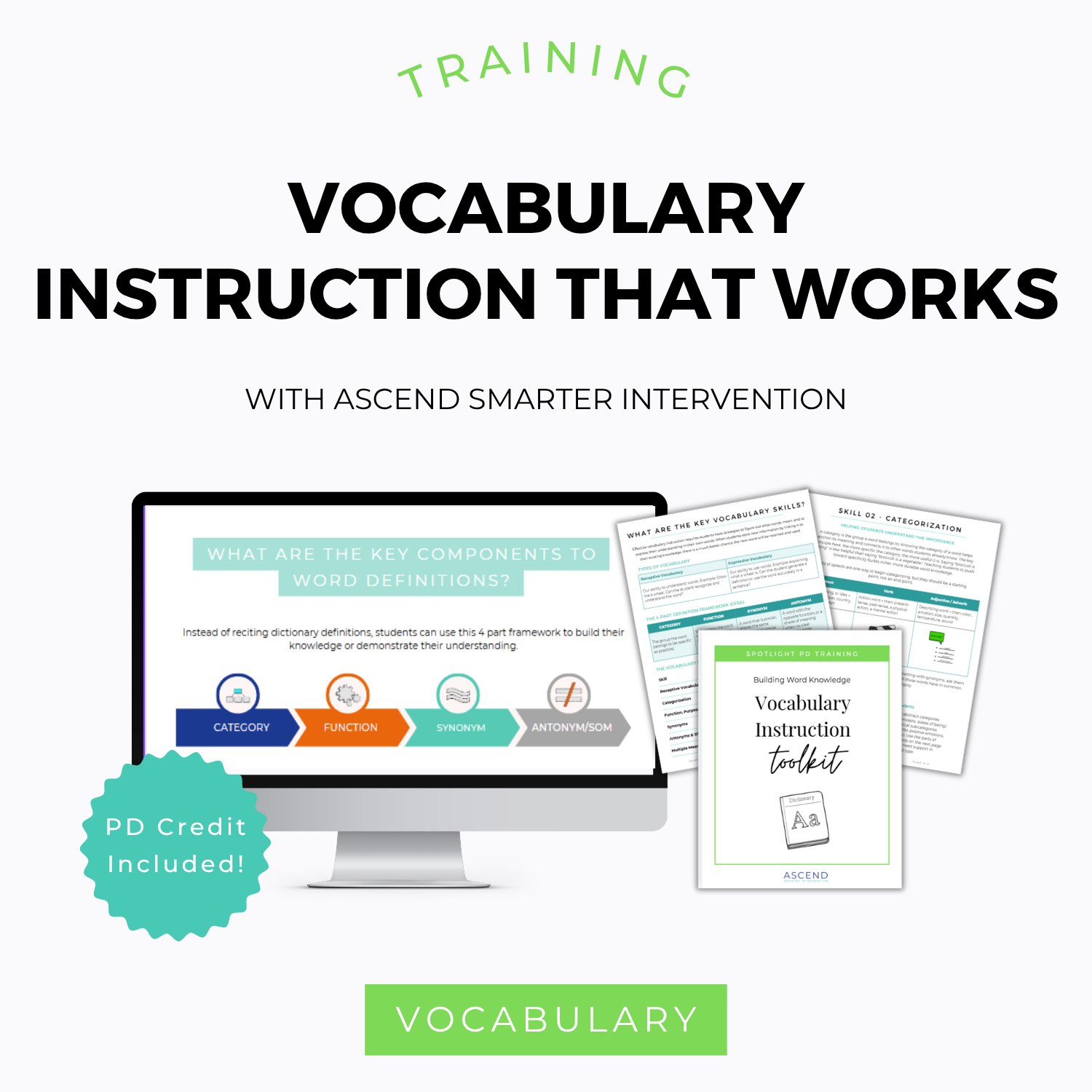
Our on-demand training, Vocabulary Instruction That Works, gives you a practical four-part framework for teaching word meanings: Category, Function/Purpose/Features, Synonym, and Antonym. You’ll learn how to use the framework to support both receptive vocabulary (understanding words) and expressive vocabulary (using words to communicate), with strategies you can adapt to your students’ needs.
The training also includes ready-to-use vocabulary activities to help you put the framework into practice, plus a one-hour PD certificate and lifetime access to the training and materials. You’ll come away with a repeatable routine and resources to help students build word knowledge they can use in the classroom and beyond.