
I'm sure we've all been there… in the middle of a lesson and our student says, "but I already know this!"

Can you relate?
In every lesson we complete, we start at the sound level and work up from there. This allows us to build a solid foundation, fill in any holes and gaps students may have in their phonics knowledge, and show students how the English language comes together.
…it can also mean that students will question why they have to do something they believe they already know.
It is important that we understand why we complete tasks like the sound drill and can explain that, so students can buy into the work we are doing.

Let's jump in.
What is a sound drill?
A sound drill (or phonogram drill, as you may have heard it called) is when you provide students with a visual of a letter and ask them what sound(s) it makes.
You can do this with individual letters or other phonograms. When we work on morphology, we like to add affixes and roots into our sound drill rotation as well.
Why is a sound drill important?
The reading brain is made up of three processors. You can read more about these >>here.<<

In order to read effectively, these three processors need to activate and connect in less than half a second. The sound drill strengthens the connection between the orthography (visual) and phonology (sound) processors.
This is helpful for a few reasons.
1- The sound drill builds sound-level fluency
As you work through the sound drill, the goal is for students to see a phonogram and produce the sound as quickly as possible. This builds automaticity that supports students' decoding abilities. This means that even if students know the letter sounds, there is likely room to build their fluency here.
2- The sound drill primes the brain to read
To read, students have to look at the letters within a word and know what sounds they make. The more complex the patterns in a word are, the more important orthographic recognition and this sound-symbol knowledge become.
For example…
The word "cat" has three sounds, /k/ /a/ /t/. To decode this, students need to see the three letters and associate each with the appropriate sound.
If the word is "catch," students need to be able to quickly recognize the "tch" and know that it says /ch/. Otherwise, they are going to get caught up trying to sound this word out as /k/ /a/ /t/ /k/ /h/, which isn't possible.
Then, if we add a suffix like "es," students need to recognize that "es" sounds like /iz/.
The faster students can recognize these sounds in the sound drill, the easier it is for them to identify them in context. Even if students know these patterns, we still complete the sound drill to build automaticity and to "warm up" the brain for reading.
So you may be asking…
How do I fit the Sound Drill into my lessons?
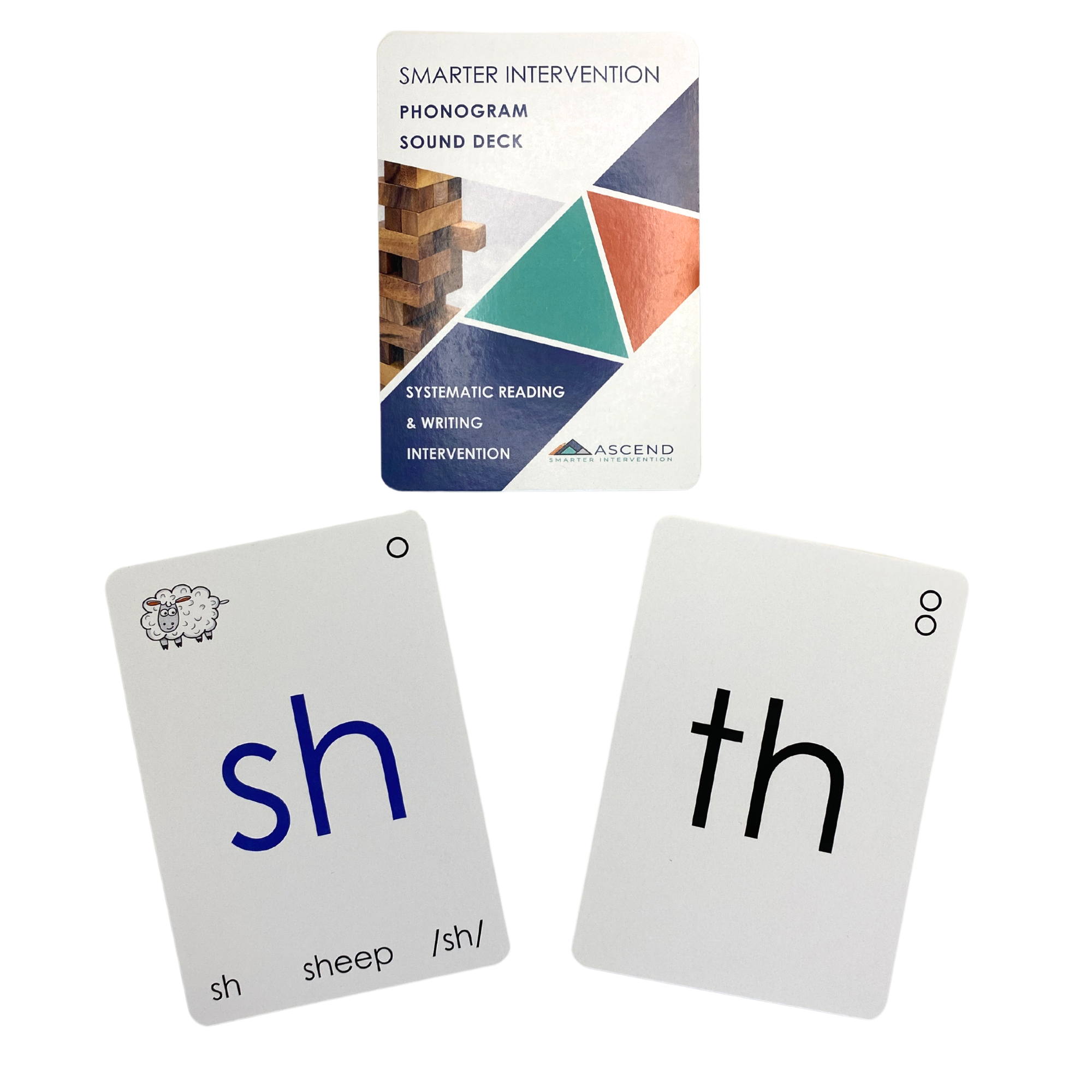
After we complete our phonological awareness drill (you can read more about that >>here<<), we complete the sound drill.
This is something we do in every lesson before asking students to read.
Depending on your student, how many patterns they have learned, and how much support they need, this task can look a bit different.
Usually, we will pull sound drill cards like >>these<< based on patterns that students have already learned. These are great because one side has the phonogram/affix in black and white. If students need a visual cue, you can flip the card over and find a color-coded version of the phonogram/affix and a key image.
As students become more automatic with these patterns, we will cycle them out so that the phonogram drill doesn't get too long. We prioritize patterns we know students struggle with to optimize the time spent on this activity. Every few weeks, we add patterns back in to check for retention.
Typically, we will provide students with anywhere from 10-30 prompts. This should take just a few minutes at the start of your lesson.
While this task appears simple, it has a far-reaching impact. Our students need explicit and repeated practice relating letters to sounds. The sound drill helps prime students' brains for reading by supporting a strong sound-symbol knowledge foundation. It is important that we also do this for writing. You can learn more about how we build sound-level automaticity and prime the brain for writing >>here.<<
Why Sound Drills Matter
Even when students can tell you the sounds a letter or phonogram makes, they may still need practice recognizing those patterns quickly and consistently. That’s the purpose of a sound drill: to strengthen those connections so students can spend less time figuring out individual patterns and more time reading and spelling words. The key is knowing what to review, how to keep the routine efficient, and how to help students carry those skills into real reading and writing.
If you’d like to take a closer look at how sound drills fit into effective phonics instruction, our on-demand training, How To Teach Phonics So It Actually Sticks, walks you through a four-level framework for moving from introducing a pattern to applying it in reading and writing.
You’ll also receive the Phonics Instruction Toolkit, with phonics rule guides, phonogram drill cards, syllable-type anchor charts and manipulatives, morpheme drill cards, Pattern Find application activities, phonics word lists for progress monitoring, and a Build a Phonogram Lesson template to help you plan lessons without starting from scratch. The training includes a one-hour PD certificate and lifetime access, so you can revisit the framework and materials whenever you need them.
To see a sound drill in action, check out the video below!