
The Biggest Intervention Tragedy: Not Applying Skills

Okay, so maybe the word tragedy is a bit hyperbolic…
But it certainly can feel upsetting when we spend so much time working on developing skills with our students, and then they don’t apply or generalize those skills to other contexts.
Honestly, one of the questions we hear more than almost any other is:
“Why aren’t my students using the skills they’re learning?”
They can decode the word lists. They can apply the rule during intervention. And then… none of it seems to show up anywhere else.
If that’s been your experience, we want to say this first, very clearly:
This is not because your instruction is the problem. And it’s not because your students aren’t trying.
We know, because we’ve been there too.
There was a season in our own work when we were doing everything we had been trained to do. We were following structured literacy approaches carefully. We were honoring the research. We were being intentional and systematic. And on paper, our students were making progress.
But something still felt off.
Students were getting better at isolated skills, yet they weren’t really reading in the way we hoped. They weren’t taking what we were practicing and using it independently in their classrooms. A few even told us, very honestly, that what we were doing didn’t feel like “real reading.”
That comment stuck with us.
At the time, we didn’t fully understand what they meant. We were teaching phonics. We were teaching spelling. We were doing what we knew was evidence-based. And yet, students would make gains during intervention only to stall once that block ended.
Eventually, we had to pause and ask ourselves a hard question:
What if the issue isn’t the skills we’re teaching, but how those skills are living (or not living) beyond our lessons?
When Skills Stay Isolated, Students Get Stuck
What we began to see was that many of our students weren’t struggling because they lacked effort or ability. They were struggling because they didn’t yet understand how the pieces fit together.
They were learning patterns and rules, but they weren’t always shown how those patterns show up in real texts. They could read a word list successfully, but when faced with a passage, everything suddenly felt harder.
Not because the passage was “too hard,” but because the connection hadn’t been made explicit.
Orthography and phonology were there, but semantics often stayed in the background. Decoding lived in isolation, instead of being clearly tied to meaning, content, and purpose.
And without that connection, skills didn’t stick.
Generalization Doesn’t Happen Automatically
One of the biggest misconceptions in literacy instruction is that if a skill is taught well enough, students will naturally apply it everywhere else.
Sometimes that happens. Often, it doesn’t.
Skill transfer requires intention. Students need help seeing that what they’re doing in intervention matters beyond the lesson itself. They need repeated opportunities to apply skills in meaningful contexts and explicit support to bridge that gap.
This is especially true for students who sit in that in-between space, students who have skills, but not yet consistency. Students who don’t need (or no longer need) highly intensive intervention, but still aren’t fully independent readers in the classroom.
These are often the students who frustrate us the most, not because they aren’t capable, but because we can see how close they are.
Shifting From “More Practice” to “More Connection”
What changed our instruction wasn’t adding more drills or more time in intensive intervention. It was shifting how we thought about application.
We started asking, “How does this skill show up in real reading?”
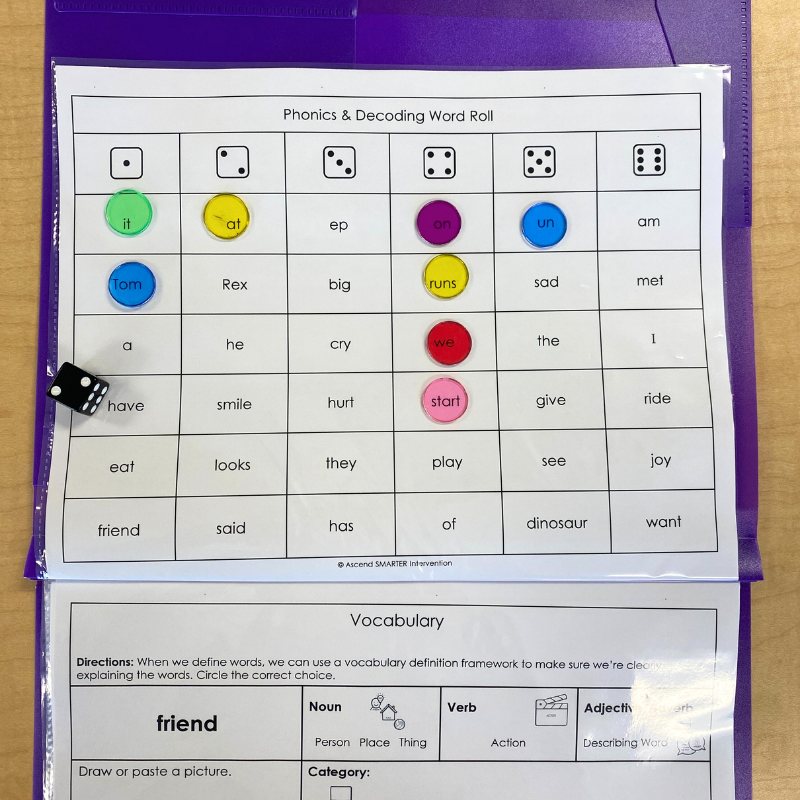
We became much more intentional about tying phonics to passages, vocabulary to content, fluency to meaning, and comprehension to something students actually cared about reading.
When skills were consistently connected to purpose, something shifted. Students began to see themselves as readers, not just students completing literacy tasks.
Seeing Bridge Support in Action
Help students move beyond practicing skills in isolation and start applying what they learn to real reading and writing with Fast 5 Lessons, a structured approach designed to make every minute of literacy intervention count.