
How to Create a Study Schedule For Your Child

As we get further into the school year, more and more tests are going to start popping up in your child’s classes. We often get questions about how to help them prepare, and one of the best pieces of advice we can give you is to create a study schedule.
Far too often, we see children waiting until the night before a test to start reviewing, causing undue stress. By getting into the habit of chunking (breaking down the workload into smaller, more manageable pieces), you can not only help your child get through their tests now but also set up better study habits for the rest of their lives.
This is the schedule that we have seen to be most effective. First, look at your calendar or your child’s agenda and find the day of the test. You are going to start here and work backward. The night before the test, you do not want your child to be studying anything new. Reserve this night for a quick review and a good night’s sleep.
Then, break it down into manageable chunks and work as far back as your child needs. For example, if your child has a science test on Friday on chapters 1, 2, and 3, on Thursday night, you should be doing a quick review. On Wednesday night, he or she should study Chapter 3, on Tuesday night study Chapter 2, and on Monday night study Chapter 1. You can break up any subject this way, even if it is not by chapters.
If it is a spelling test at school, start on the day of the test, do a review the night before, and then break it down into a few words a night and work your way backward as far as your child needs. This allows them to learn over time and avoids cramming the night before the test.
We strongly recommend that you or your child **write this schedule down**, whether it be in the child’s planner/agenda, or on a family calendar. This helps keep him or her accountable and makes the idea of chunking much more concrete than if he or she tried to do it in his or her head.
These planning and study skills are especially helpful as your child gets older and the material is more in-depth. However, by starting this practice early, it becomes a good habit that your child will have as they progress through school.
Want to take these strategies further?
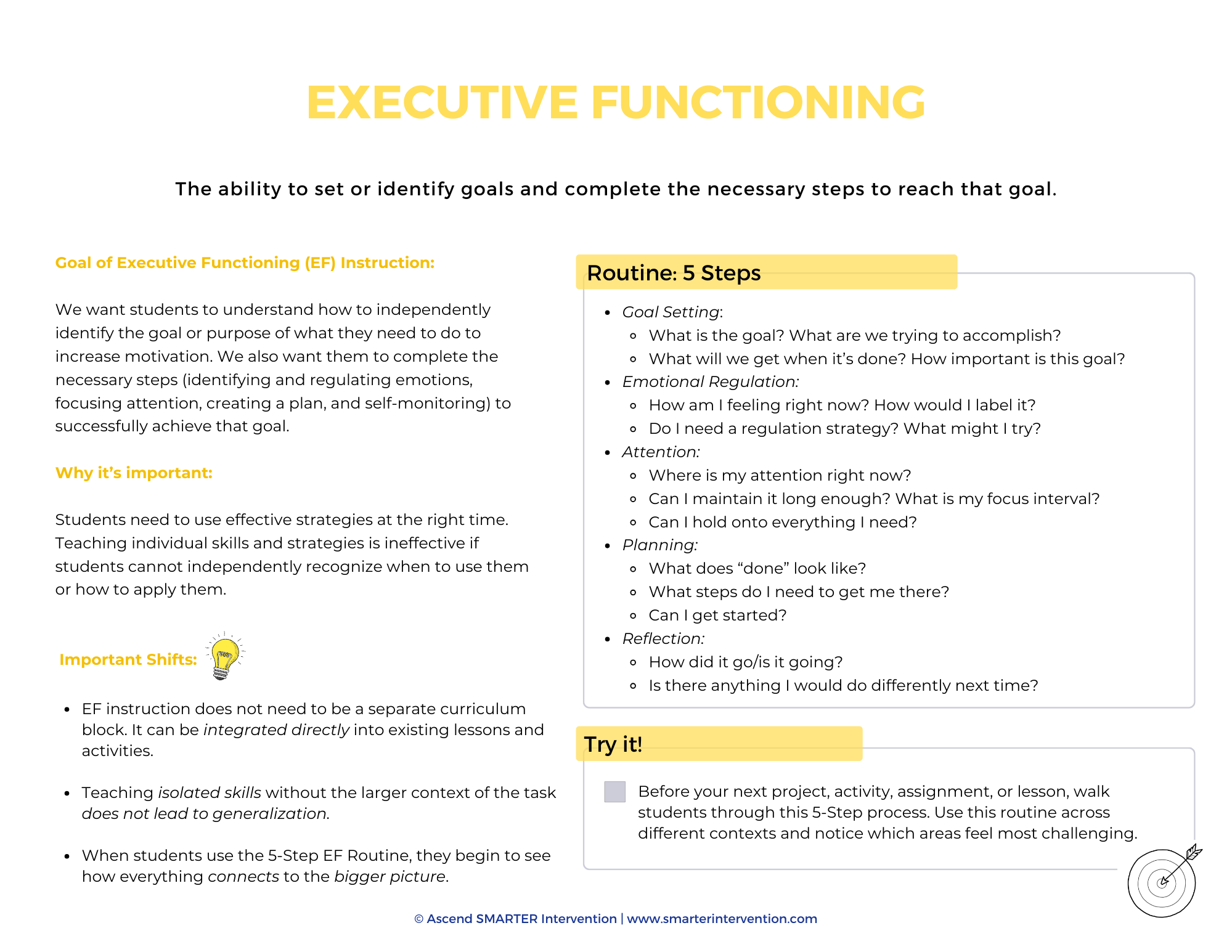
Check out our FREE Executive Functioning Routine!
The routine uses 5 steps to guide students through any task or project, increasing motivation and helping them to successfully achieve that goal. In this guide, we:
Break down goal setting, emotional regulation, attention, planning, and reflection into steps
Explain the importance and goal of including EF in your instruction
Provide simple steps and prompts you can use with your students
This is designed for educators who are ready to take this knowledge into practical, grounded implementation.