
How to Develop Early Literacy Skills Through Read Alouds
Is there anything better than a great read-aloud when developing early literacy skills?
We think not!
One of the questions we get often is,
How do I align my read-aloud with the Science of Reading?

We know that several components need to come together for students to be able to read and write effectively and efficiently.
We can begin by -
Using authentic literature (the books your students LOVE) to help keep them engaged while allowing them an opportunity to generalize literacy skills.
This is an excellent way to help your students see how activities targeting the five core components of literacy apply to “real reading!”
So what exactly does this look like?
When reading aloud, we always follow a three-step process.
Before Reading - Activate background knowledge
During Reading - Look for important information
After Reading - Reflect on the Reading
Let’s break it down a bit further -
Step 1 - Before Reading
This is our pre-reading phase. During this phase, we can do a few things:
Preview vocabulary
Make predictions about the story or content based on things like the cover or our background knowledge
Talk about the author and illustrator
Provide information about the story structure, we might say something like "This story has characters, a setting, a problem, and a solution, but the events did not happen in real life. What do we call this type of story? [Fiction!]

Step 2 - During Reading
During our Shared Reading or Read-aloud, we can start looking for important information with our students.
Focus on a specific letter or phonogram pattern (for example, if you are working on teaching the TH pattern, can you find words that include TH in the book?) - have students be on the lookout for these patterns as you read
Focus on the 5 Ws (who/what, did what, when, where, why, or how)
Begin to model comprehension strategies (sequencing, making connections, making inferences, and predictions)
Step 3 - After Reading
After reading, we can begin to reflect on our reading and add additional opportunities for practice and review.
Focus on specific comprehension strategies, working through each level of comprehension
Tie in additional skill activities that align with the book, targeting the 5 core components of literacy
Phonological awareness skills that align with words or concepts from the book
How many syllables are in dragon? How many sounds are in taco?
Phonics building
Look for decodable words in the story
Point out high-frequency or learned sight words that students have practiced
Fluency building
Have students take one sentence from the story and practice breaking the sentence down into who/what, did what, when/where, why, or how.
Writing skills
Have students write a reflection or answer any of the questions you asked during the comprehension work in writing
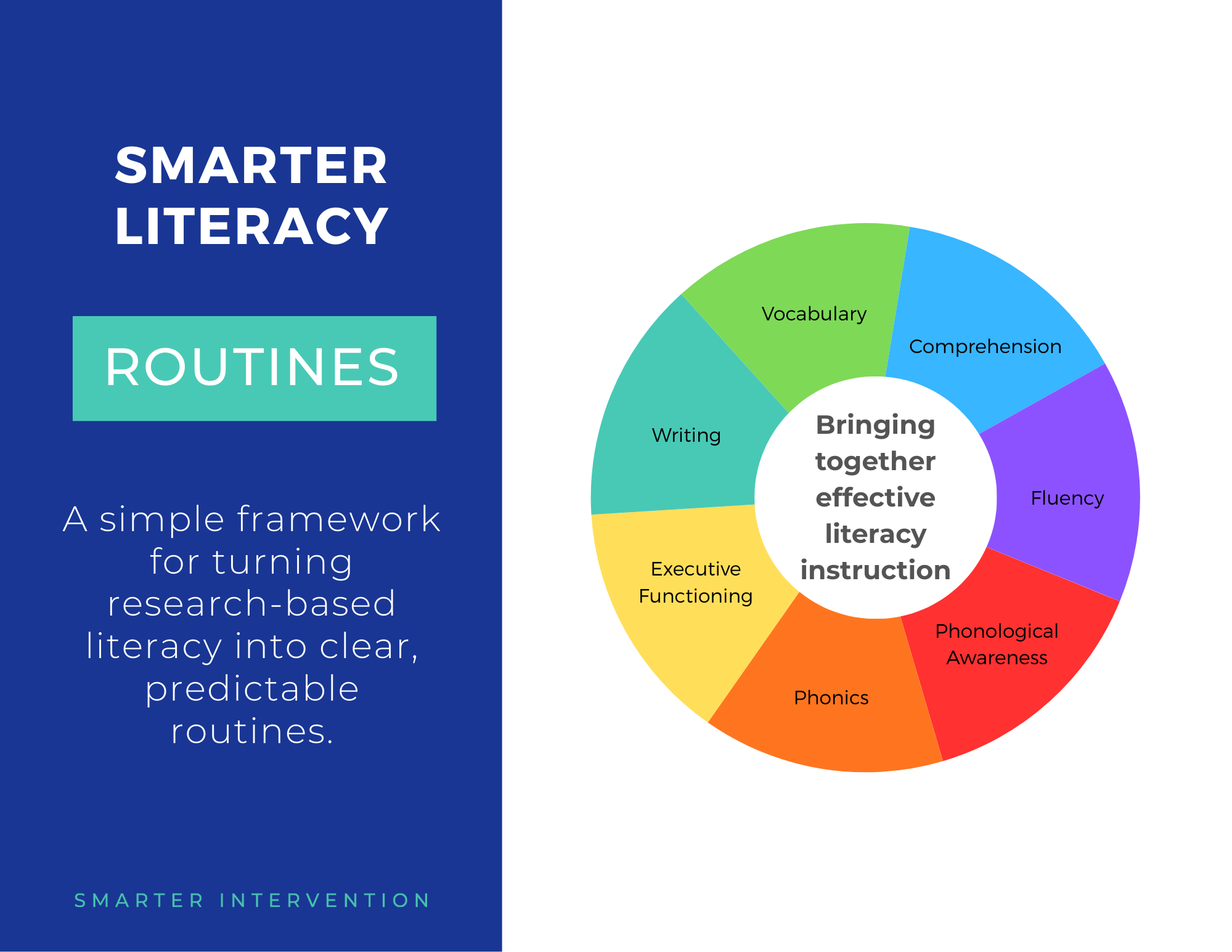
So that’s it - those are the skills we work to target for our early literacy students.
These are all simple strategies that you can begin to incorporate into your current read-aloud to directly align your instruction with evidence-based practices!
If you want to start including all the reading and writing skills in your instruction, start with research-aligned routines that connect the pieces. We made a FREE Literacy Routines Guide that provides a simple framework for turning research-based literacy into clear, predictable routines.
Give it a try and see how these routines help add structure and flow to your instruction.