
Helping Your Students Regulate Their Emotions

We all have students who struggle to manage their emotions. We may see them as the students who react quickly, whose emotions spill out before words do.
The students who derail the room just as learning is getting started.
What’s so important to recognize here is that what’s underneath some of that isn’t a lack of effort or respect.
It’s a breakdown in emotional regulation. An emotional regulation isn’t a behavior skill..
Emotional Regulation Is an Executive Functioning Skill
Emotional regulation is the ability to notice what we’re feeling, understand it, and respond in a way that allows learning to continue. And that distinction matters.
Many students are being asked to regulate emotions they don’t yet have the tools to manage, in environments that are more cognitively demanding than ever before. When regulation breaks down, it rarely looks subtle.
It looks like outbursts or shutdowns. Or, it might look like avoidance, tears, defiance, or reactions that feel bigger than the moment in front of you.
These aren’t discipline problems. They’re nervous system signals.
Why Regulation Has to Come First
It’s important for us to recognize that a dysregulated brain cannot access higher-level thinking.
When emotions are high, the brain’s emotional center is driving the show. Planning, attention, problem-solving, and self-monitoring are temporarily offline. That’s why emotional regulation sits so early in our executive functioning framework.
We don’t plan first. We don’t initiate first. We regulate first.
Before we ask students to engage with tasks, we have to help their bodies and brains feel safe enough to try. So how do we do this?
Step 01 - Help Students Name What They’re Feeling
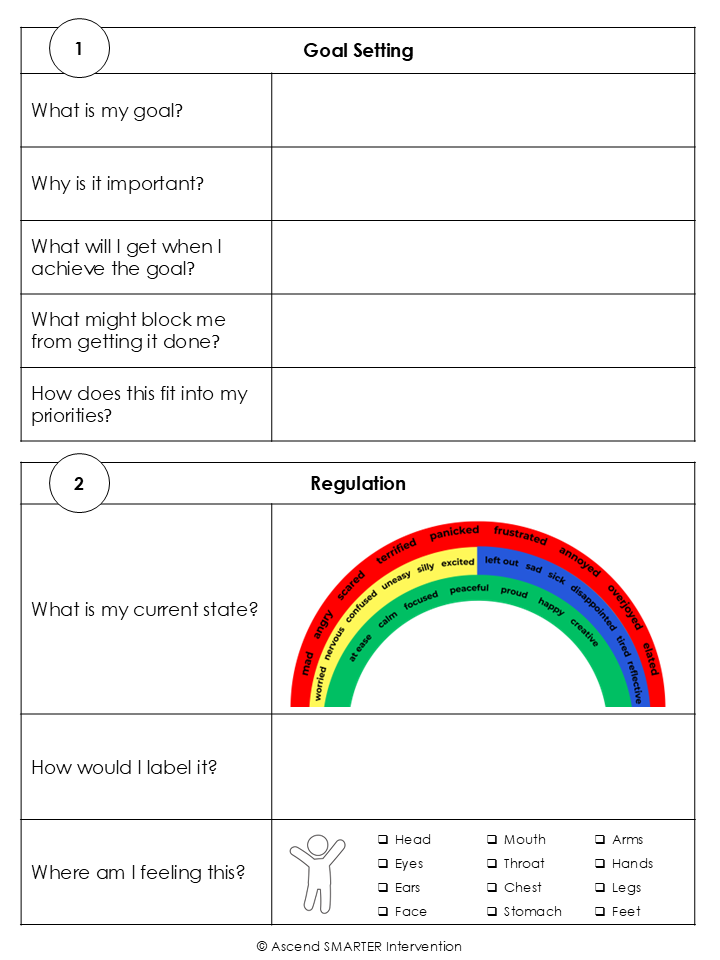
For many students, emotions don’t arrive neatly labeled. They arrive all at once, in a rush, without words.
Without language, emotions feel overwhelming, but with language, they become manageable.
Helping students build emotional vocabulary is one of the most powerful regulation tools we have. Moving beyond “happy,” “sad,” and “mad” gives students a way to make sense of what’s happening inside them. Words like frustrated, anxious, overwhelmed, restless, or disappointed help create clarity.
Naming emotions helps validate their experience, reduces intensity, and creates just enough space for the student to pause instead of react.
This is also where connecting emotions to the body becomes so important. Many students can identify where they feel an emotion before they can explain it. A tight chest. A fast heartbeat. A knot in the stomach. Pressure in the head or tension in the shoulders.
When students begin to link physical sensations to emotional labels, they start to recognize patterns. Over time, that awareness helps them notice escalation earlier, before emotions spill over.
Step 02 - Teach Students How to Communicate Their Needs
Once a student can identify how they’re feeling, the next step is helping them communicate it safely.
This doesn’t have to be complicated. Some students benefit from visual signals or nonverbal break requests. Others need sentence starters or a consistent check-in routine. What matters most is that the system is predictable and practiced before emotions run high.
Students need to know, “When I feel this way, here’s how I can let someone know.”
Step 03 - Build Regulation as a Skill
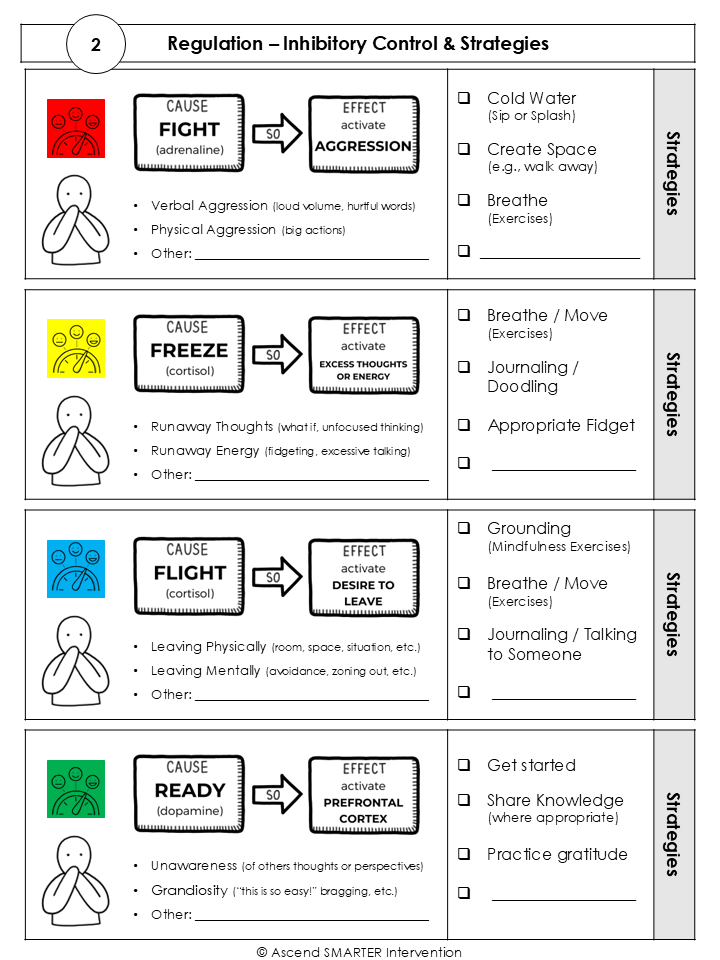
Regulation strategies aren’t one-size-fits-all, and they aren’t about making emotions disappear. They’re about helping students return to a state where learning is possible again.
Some students need to slow their bodies down. Others need movement to release energy. Some need quiet. Others need connection. The goal isn’t to prescribe the “right” strategy, but to help students explore what works for them.
That exploration is executive functioning in action. When students learn to choose a strategy, try it, and reflect on whether it helped, they’re building skills they’ll use far beyond the classroom.
One of the most effective ways to teach emotional regulation is to model it ourselves.
Sometimes that sounds like naming what we’re noticing out loud:
“The room is starting to feel really loud, and I can feel my body getting tense. I’m starting to feel a little anxious, and I notice it in my chest because my heart rate is picking up. I’m going to take a few deep breaths to help my body slow down. Let’s try it together.”
Moments like this normalize emotions, show students that regulation is a skill (not a personality trait), and reinforce that everyone needs tools sometimes.
Calm creates calm.
Want to go deeper with Executive Functioning support?
We have to be honest, this work can feel challenging at times. When one student escalates, the whole room feels it. When regulation breaks down, instruction pauses. And when emotional needs go unmet, we, as educators, often feel stretched thin. These are the moments where we have to practice our own emotional regulation!
Emotional regulation instruction works best when there’s shared language across classrooms, predictable routines for students, and support systems that teach regulation proactively, not only in moments of absolute breakdown.
When we build environments that support regulation, we don’t just reduce behaviors. We create classrooms where learning feels possible again.
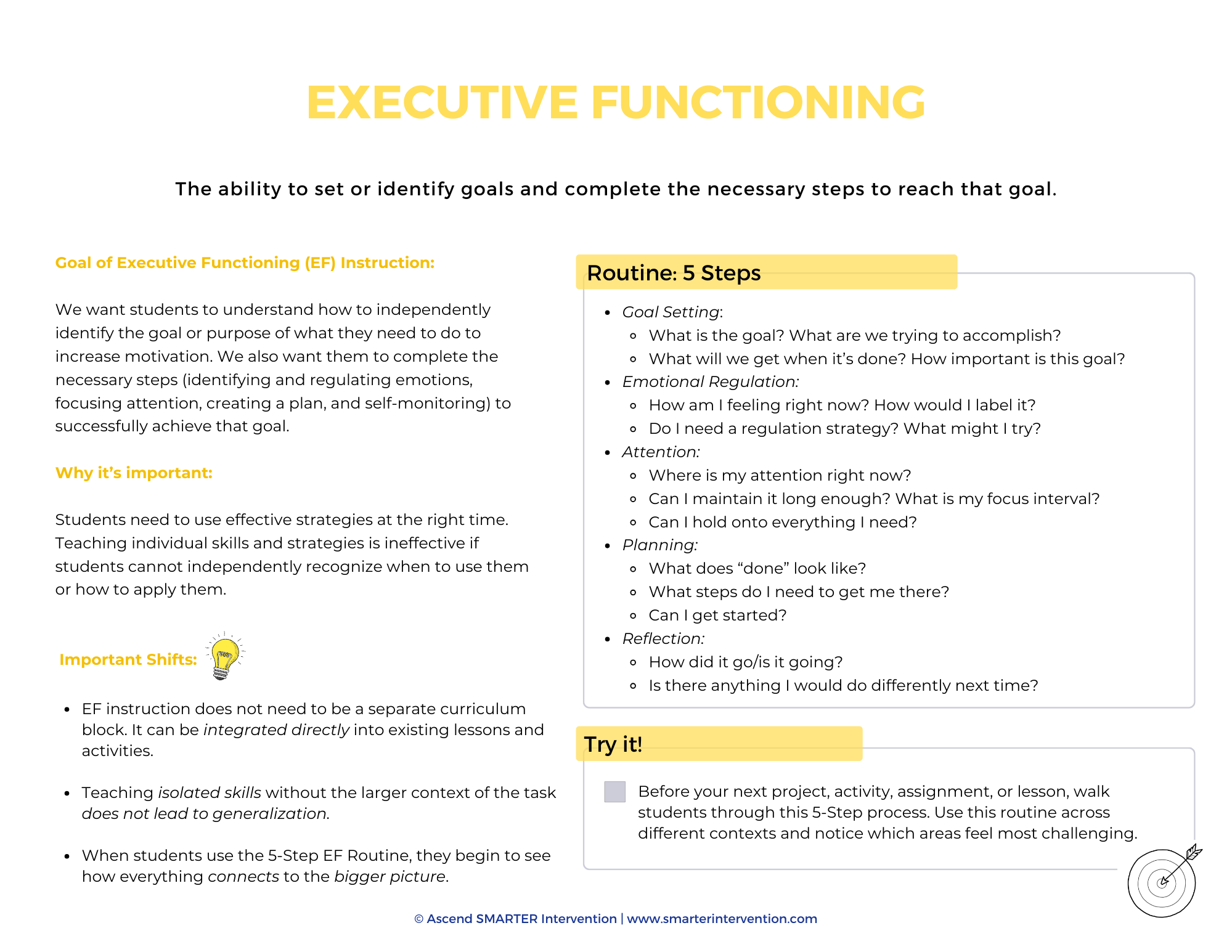
And, if you’re looking for a deeper, more structured way to support emotional regulation and other executive functioning skills across your classroom or instructional setting, the Executive Functioning Routine was designed to help.
Inside the routine, you’ll find a practical process that aligns with the 5-step executive functioning framework, including language and prompts to build emotional vocabulary, increase self-awareness, and support regulation before behaviors escalate.
The routine is available for FREE, so you can try it with your students immediately.