How Can I Help My Students Pay Attention?
“Pay attention” is one of the most common directions students hear and also one of the least explicitly taught.
We often associate attention with quiet bodies, still hands, and eyes forward. But attention is far more complex than compliance, and it can look very different from student to student.
Some students attend best when they are still. Others need movement, fidgets, or stimulation to stay engaged.
The challenge for educators isn’t just getting students to attend; it’s helping them recognize when their attention has drifted and know how to redirect it.
That skill is called self-monitoring.
Attention Is a Foundational Executive Functioning Skill
Attention is a core executive functioning skill that supports learning, task completion, and emotional regulation. It relies heavily on the prefrontal cortex, sometimes referred to as the “CEO of the brain,” which develops gradually throughout childhood and adolescence. When students struggle with attention, it impacts nearly every other EF skill.
Attention Is Not One Skill, It’s Several
One of the most helpful shifts we can make is teaching students that attention is not a single ability. Attention is a skill we use to filter information in our environment so we can focus on what matters and ignore what does not. But attention has limits; we can only attend to so much information for so long. There are different types of attention, each with different demands. When students struggle, it’s rarely because they “can’t pay attention.” It’s because a specific type of attention is being overloaded.
While there are many ways we can think about attention, we like to break it into these five categories:
Focused Attention
This is the ability to concentrate on a specific task or stimulus for a short period of time. This might look like taking a test, reading a passage, or completing a worksheet.
When focused attention breaks down, students may appear to be “zoning out” or attending to the wrong details instead of the task at hand.
Sustained Attention
This is the ability to hold attention over a longer period of time. This might look like listening during a lesson, completing independent work, or completing an assignment or project.
Students with difficulty sustaining attention may start tasks but abandon them, feel restless, or lose momentum as time passes. This is where focus intervals, timers, and planned breaks are especially helpful.
Selective Attention
This is the ability to focus on a task even when there might be distractions or other things competing for attention. This might look like working in a busy classroom, ignoring background noise, staying engaged while peers are moving or talking.
When selective attention is weak, students may be highly distractible, even if they understand the task itself. This is not a motivation issue; it is a filtering issue.
Alternating Attention
This is the ability to shift between tasks or parts of a task. This might look like switching between reading and writing for a written response, moving between steps in a multi-part assignment, or transitioning between activities.
Alternating attention requires cognitive flexibility and is especially demanding for students with executive functioning challenges. If students are struggling here, they may struggle with multistep directions, have slower transitions, get frustrated when the task changes, or get “stuck” on one part of an assignment.
Divided Attention
This is the ability to attend to more than one thing at once. This might look like listening while taking notes or following directions while organizing or finding the necessary materials.
Divided attention is often overestimated in classrooms. Many students are expected to divide attention before their brains are developmentally ready to do so effectively.
Why This Matters for Self-Monitoring
When students don’t understand which type of attention a task requires, they often internalize failure as:
“I’m bad at paying attention.”
But when we teach them to ask:
Is this a focused attention task?
Do I need sustained attention right now?
Is the challenge ignoring distractions or switching tasks?
They gain language, awareness, and agency. That awareness is the foundation of self-monitoring.
Teaching Students to Self-Monitor Attention
Self-monitoring attention means helping students notice:
Where their attention is
What type of attention is required
Whether a strategy is needed
This works best when check-ins are normalized for everyone (not just the students who struggle), cues are neutral and predictable, and redirection is framed as a skill, not a correction. Instead of “pay attention,” students learn:
“My attention drifted, I can bring it back.”
We’ve all been there. I have to tell myself this all the time, so when we can normalize this for our students, it makes a huge difference for them.
Want to go deeper?
Understanding the different types of attention is often an “aha moment” for us as educators. I know it was for me. It was that moment where I realized, “oh this is actually a skill gap and one we can support!”
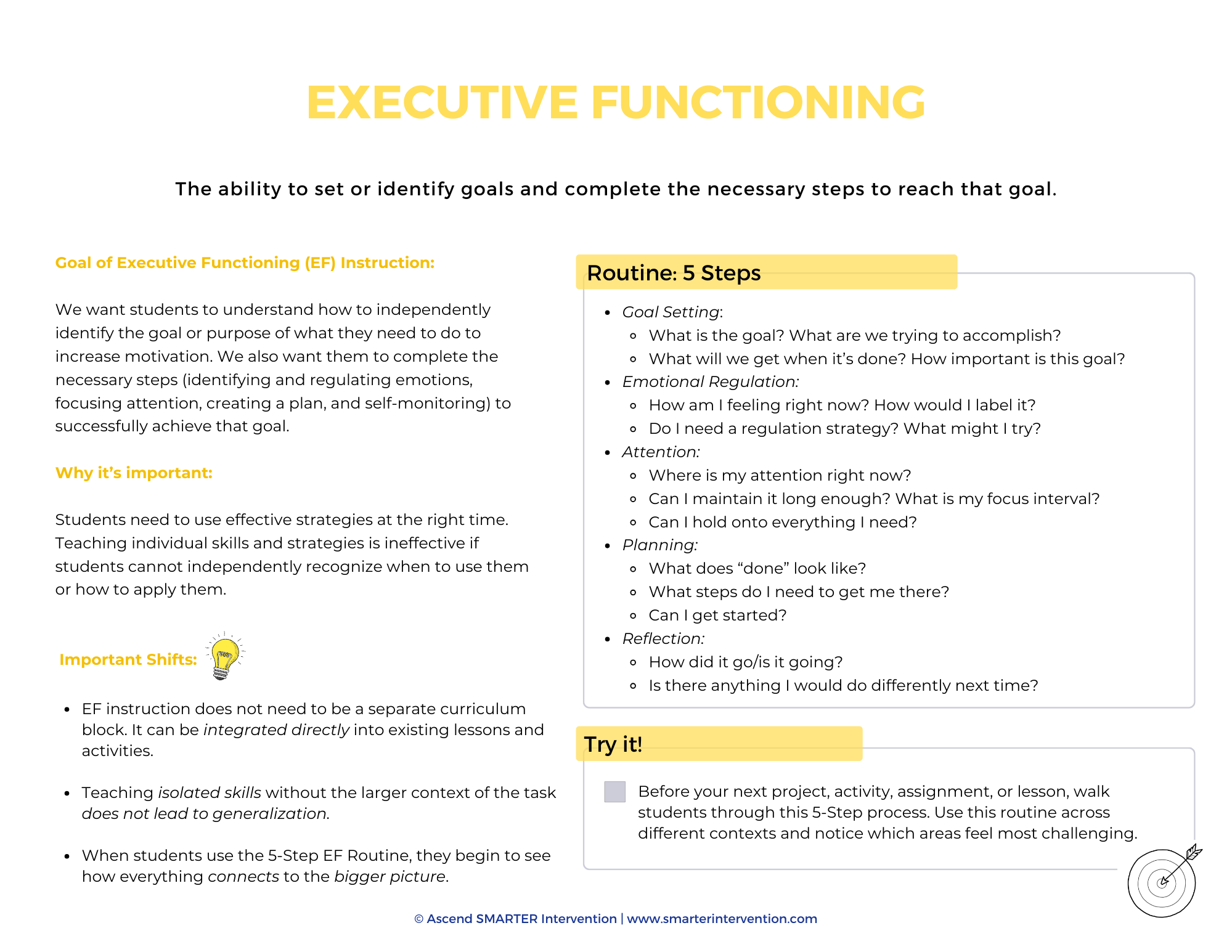
In our FREE Executive Functioning Routine, we:
Break down goal setting, emotional regulation, attention, planning, and reflection into steps
Explain the importance and goal of including EF in your instruction
Provide simple steps and prompts you can use with your students
This routine is designed for educators who are ready to take this knowledge into practical, grounded implementation.