
Executive Functioning: Self-Control

There’s a moment many educators remember clearly.
A student is escalated. Maybe they’re yelling. Maybe they’re under a desk. Maybe they’ve shut down completely. And someone says, “They just need better self-control.”
But here’s the thing we’ve learned over and over again in real classrooms and intervention spaces:
Self-control isn’t a trait. It’s an outcome.
And it’s one that depends heavily on what’s happening inside a student’s nervous system in that moment.
And something that I’ve learned during my years as an educator is that:
Self-control lives inside regulation, not compliance
In the executive functioning framework we use, self-control (often referred to as inhibitory control) lives inside Step 2: Regulation.
Regulation is about:
awareness of emotional and physical state
understanding how that state affects behavior
having strategies to shift when needed
When students are regulated, self-control becomes possible. When they’re not, it’s often inaccessible, no matter how many reminders we give or how escalated we become.
What “loss of self-control” is really telling us
When students struggle with self-control, we often see behaviors like:
physical or verbal aggression
shutting down or freezing
excessive movement or talking
leaving the room, mentally or physically
Instead of asking, “Why won’t they control themselves?” the EF lens asks: What state is their nervous system in right now?
Many educators find it helpful to think in terms of four common regulation states:
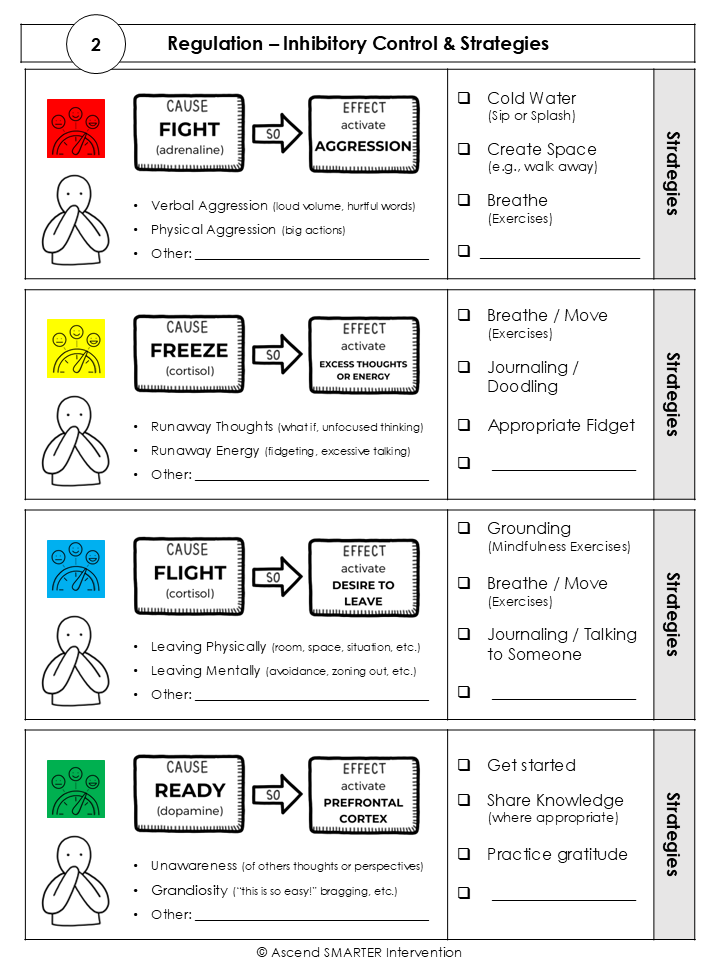
Fight – adrenaline-driven, leading to aggression
Freeze – cortisol-driven, leading to overwhelm or excess energy
Flight – desire to escape the situation
Ready – regulated, flexible, and able to engage
It’s also so important to realize that none of these states are “bad.” They are information, and we all shift between these states multiple times throughout the day.
Regulation starts with awareness, not correction
One of the most helpful shifts we can make is helping students name what they’re feeling, without judgment.
That might sound like:
“I’m noticing your body looks really tense right now.”
“It seems like your thoughts are moving really fast.”
“Are you feeling angry, overwhelmed, or something else?”
For some students, this is the first time anyone has helped them connect:
emotions
physical sensations
behavior
That awareness alone can begin to lower the intensity.
Strategies work when they match the state
This is where many regulation plans fall apart.
We give students strategies, but not decision-making tools for choosing the right one. In our EF process, we explicitly connect:
state → effect → strategy
For example:
A student in a “fight” state may need cold water, space, or grounding before talking.
A student in a “freeze” state may benefit from movement or doodling.
A student in a “flight” state may need reassurance and a brief break.
A student who is “ready” can move forward with learning tasks.
One student we worked with often arrived at sessions physically aggressive and completely dysregulated. Over time, we noticed a pattern. When he was able to label that he felt angry, and we responded with cold water and a snack, his body settled quickly.
It turned out he wasn’t “out of control.” He was hungry and needed water.
Before we had this regulation process in place, we spent hours frustrated. He was frustrated, I was frustrated. But with it, we learned how to help him return to learning together.
Self-control develops through modeling, not expectations
Students don’t learn self-control because we tell them to behave. They learn it because we model how to notice, pause, and adjust.
Every time we walk students through:
identifying their state
choosing a strategy
reflecting on what worked
We’re teaching them how self-control actually works. This is one part of the larger executive functioning process we use to support students in setting goals, regulating, focusing attention, planning, and reflecting.
A simple next step
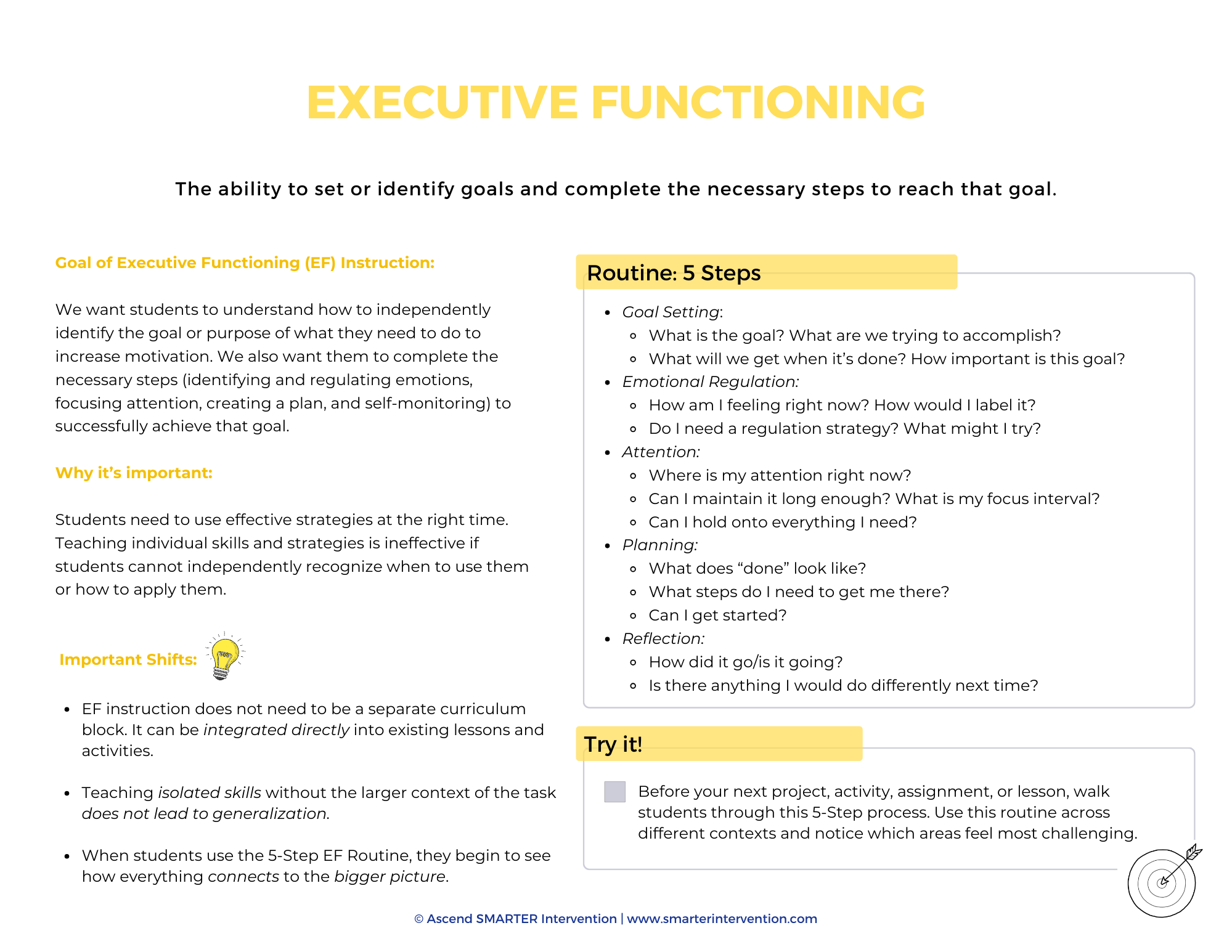
Check out our FREE Executive Functioning Routine!
In this guide, we:
Break down goal setting, emotional regulation, attention, planning, and reflection into steps
Explain the importance and goal of including EF in your instruction
Provide simple steps and prompts you can use with your students
This routine is designed for educators who are ready to take this knowledge into practical, grounded implementation.