Executive Functioning: Working Memory

Working memory is one of the most misunderstood executive functioning skills.
Working memory refers to our ability to hold information in mind long enough to use it. It is part of our short-term memory system, and it plays a critical role in attention, learning, and follow-through.
When information enters working memory, it is fleeting. We only have a short window of time to:
Process it
Make sense of it
Connect it to what we already know
Decide what to do next
If that information is not actively supported, it can be lost before it ever makes it into long-term memory.
Why Working Memory Matters for Attention
Within our 5-Step Executive Functioning Framework, working memory fits most closely within Step 03: Attention.
That’s because attention isn’t just about “looking” or “listening.” It’s about whether a student can hold onto information long enough to act on it.
A student may appear inattentive when, in reality, they:
Heard the directions
Started to process them
Lost pieces before they could be carried out
This is especially noticeable in classroom environments where information is often presented orally, quickly, and in multiple steps.
What Working Memory Difficulties Can Look Like
Working memory challenges often show up as:
Difficulty following multi-step directions
Frequently asking for directions to be repeated
Losing track of steps while working
Forgetting what they were doing mid-task
Appearing “off-task” or disengaged
From the outside, this can look like poor attention or lack of effort. But for many students, the issue is not motivation. It’s a capacity issue.
An Important Clarification About Working Memory
Working memory capacity itself tends to be relatively stable over time. We do not typically “train” working memory in the same way we train a skill like reading or math.
However, (and this is critical) we can absolutely teach strategies and structures that support working memory.
When we reduce the amount of information students need to hold in their heads at once, we free up cognitive energy for understanding, applying, and sustaining attention.
The goal is not to make students remember more. The goal is to ask them to hold less.
Practical Ways to Support Working Memory
Some of the most effective working memory supports are actually quite simple.
Externalize information whenever possible
Write directions instead of relying on oral instructions (giving both is the best bet!)
Provide checklists or visual steps
Allow students to take photos of directions or assignments
Reduce the memory load
Give instructions one step at a time (ask students to repeat them back)
Break tasks into smaller chunks (this is especially great because attention spans are shorter than ever)
Number or sequence steps clearly
Reinforce understanding
Ask students to paraphrase directions in their own words
Have students repeat key information back before starting
Encourage connections to prior knowledge
Use memory supports intentionally
Mnemonics or acronyms (for example, PEMDAS)
Graphic organizers that outline processes (like our 5-Step EF Process!)
Build awareness
Help students notice when they’ve lost track
Normalize the need to check back
Encourage help-seeking without shame
Games like Simon Says or Bop-It can be fun ways to practice holding and responding to information, but the most meaningful support happens within real academic tasks.
Working Memory and Educational Accommodations
For students with significant working memory challenges, accommodations can make an enormous difference.
Helpful supports may include:
Written directions in addition to oral instructions
Access to notes or guided outlines
Clear daily schedules
Opportunities to ask for clarification
Reduced memory demands during instruction
Reframing How We Think About Working Memory
When students struggle with working memory, it’s easy to assume they aren’t paying attention.
But often, they are paying attention. They just can’t hold onto the information long enough to act on it.
When we shift our focus from “remembering” to supporting attention, we reduce frustration, increase independence, and create more equitable learning environments.
Want a simple way to support this process?
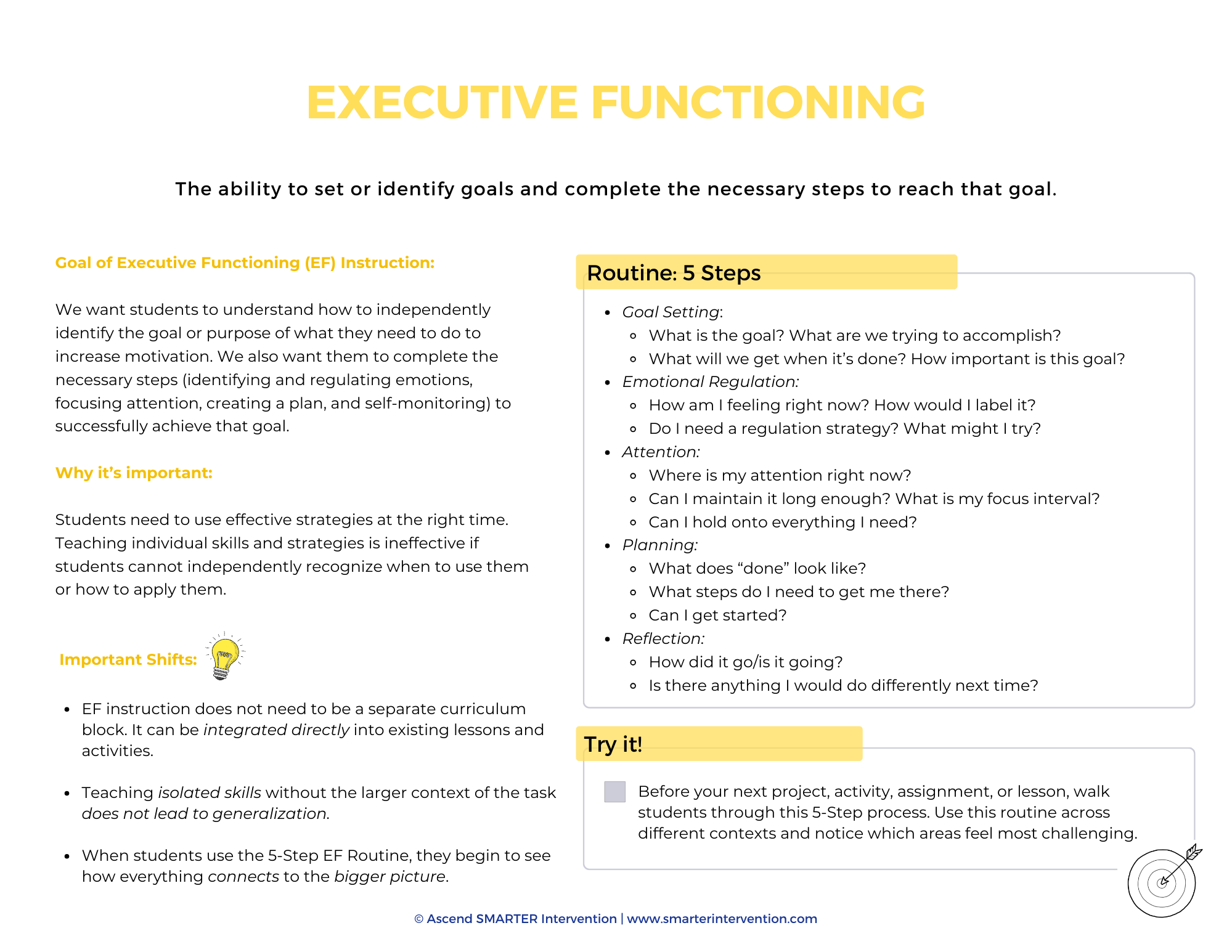
Check out our FREE Executive Functioning Routine
In this guide, we:
Break down goal setting, emotional regulation, attention, planning, and reflection into steps
Explain the importance and goal of including EF in your instruction
Provide simple steps and prompts you can use with your students
This routine is designed for educators who are ready to take this knowledge into practical, grounded implementation.