Executive Functioning: Planning

Have you ever gone to the store without a list and walked out with a cart full of things you didn’t need, only to realize you forgot the one item you went in for?
Or remembered an important deadline just moments before it was due?
These experiences aren’t about intelligence or effort. They reflect a breakdown in an executive functioning skill called planning.
What Is Planning in Executive Functioning?
Planning is the ability to:
Identify a goal
Anticipate what needs to happen
Sequence steps
Prepare materials
Allocate time
Within executive functioning, planning is the process that connects intention to execution. Moving from “I want or need to do this” to “I actually did it.”
Students may understand what they are supposed to do. They may even want to do it. But without a planning structure in place, that understanding often doesn’t translate into action.
Why Planning Is the Bridge Between Attention and Action
In our 5-Step Executive Functioning Routine, planning lives in Step 4.
This placement matters. Planning is what allows students to take:
Attention (What am I focusing on? What do I need to hold onto?)
and turn it intoAction (What am I doing first? What comes next? Am I ready to start?)
Without planning, students are left holding information in their heads and hoping they remember to act on it later. For students with executive functioning challenges, this is rarely successful.
Why “Small” Tasks Often Cause Big Breakdowns
Planning failures are most likely to occur with tasks that seem small or simple.
It might be a permission slip. Or maybe a material to bring home (oops, didn’t bring your book home again?!). It could be a short assignment due tomorrow.
Because the task feels manageable, students may skip planning altogether. They assume they’ll remember. But when planning isn’t externalized, it relies entirely on working memory, attention, and timing, all areas that are commonly fragile for students with EF challenges.
A breakdown can happen at any point:
The task isn’t written down
Materials aren’t brought home
The right person isn’t available
The item isn’t returned the next day
The problem isn’t the task. It’s the lack of a planning system. As a parent, I was incredibly frustrated when my son kept coming home with NHIs (not handed in assignments) that were tanking his grades. When I went in to meet with the school about our concern, the first thing they asked was whether he was using a planner. I was a little dumbfounded, but also realized that no…he wasn’t using a planner!!! And while he was bright, he just honestly was forgetting all of his assignments.
What Effective Planning Actually Looks Like
Effective planning is not about doing more. It’s about making the invisible visible.
Strong planning systems help students:
Clarify what “done” looks like
Break tasks into steps
Identify what needs to happen first
Prepare materials ahead of time
Anticipate obstacles
When these pieces are externalized, students are no longer trying to hold everything in their heads at once.
Planning Reduces Cognitive Load
One of the most important benefits of planning is that it reduces cognitive load.
When students know:
What they’re working toward
What the steps are
What materials are needed
How much time is available
They can devote more mental energy to learning, problem-solving, and persistence. Planning doesn’t remove challenge. It just removes the unnecessary friction.
Teaching Planning as a Process (Not a Trait)
Planning is often assumed rather than taught. But planning is a learnable process that requires:
Explicit modeling
Repetition
Visual supports
Guided practice
Students don’t need to be told to “plan better.” They need to be shown how to plan and given structures that support them in doing so. This was the “aha” moment I had with my son in his freshman year of high school.
Planning as the Gateway to Initiation
Planning also plays a critical role in task initiation.
Students are far more likely to get started when they:
Can visualize the endpoint
Know the next step
Have materials ready
This is why our planning process follows a simple sequence: visualize “done,” plan the steps, prepare materials, then go.
When planning is clear, initiation becomes possible.
Want a simple way to support this process?
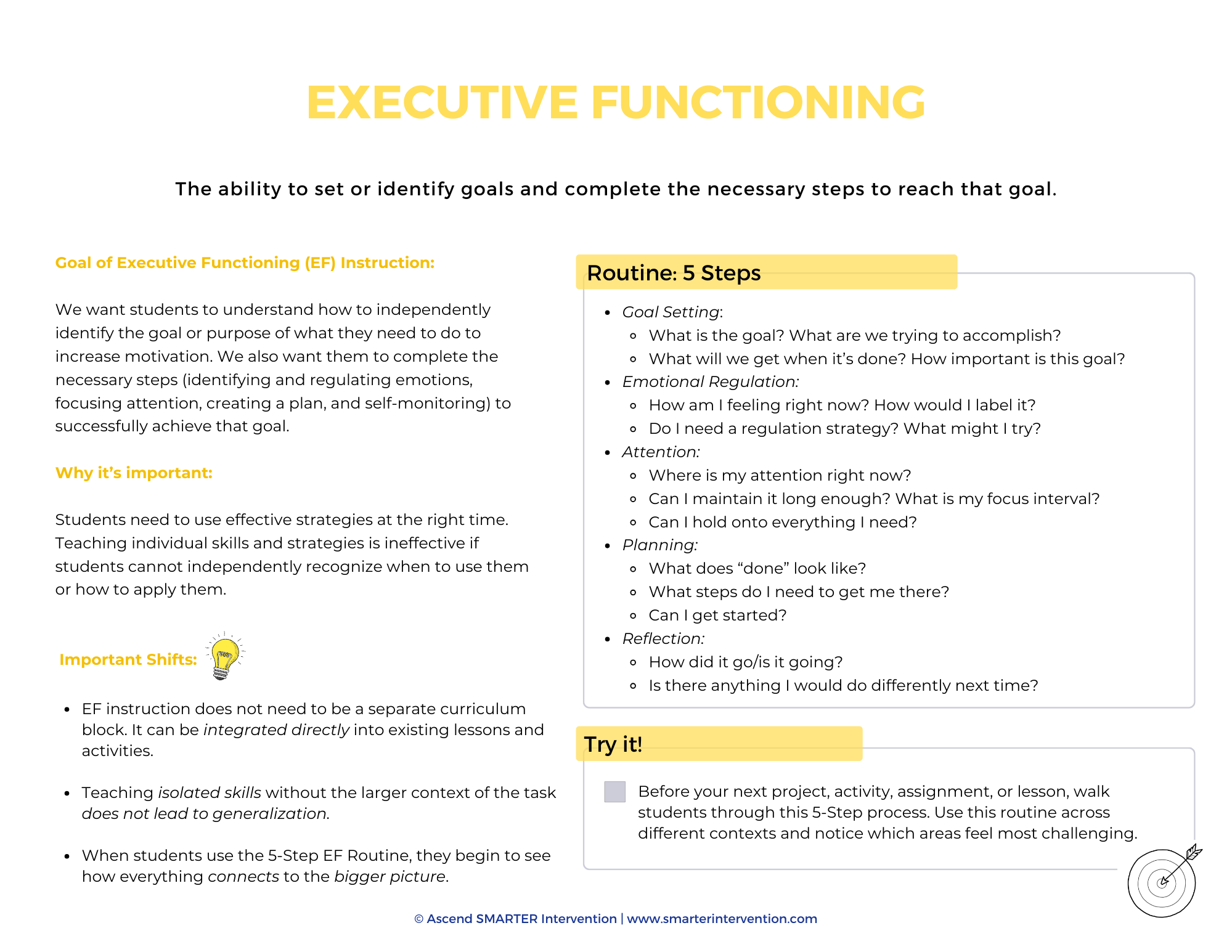
Check out our FREE Executive Functioning Routine!
In this guide, we:
Break down goal setting, emotional regulation, attention, planning, and reflection into steps
Explain the importance and goal of including EF in your instruction
Provide simple steps and prompts you can use with your students
This routine is designed for educators who are ready to take this knowledge into practical, grounded implementation.