#1 Tip for Helping Your Students Time Block Their Homework

We hope you are enjoying our theme of the month - Executive Functioning! This week, we want to turn our focus to time blocking. This is a concept that a lot of us educators are already familiar with (you have your literacy block, math, lunch, etc.), but did you know that you can change a child's educational outlook with time-blocking, too?
One of the most common things we hear when families are looking for Learning Evaluations for their children is that "homework takes forever." This is a tell-tale sign that the child might be struggling somewhere academically.
This could be attention, dyslexia, or a number of other learning disabilities. While it probably doesn't actually take "forever" to complete the assignment, there is a point where your child may be spending too much time on homework.
Tip for Helping Your Students Time Block Their Homework
The rule we always tell our families is that homework should take 10 minutes per grade level. If you have a second grader, they should be spending 20 minutes on homework. If you have an 8th grader, it should be 80 minutes.
As a teacher, you rarely see the students completing their homework. However, if you can provide families with this information, it can help them understand if their child is struggling much earlier on. If you are teaching third grade (where kids should spend about 30 minutes on homework every night), but you have a family who says that it is taking them 90 minutes to get through it, please pass this information along.
By giving your students' families this homework time-blocking information, they will be more aware of how long their child should be spending on assignments each night. While spending too much time on homework itself is not enough to diagnose a learning disability, the parents need to know that it is a valid concern. There could be an academic struggle that is impacting how long it takes the student to complete their homework.
Want to take these strategies further?
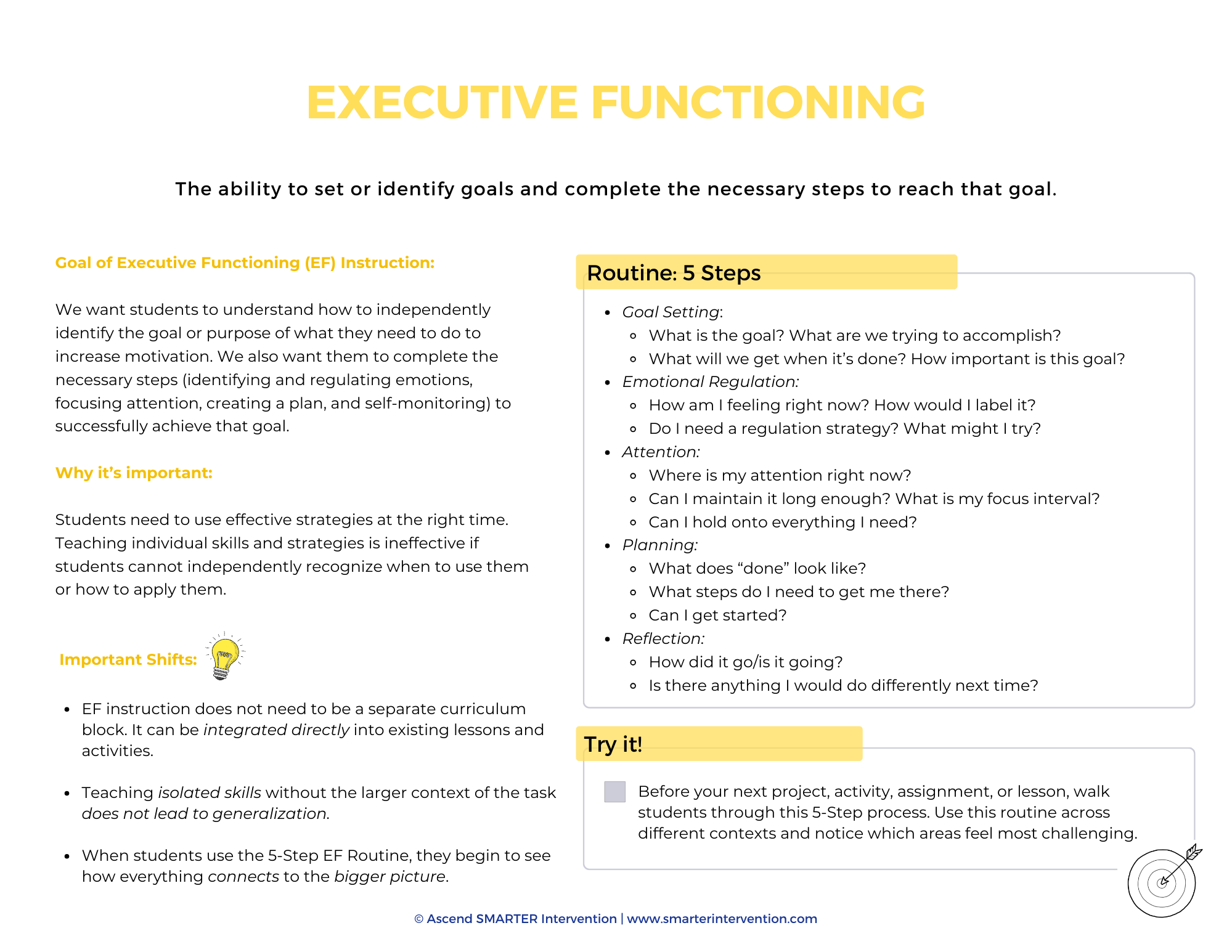
Check out our FREE Executive Functioning Routine!
This guide gives you a clear, practical framework to support attention, planning, regulation, and goal-setting from kindergarten through high school.
Executive functioning is one of the most talked-about topics in education right now, but most educators are asked to support EF skills without ever being shown how…until now. In this guide, we:
Break down goal setting, emotional regulation, attention, planning, and reflection into steps
Explain the importance and goal of including EF in your instruction
Provide simple steps and prompts you can use with your students
This routine is designed for educators who are ready to take this knowledge into practical, grounded implementation.