
1 Easy Way To Encourage Positive Behavior In Your Classroom

Many classroom behavior challenges don’t show up during direct instruction.
They show up during:
independent work time
open-ended projects
quiet study periods
“go work on this” blocks
These are often the moments when students seem distracted, disruptive, disengaged, or unmotivated.
But in many cases, what looks like a behavior problem is actually an attention mismatch.
When Tasks Are Bigger Than Attention Capacity
Students are frequently asked to sustain attention for longer periods than they are currently able to manage.
In early grades, this might sound like: “Read quietly in the library corner.” or “Write your paragraph.”
In middle grades, it might sound like, “Work on your project,” or “Finish your assignment independently.”
In high school, it often sounds like, “Use this time productively,” or “Independent study periods.”
Even when directions are clear, these requests can be overwhelming, especially for students with developing executive functioning skills.
Because when students don’t know:
what to focus on right now
how long they’re expected to sustain effort
what success looks like in the short term
They’re more likely to disengage.
Why Focus Intervals Work
Focus intervals break larger tasks into short, specific windows of attention. Instead of asking students to work for an undefined amount of time, we ask them to focus on:
one clear goal
for a short, achievable interval
This approach mirrors how we build stamina in other areas. You wouldn’t ask a new runner to run for an hour straight. You’d train in intervals, building capacity over time. Attention works the same way.
What Focus Intervals Look Like in Practice
A focus interval answers three questions for students:
What am I working on right now?
How long am I expected to focus?
What does “done” look like for this interval?
For example:
“For the next 5 minutes, reread the directions and highlight key words.”
“For the next 10 minutes, complete problems 1–3.”
“For this interval, draft just your introduction following this step-by-step framework.”
When the interval ends, students check in:
What did I complete?
Do I need another interval?
Do I need to adjust the plan?
This structure reduces overwhelm and increases follow-through. The goal of focus intervals is not to keep tasks short forever. The goal is to start where students are, build capacity gradually, and increase interval length as stamina improves. In the beginning, you may need to start with shorter intervals, but as they become clear on the expectation, you can gradually start extending those intervals.
Why This Supports Positive Behavior
When students can maintain attention long enough to complete a task, experience visible progress, and start to feel more successful in small increments, their confidence grows.
That confidence leads to better engagement, improved task persistence, fewer disruptive behaviors, and a stronger sense of agency. The “amazing” feeling that comes from finishing something carries forward into attitude, motivation, and self-regulation.
Positive behavior often follows felt success, not external rewards. So when students appear off-task, disruptive, or disengaged, it’s worth asking:
Is the task clear?
Is the interval manageable?
Does the student know what success looks like right now?
Often, behavior improves not through correction but through increased clarity and structure.
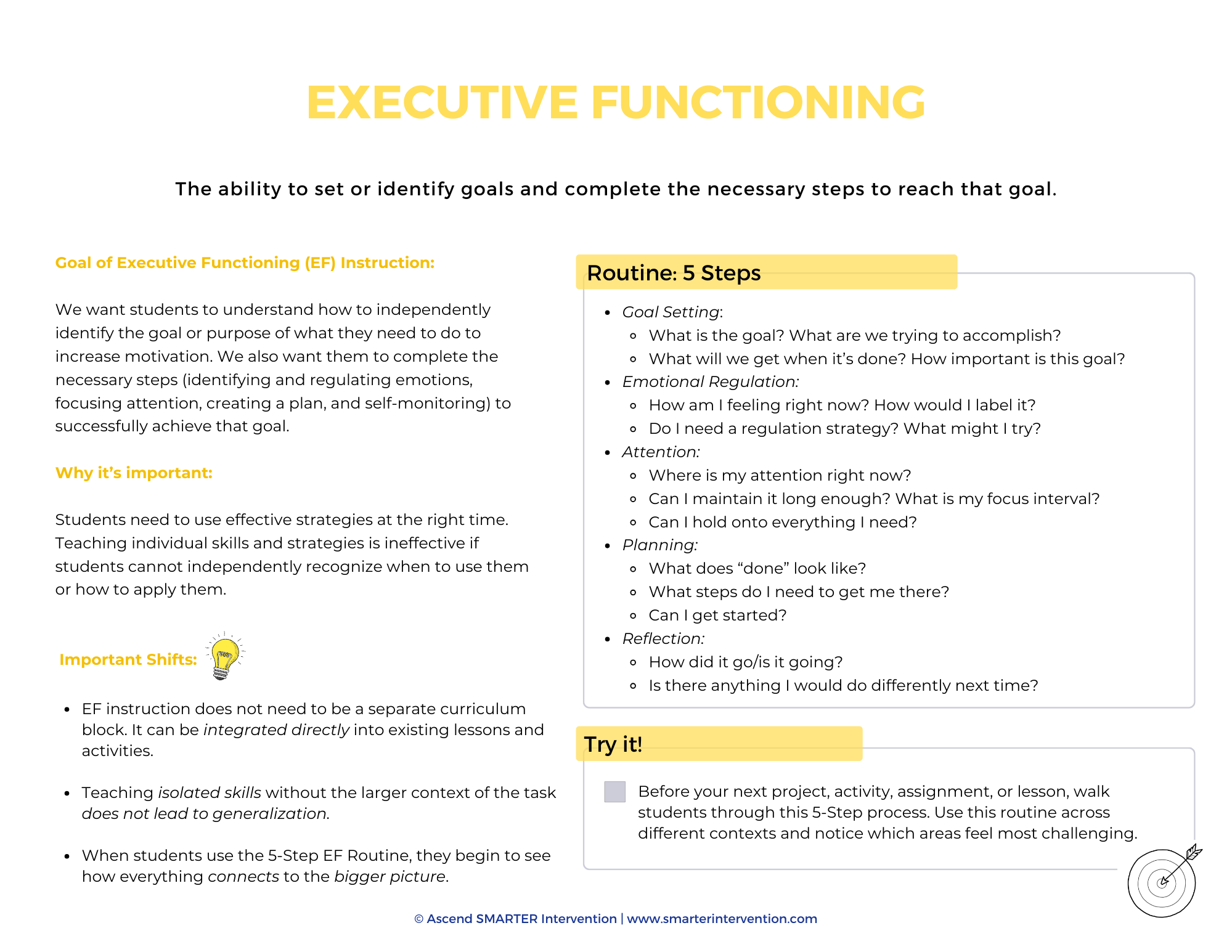
Want to go deeper with Executive Functioning support?
Check out our FREE Executive Functioning Routine
In this guide, we:
Break down goal setting, emotional regulation, attention, planning, and reflection into steps
Explain the importance and goal of including EF in your instruction
Provide simple steps and prompts you can use with your students
This routine is designed for educators who are ready to take this knowledge into practical, grounded implementation.